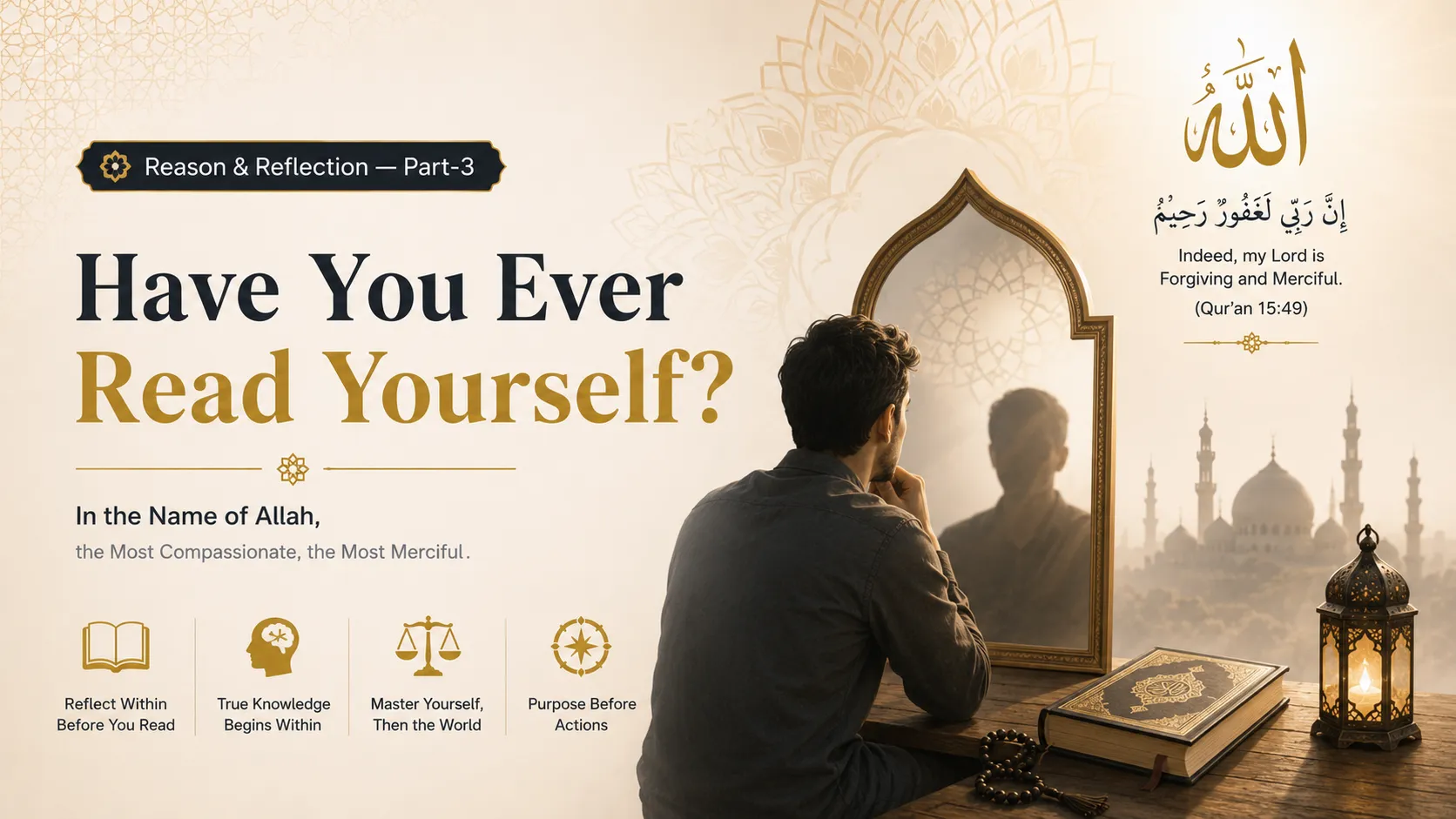

A Punjabi mystic once wrote:
You have read thousands of books,
Yet you have never read yourself.
You have visited countless temples and mosques,
Yet you have never entered your own heart.
You keep fighting Satan,
Yet you have never struggled against your own self.
First learn to read yourself.
Then enter the temple or the mosque.
When your ego is conquered,
Then you may begin your battle with Satan.
These poetic lines pose a question that is both simple and unsettling:
Have you ever truly read yourself?
Most of us spend our lives running in circles.
A good education.
A respectable career.
A comfortable home.
A better car.
A larger salary.
And then we pass this same cycle on to the next generation.
Like a beast tied to a millstone, we continue moving without ever asking where we are going—or why.
In the previous article, we began exploring the story of a man whose search for answers led him to question everything he thought he knew about life, God, and human existence.
His name was Dr. Jeffrey Lang.
And his journey offers a remarkable perspective on one of humanity's oldest questions:
Why were human beings created?
A Childhood Filled with Questions
Dr. Jeffrey Lang was a professor of mathematics at the University of Kansas in the United States.
Brilliant and intellectually gifted, he nevertheless carried deep wounds from childhood.
His father was a harsh and often abusive man who treated his mother cruelly.
As a young boy, Jeffrey frequently found himself wishing for only one thing:
That the suffering would end.
He would pray to God.
He would beg for relief.
He would ask that the violence stop.
He would ask that his mother be freed from fear.
But nothing seemed to change.
His father remained.
The abuse continued.
And gradually, a painful question began to grow within him:
If God exists, why does He not answer my prayers?
As he grew older, the turmoil of the 1960s and 1970s intensified his doubts.
He witnessed a world filled with tragedy:
The assassinations of John F. Kennedy, Robert Kennedy, and Martin Luther King Jr.
The devastation of the Vietnam War.
Urban riots.
Gang violence.
The suffering of innocent people.
The deaths of countless children.
He looked at the world around him and asked:
If God exists, why does He allow all of this?
Why are innocent children burned alive in war?
Why do good people suffer?
Why create sinful human beings at all?
Why not create only angels?
Why give humanity the ability to choose evil?
No one seemed able to provide answers that satisfied him.
And so, at the age of sixteen, Jeffrey Lang became an atheist.
Yet atheism did not remove the questions.
The restlessness remained.
The longing remained.
The search continued.
An Unexpected Encounter with the Qur'an
Years later, when Dr. Lang was twenty-eight years old, his life took an unexpected turn.
A few friends gave him a copy of the Qur'an as a gift.
One evening, sitting alone in his apartment with nothing else to read, he opened it.
He began reading from the beginning.
Page after page.
Verse after verse.
Then he arrived at Surah Al-Baqarah.
And suddenly, he stopped.
He read:
"And when your Lord said to the angels, 'Indeed, I will place upon the earth a vicegerent (khalifah).'"
(Qur'an 2:30)
The verse immediately captured his attention.
Coming from a Christian background, he had been taught that humanity's presence on earth was primarily a consequence of Adam's fall.
But the Qur'an was presenting something entirely different.
Humanity was not being described as an accident.
Nor merely as a punishment.
Rather, humanity's role on earth appeared intentional.
Purposeful.
Planned from the very beginning.
Then he read the next part of the verse.
The angels asked:
"Will You place therein one who will spread corruption and shed blood, while we glorify You with praise and sanctify You?"
(Qur'an 2:30)
At that moment, Dr. Lang felt a shock run through him.
The question of the angels was the very question he had been asking for nearly twenty-eight years.
Why create a creature capable of violence, injustice, and evil?
Why create humanity at all?
For the first time, he felt as though the Qur'an was speaking directly to him.
As though it already knew the questions he carried.
As though it was inviting him into a conversation he had been trying to have his entire life.
"I Know What You Do Not Know"
The next verse deepened the mystery.
Allah replied:
"Indeed, I know what you do not know."
(Qur'an 2:30)
Dr. Lang found himself captivated.
What was it that God knew?
What was the hidden reality that even the angels could not see?
The answer seemed to unfold in the verses that followed.
The Qur'an says:
"And He taught Adam the names of all things."
(Qur'an 2:31)
Allah then presented these realities before the angels and challenged them to identify them.
The angels responded:
"Glory be to You. We have no knowledge except what You have taught us. Indeed, You are the All-Knowing, the All-Wise."
(Qur'an 2:32)
Then Allah instructed Adam:
"O Adam, inform them of their names."
(Qur'an 2:33)
And Adam did.
Afterward, Allah said:
"Did I not tell you that I know the unseen realities of the heavens and the earth?"
(Qur'an 2:33)
The Discovery That Changed Everything
For Dr. Lang, this was a transformative moment.
He began to see something he had never noticed before.
Human beings had been given a unique gift.
The capacity to learn.
The capacity to understand.
The capacity to acquire knowledge.
The capacity to make choices.
The angels were pure and obedient.
They did not sin.
They did not rebel.
They carried out Allah's commands perfectly.
But they were not given the same kind of freedom that human beings possess.
Humanity had been granted something extraordinary:
The ability to learn, explore, reason, discover, and choose.
The ability to make decisions independently.
The ability to grow through experience.
The ability to seek truth voluntarily rather than obey automatically.
And suddenly, Dr. Lang understood something that had eluded him for years.
The purpose of humanity could not be understood without understanding freedom.
Knowledge, Intelligence, and Free Will
The story of Adam was not merely a story about names.
It was a story about human potential.
About intelligence.
About learning.
About consciousness.
About the responsibility that comes with freedom.
Dr. Lang realized that if human beings were incapable of choosing evil, they would also be incapable of choosing good.
Without free will, there could be no genuine virtue.
No meaningful moral choices.
No true responsibility.
No test.
No distinction between righteousness and wrongdoing.
The possibility of evil exists because freedom exists.
And freedom exists because humanity was created for a purpose greater than automatic obedience.
For the first time, the problem of evil began to make sense to him.
The existence of evil was not evidence against God.
Rather, it was connected to the very freedom that makes human life meaningful.
A Forgotten Legacy
Yet there is an uncomfortable reality we must confront.
The Qur'an repeatedly emphasizes knowledge, reflection, understanding, and wisdom.
But many Muslim societies today have drifted far from these ideals.
We have neglected intellectual excellence.
We have neglected critical thinking.
We have neglected the pursuit of wisdom.
In many ways, we suffer from a form of intellectual paralysis.
We have inherited a civilization built upon knowledge while often failing to appreciate knowledge ourselves.
And perhaps that is why many of the Qur'an's deepest messages remain hidden from us.
Two Questions Remain
Dr. Lang's reflections raise two important questions.
First:
If these verses emphasize learning, intelligence, and knowledge, how did Dr. Lang conclude that they also point toward human free will?
Second:
Does the Qur'an emphasize intelligence and reason elsewhere as strongly as it does in the story of Adam?
And if it does, how does Allah want us to use our intelligence?
Where should it lead us?
Those questions will guide the next stage of our journey.
Looking Ahead
This was Part 3 of our Reason & Reflection series.
In the next article, we will explore the relationship between knowledge, free will, and human responsibility more deeply, while examining how the Qur'an repeatedly calls upon humanity to think, reason, observe, and reflect.
Until then, take a moment to consider the question with which we began:
Have you ever truly read yourself?
Because perhaps the journey toward understanding God begins with understanding the remarkable creature He created.
May the peace, mercy, and blessings of Allah be upon you.