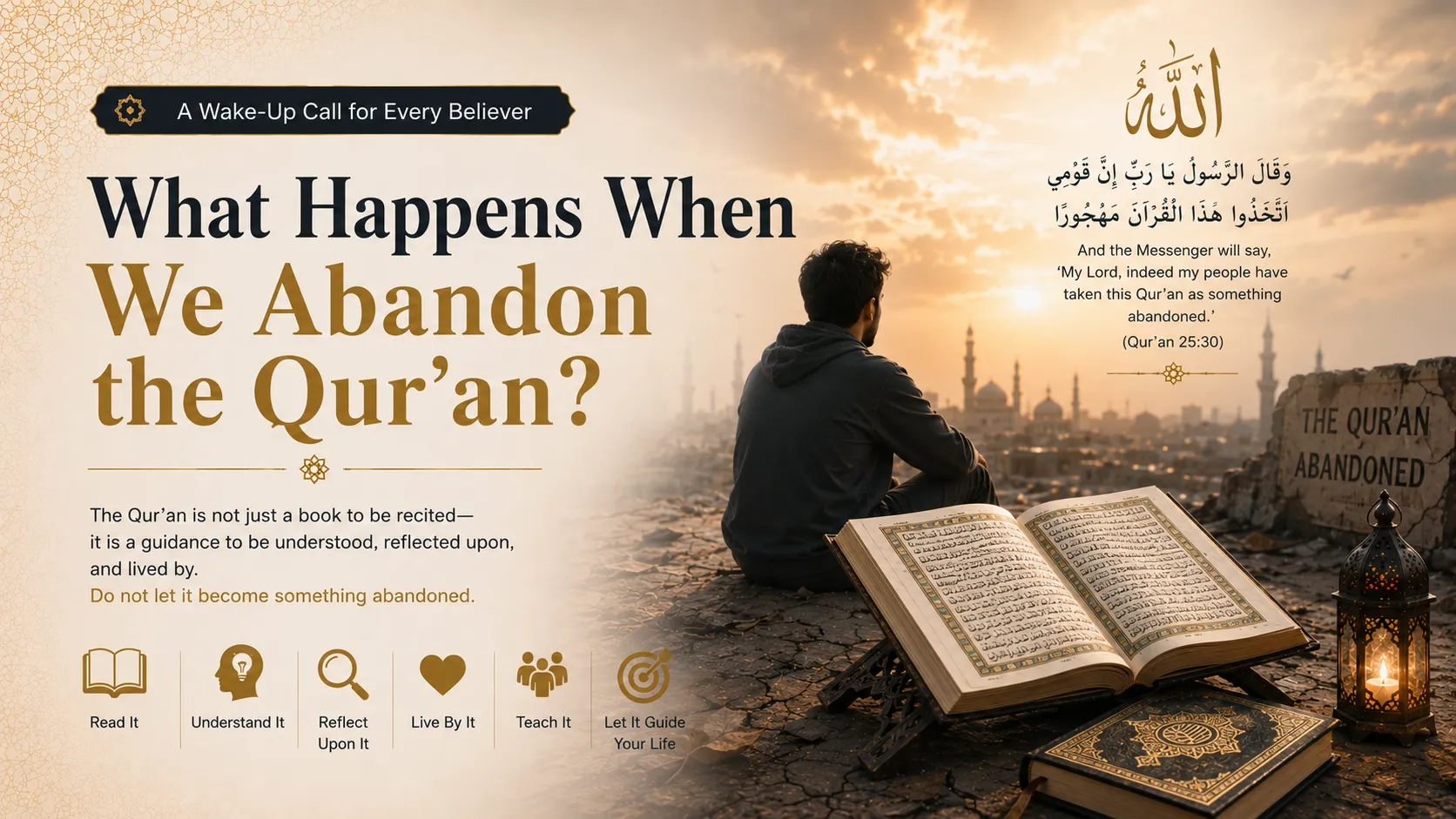
“And the Messenger will say, ‘My Lord, indeed my people have taken this Qur’an as something abandoned.’”
(Qur’an 25:30)
Few verses in the Qur’an are as heartbreaking as this one.
Imagine the Day of Judgment. The day when every soul will stand before Allah. The day when wealth, status, family, and worldly achievements will be of no benefit unless Allah grants His mercy.
On that day, the Prophet Muhammad ﷺ—the man who spent twenty-three years conveying Allah’s message, endured persecution for it, sacrificed everything for it, and cared deeply for his followers—will make a complaint.
But he will not complain about his enemies.
He will not complain about those who mocked him.
He will not complain about those who fought against him.
Instead, he will say:
“My Lord, indeed my people have taken this Qur’an as something abandoned.”
This verse should stop every believer in their tracks.
The question is not whether we own a copy of the Qur’an.
The question is: Have we abandoned it?
What Does It Mean to Abandon the Qur’an?
Many people assume that abandoning the Qur’an means rejecting it altogether. In reality, abandonment can take many forms.
A person may possess several copies of the Qur’an in his home and yet be distant from its message.
A person may recite it beautifully and yet never reflect upon its meanings.
A person may understand its teachings and yet fail to live by them.
A society may honor the Qur’an ceremonially while ignoring its guidance practically.
Abandoning the Qur’an does not simply mean refusing to read it. It means neglecting the purpose for which it was revealed.
The Qur’an was not sent merely to be displayed, kissed, memorized, or recited. It was revealed to guide human beings toward their Creator and teach them how to live.
When this purpose is forgotten, abandonment begins.
The Qur’an: More Than a Holy Book
When asked what the Qur’an is, many people simply answer, “It is the holy book of Islam.”
While true, this description barely scratches the surface.
The Qur’an is Allah’s final revelation to humanity.
It is guidance for those searching for truth.
It is a criterion that distinguishes right from wrong.
It is a mercy for believers.
It is a warning for those who persist in wrongdoing.
It is a light that illuminates the darkness of confusion and misguidance.
Allah describes it as:
“This is a communication to be transmitted to mankind so that they may be warned by it and so that they will know that He is One God and so that people of intelligence will pay heed.”
(Qur’an 14:52)
The Qur’an was revealed to be understood, reflected upon, and implemented—not merely recited without comprehension.
Yet this is precisely where many people fall short.
When the Qur’an Becomes a Decoration
One of the tragedies of our time is that many Muslims respect the Qur’an without truly engaging with it.
It is often placed on the highest shelf in the house.
Its verses decorate walls.
Its recitation fills gatherings.
Its beautiful calligraphy adorns homes and mosques.
Yet for many people, their relationship with the Qur’an ends there.
They may spend years reciting words whose meanings they do not understand.
They may complete the Qur’an multiple times without ever studying what Allah is actually saying to them.
Others reduce it to a source of blessings while neglecting its guidance. It becomes something read during ceremonies, funerals, or special occasions rather than a living guide for everyday life.
The result is that the Qur’an remains physically present while its message is practically absent.
What Happens When We Abandon the Qur’an?
The consequences are far greater than most people realize.
Abandoning the Qur’an does not merely mean neglecting a book. It means turning away from the very guidance sent by the Creator of mankind.
1. We Lose Our Sense of Purpose
Every human being asks the same fundamental questions:
Why am I here?
What is the purpose of life?
What happens after death?
Why was I created?
The Qur’an answers these questions clearly and repeatedly.
Without its guidance, people search endlessly for meaning in wealth, careers, relationships, fame, and material success. Yet despite achieving many of these things, they often remain spiritually empty.
The Qur’an reminds us that we were not created without purpose.
“I only created jinn and mankind to worship Me.”
(Qur’an 51:56)
When the Qur’an is abandoned, life loses its ultimate direction.
2. Truth Becomes Mixed with Falsehood
When people stop learning religion from its original source, misconceptions inevitably emerge.
Cultural traditions begin to replace revelation.
Superstitions replace authentic teachings.
Human opinions begin to compete with divine guidance.
This is why many practices commonly associated with Islam often have little connection to the Qur’an itself.
The farther people move from the Qur’an, the easier it becomes for confusion and falsehood to enter their beliefs.
3. Hearts Become Hardened
Allah repeatedly calls believers to reflect upon His words.
He asks:
“Do they not then reflect upon the Qur’an, or are there locks upon their hearts?”
(Qur’an 47:24)
The Qur’an softens hearts, awakens consciences, and reminds people of their accountability before Allah.
But when a person becomes distant from the Qur’an, worldly distractions gradually dominate the heart.
Sins become easier.
Repentance becomes less frequent.
Spiritual sensitivity begins to fade.
The heart that no longer listens to Allah's words eventually becomes deaf to His reminders.
4. Morality Begins to Decline
The Qur’an teaches honesty, justice, humility, patience, compassion, gratitude, forgiveness, and responsibility.
These are not merely religious virtues; they are the foundations of healthy individuals and healthy societies.
When Qur’anic values are neglected, selfishness replaces service, desires replace principles, and personal interests outweigh moral obligations.
A society may become technologically advanced and materially prosperous, yet remain spiritually and morally impoverished.
5. We Lose the Light of Guidance
Allah repeatedly describes revelation as light.
Without light, people stumble in darkness.
Without the Qur’an, people become vulnerable to every new ideology, trend, and temptation that promises happiness but fails to deliver it.
The Qur’an protects believers from confusion because it provides a stable foundation that does not change with time.
When that foundation is abandoned, uncertainty and doubt quickly take its place.
6. We Distance Ourselves from Allah
Perhaps the greatest consequence of abandoning the Qur’an is that it weakens our relationship with Allah.
The Qur’an is not merely a book; it is Allah’s communication with humanity.
Every verse is a reminder from our Creator.
Every command is for our benefit.
Every prohibition is for our protection.
Every story contains wisdom.
Every warning contains mercy.
When we neglect the Qur’an, we gradually distance ourselves from the One who revealed it.
The Qur’an Calls Us to Think
Contrary to common misconceptions, the Qur’an does not demand blind acceptance.
It repeatedly invites people to think, reflect, reason, and ponder.
Allah says:
“Will they not ponder the Qur’an?”
(Qur’an 4:82)
And He says:
“We have made the Qur’an easy to remember. So is there anyone who will be mindful?
The Qur’an addresses the intellect as well as the heart. It encourages reflection on creation, history, human nature, morality, and the purpose of existence.
Its message is not reserved for scholars alone. It is a message for all humanity.
Returning to the Qur’an
The solution to many of our spiritual struggles is simpler than we often imagine.
We must return to the Qur’an.
Not merely as a book to be recited.
Not merely as a source of blessings.
Not merely as a family heirloom.
But as a guide for life.
Read it.
Understand it.
Reflect upon it.
Live by it.
Allow its teachings to shape your character, your decisions, your relationships, and your priorities.
The Qur’an was sent to transform lives. It cannot fulfill that purpose while remaining closed on a shelf.
A Final Reflection
One day, every one of us will stand before Allah.
On that day, the complaint of the Messenger ﷺ will be heard:
“My Lord, indeed my people have taken this Qur’an as something abandoned.”
Before that day arrives, each of us should ask ourselves a difficult but necessary question:
If the Prophet ﷺ were to look at my relationship with the Qur’an today, would I be among those who honored it—or among those who abandoned it?
The answer to that question may determine the direction of our lives in this world and our success in the Hereafter.