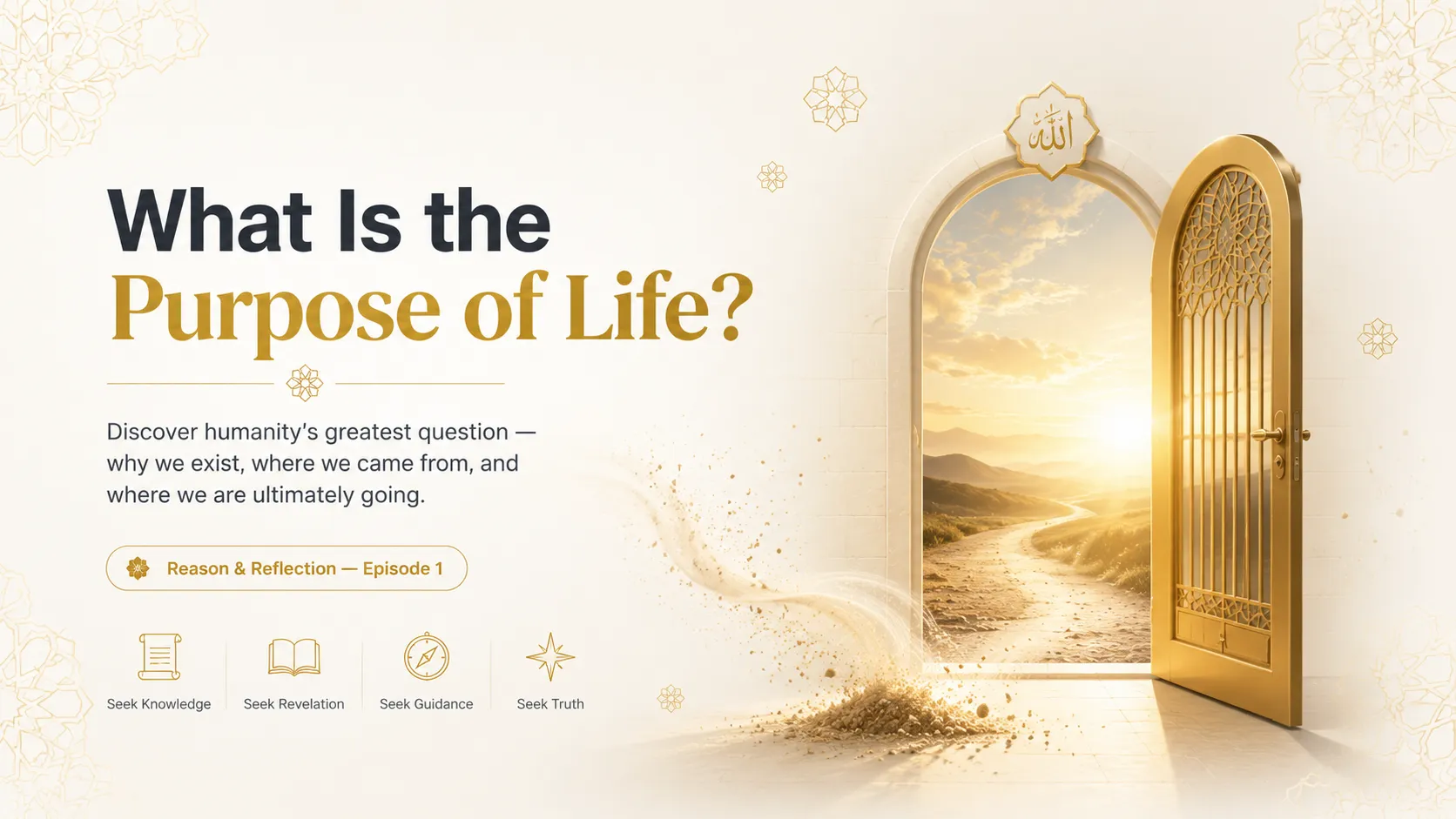
Ghaur-o-Fikr (Reflection and Contemplation) – Episode 1

A poet once said:
"If someone asks you what life is,
Place a little dust upon your palm,
And let the wind carry it away."
We all know how temporary life is.
We know that everything attached to it—wealth, status, beauty, power, relationships, and possessions—is equally temporary.
Yet have we ever paused to ask ourselves a deeper question?
What is the purpose of this temporary life?
The Greatest Failure of Modern Education
One of the greatest tragedies of our educational systems is that we spend years acquiring knowledge, earning degrees, studying political systems, analyzing societies, and mastering various disciplines, yet we often remain unable to answer the most fundamental question of all:
Why do we exist?
Our educational institutions teach us how to earn a living, but rarely teach us why we are living.
They do not tell us:
- Where did we come from?
- Why were we sent here?
- Where are we ultimately going?
As a result, modern society suffers from a profound absence of existential awareness.
We are producing educated people who possess information but lack wisdom.
People who know many things, yet do not know themselves.
The Open Prison
The great Muslim mystic مولانا جلال الدین رومی once shook people awake with a powerful observation:
"If God's earth is so vast,
Why do you choose to remain imprisoned?"
In other words, many of us live inside mental prisons.
The door is open.
Beyond it lies a vast world of truth, meaning, and discovery.
Yet we continue to sit within the confines of our assumptions, fears, and inherited habits.
Freedom is available, but we do not seek it.
Humanity's Endless Search
Throughout history, thoughtful men and women have struggled with the same question:
What is the purpose of life?
The poet-philosopher Allama Muhammad Iqbal raised similar questions in his famous poem Khizr-e-Rah:
What is the secret of life?
What is power?
What is sovereignty?
Likewise, the renowned Pashtun thinker and poet Ghani Khan wrestled with these questions through philosophy and spirituality. He asked:
"I am a human being made of clay,
And one day I shall return to clay.
Why was I created?
What was the purpose behind my creation?"
The same search occupied some of the greatest minds in history.
John Keats.
William Wordsworth.
Socrates.
Plato.
Aristotle.
Each sought answers to the mystery of existence.
Aristotle's Answer: Eudaimonia
Aristotle proposed that the ultimate purpose of life is Eudaimonia, a Greek term often translated as "human flourishing," "well-being," or "true happiness."
But what constitutes true happiness for the average person?
A comfortable home?
Financial security?
Love?
Success?
Prestige?
At first glance, these seem like reasonable answers.
Yet all of these things share one characteristic:
They are temporary.
They can be gained.
And they can be lost.
If life's purpose rests upon things that inevitably disappear, can they truly be life's ultimate purpose?
"And Then What?"
The celebrated poet Majal Ludhianvi posed this challenge beautifully in a thought-provoking poem directed toward those who believe worldly achievements alone can satisfy the human soul.
He writes:
I shall gather wealth and riches—
And then what?
I shall build a magnificent house—
And then what?
I shall satisfy every desire and ambition—
And then what?
I shall experience beauty, love, and companionship—
And then what?
One day death will knock upon the door of life.
The lamp of existence will be extinguished—
And then what?
Dust rose from dust and returned to dust.
After that,
Who knows what comes next?
The haunting question remains:
And then what?
The Limits of Human Knowledge
By now, one thing becomes clear.
Despite all of humanity's intellectual achievements, scientific discoveries, philosophical systems, and cultural advancements, we have never reached a universal agreement on the purpose of life.
Human knowledge, for all its strengths, has limits.
This brings us to an important distinction.
There are broadly two kinds of knowledge.
Acquired Knowledge
The first is knowledge that human beings obtain through observation, reasoning, experimentation, and experience.
This is what philosophers call acquired knowledge.
Science, history, mathematics, sociology, and philosophy largely belong to this category.
Revealed Knowledge
The second is knowledge that comes from Divine revelation.
Knowledge that is not discovered by humanity but granted to humanity.
This is known as revealed knowledge.
It comes through prophets and divine scripture.
When acquired knowledge reaches its limits and cannot answer certain ultimate questions, it becomes reasonable to ask whether revealed knowledge may provide the answers we seek.
Did Anyone Ever Ask God?
If philosophers, poets, and thinkers have spent centuries asking:
"Why are we here?"
Then another question naturally arises:
Has humanity ever received an answer from God Himself?
Has the Creator ever explained why human beings were created?
Has revelation addressed the purpose of life?
These are the questions that will guide our journey.
The Beginning of a Journey
This series is titled Ghaur-o-Fikr (Reflection and Contemplation).
Today's discussion serves as the first step in that journey.
In the next episode, we will turn to revealed knowledge and explore what Allah tells us about the purpose of human existence.
Why were we created?
Why were we placed in this world?
What is expected of us?
And where are we ultimately headed?
These are not merely philosophical questions.
They are the most important questions a human being can ever ask.
We invite you to continue this journey with us.
Reflect.
Question.
Seek.
And together, let us search for the purpose of life through the guidance of Divine revelation.
Until next time,
May the peace, mercy, and blessings of Allah be upon you.