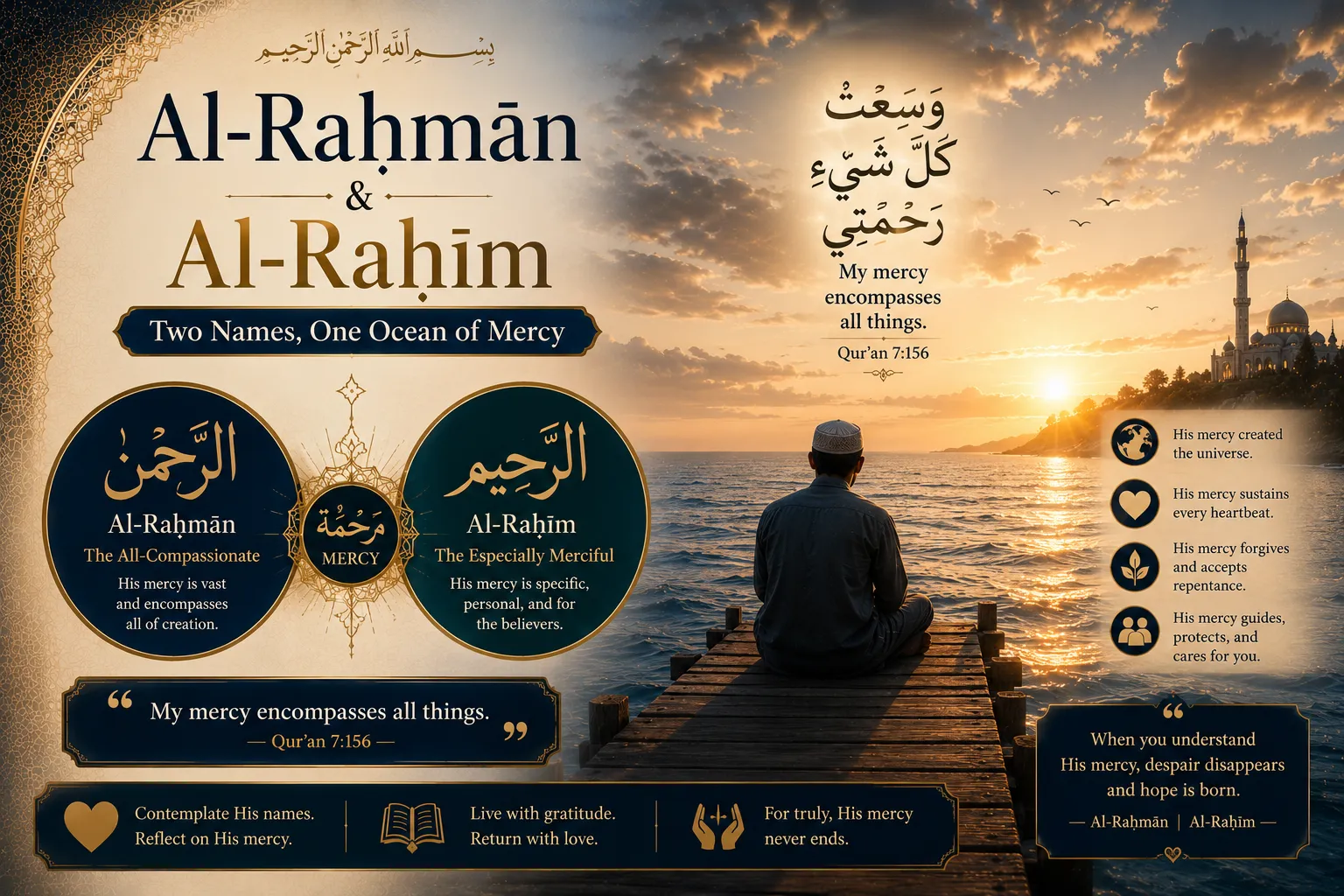
Every time a Muslim opens the Qurʾān, every time they begin their prayer, every time they recite the Basmalah — they encounter these two majestic Names side by side: Al-Raḥmān (الرَّحْمٰن) and Al-Raḥīm (الرَّحِيم). To the casual ear, they sound nearly identical. Yet the scholars of Islam — masters of the Arabic language, the Qurʾān, and the sciences of theology — have devoted extensive effort to distinguishing their meanings, recognizing that Allāh (SWT) does not repeat Himself unnecessarily. Each name carries its own distinct implication about the nature of Divine Mercy, and together they form a complementary portrait of a mercy that is both infinite in its essence and active in its expression.
This article presents a researched, structured analysis of the distinction between these two names, drawing from the Qurʾān, authentic Hadith, and the opinions of classical and contemporary scholars.
1. Linguistic Root & Derivation
Both names are derived from the single Arabic root ر-ح-م (r-ḥ-m), which conveys the concepts of tenderness, deep compassion, and womb-like nurturing care. The Arabic word raḥim (رَحِم) means "womb" — a remarkable etymological link suggesting a love that is protective, sustaining, and unconditional from the moment of existence.
However, despite sharing the same root, the two names belong to different morphological patterns (ṣīgha) in the Arabic language, and this grammatical difference is precisely what unlocks their distinct theological meanings.
Shaykh Ibn ʿUthaymīn (raḥimahullāh)
Major scholar of the 20th century | Author of Al-Qawāʿid al-Muthlā
"Al-Raḥmān is the Owner of vast mercy, because the faʿlān form in Arabic indicates vastness and abundance — as it is said rajulun ghaḍbān (a man filled with anger) when he is overflowing with it. Al-Raḥīm is a name which refers to the action, as the faʿīl form in Arabic refers to the doer of an action. So the phrase Al-Raḥmān Al-Raḥīm indicates that the mercy of Allāh is vast — as is understood from Al-Raḥmān — and that it encompasses His creation — as is understood from Al-Raḥīm."
In plain terms: Al-Raḥmān (faʿlān pattern) conveys the state — Allāh is overflowing, brimming, saturated with mercy as an intrinsic attribute. Al-Raḥīm (faʿīl pattern) conveys the action — Allāh actively directs and bestows that mercy upon His creation.
2. The Scope of Each Name: General vs. Special Mercy
The most widely cited distinction among scholars concerns the scope of each name's mercy:
|
Al-Raḥmān الرَّحْمٰن |
Al-Raḥīm الرَّحِيم |
|
|
Scope |
Universal — for all of creation without distinction |
Specific — especially for the believers |
|
Time |
This world (dunyā) — given to all, believer and disbeliever |
Primarily the Hereafter (ākhirah) — saved for the faithful |
|
Nature |
The attribute itself — Allāh possesses boundless mercy |
The expression — Allāh actively sends mercy upon creation |
|
Exclusivity of name |
Belongs to Allāh alone; cannot be used for any created being |
May be applied to creation; the Prophet ﷺ was called Raḥīm |
|
Arabic grammar |
Faʿlān — intensive state (overflowing fullness) |
Faʿīl — doer of action (one who performs mercy) |
3. Evidence from the Qurʾān
3.1 — Al-Raḥmān as Universal, All-Encompassing Mercy
ٱلرَّحْمَٰنُ عَلَى ٱلْعَرْشِ ٱسْتَوَىٰ
"The Most Merciful [Al-Raḥmān] rose over the Throne."
Sūrah Ṭāhā (20:5)
Ibn Kathīr notes in his Tafsīr that Allāh (SWT) specifically chose the name Al-Raḥmān here — not Al-Raḥīm — when describing His Istiwa (rising over the Throne). This is because the Throne encompasses all of creation, and Al-Raḥmān is the name that covers all of creation with mercy. The entire universe sits beneath His Raḥmān-mercy.
ٱلرَّحْمَٰنُ عَلَّمَ ٱلْقُرْءَانَ خَلَقَ ٱلْإِنسَٰنَ
"Al-Raḥmān. He taught the Qurʾān. He created man."
Sūrah Al-Raḥmān (55:1–3)
The opening of this Sūrah is profoundly instructive: Allāh begins with the name Al-Raḥmān and immediately proceeds to list His universal gifts — the Qurʾān, the creation of man, speech, the sun, the moon, the stars, the trees, the rain. All of this is from His Raḥmān-mercy, extended to all creatures regardless of belief.
أَلَا يَعْلَمُ مَنْ خَلَقَ وَهُوَ ٱللَّطِيفُ ٱلْخَبِيرُ
"قُلِ ٱدْعُوا۟ ٱللَّهَ أَوِ ٱدْعُوا۟ ٱلرَّحْمَٰنَ ۖ أَيًّا مَّا تَدْعُوا۟ فَلَهُ ٱلْأَسْمَآءُ ٱلْحُسْنَىٰ"
"Say: Call upon Allāh or call upon Al-Raḥmān; by whichever name you call, to Him belong the Most Beautiful Names."
Sūrah Al-Isrāʾ (17:110)
This verse explicitly shows that Al-Raḥmān is a proper name exclusive to Allāh — equivalent in exclusivity to the name "Allāh" itself. No created being may carry this name.
3.2 — Al-Raḥīm as Specific Mercy for the Believers
وَكَانَ بِٱلْمُؤْمِنِينَ رَحِيمًا
"And He is ever, to the believers, Merciful [Raḥīmā]."
Sūrah Al-Aḥzāb (33:43)
إِنَّهُۥ بِهِمْ رَءُوفٌ رَّحِيمٌ
"Indeed, He was Kind and Merciful [Raḥīm] to them."
Sūrah Al-Tawbah (9:117)
Note carefully: in the Qurʾān, Al-Raḥīm is always paired with a specific object — "to the believers," "to them." This is a pattern observed and analyzed by the classical scholars. Al-Raḥmān, by contrast, never appears in the Qurʾān followed by "with them" or "to them," because His Raḥmān-mercy has no specified recipient — it covers everything.
Imam Abū Jaʿfar Muḥammad ibn Jarīr Al-Ṭabarī (raḥimahullāh)
d. 310 AH | Author of the monumental Jāmiʿ Al-Bayān (Tafsīr Al-Ṭabarī)
"The elucidated meaning from the name of Allāh Al-Raḥmān is different from that of the name Al-Raḥīm. For His name Al-Raḥmān denotes all-encompassing mercy for His entire creation, while His name Al-Raḥīm stipulates mercy for some of His creation — either corresponding to all of their conditions, or some of them."
After exhaustive analysis of every verse containing both names, Al-Ṭabarī concluded that Al-Raḥmān is the One attributed with mercy, while Al-Raḥīm is the One who applies mercy upon His creation.
3.3 — The Prophet ﷺ was called Raḥīm, but Never Raḥmān
لَقَدْ جَآءَكُمْ رَسُولٌ مِّنْ أَنفُسِكُمْ عَزِيزٌ عَلَيْهِ مَا عَنِتُّمْ حَرِيصٌ عَلَيْكُم بِٱلْمُؤْمِنِينَ رَءُوفٌ رَّحِيمٌ
"There has certainly come to you a Messenger from among yourselves... with the believers he is gentle and merciful [Raḥīm]."
Sūrah Al-Tawbah (9:128)
This verse demonstrates that the attribute Raḥīm can be used for creation — here it is applied to the Prophet ﷺ himself. This is because Al-Raḥīm, in the faʿīl pattern, is a description of one who performs mercy — and a human being can perform acts of mercy. But Raḥmān, in the faʿlān pattern, implies an absolute fullness and interior state of mercy that belongs only to Allāh (SWT). No created being can contain such fullness of mercy within themselves.
4. Evidence from the Sunnah
Hadith 1 — Sahih Al-Bukhārī & Sahih Muslim
"Allāh has divided mercy into 100 parts. He retained with Him 99 parts, and sent down to earth one part. Through this one part, creatures deal with one another with compassion — so much so that an animal lifts its hoof over its young lest it should hurt it."
Reported by Abu Hurayrah (RA) | Sahih Al-Bukhārī (6469) | Sahih Muslim (2752)
This hadith is a masterpiece of explanation. All the mercy visible in this world — a mother's love, a father's sacrifice, a doctor's care, even an animal's tenderness toward its offspring — comes from one part out of 100. This one part is a reflection of Al-Raḥmān: universal, visible in creation for all to benefit from regardless of faith. The 99 remaining parts — Al-Raḥīm's special mercy — are reserved for the Day of Resurrection, for Allāh's believing servants.
Hadith 2 — Sahih Muslim (2751) — The Mercy that Precedes All
"When Allāh created the creation, He wrote in His Book — which is with Him above the Throne — 'Indeed, My mercy precedes My wrath.'"
Reported by Abu Hurayrah (RA) | Sahih Muslim (2751)
This hadith underlines the primacy of mercy in Allāh's very nature — a direct affirmation of what Al-Raḥmān conveys: mercy is not secondary to Allāh's other attributes; it is first, it is foremost, it is intrinsic.
Hadith 3 — Sahih Al-Bukhārī (5999) — The Mother Analogy
A captive woman was found searching frantically for her child among the prisoners. When she found the child, she clutched it to her chest and nursed it. The Prophet ﷺ said to the Companions: "Do you think this woman would throw her child into the fire?" They said: "No, by Allāh, not if she has the power to prevent it." The Prophet ﷺ said: "Allāh is more merciful to His slaves than this woman is to her child."
Reported by ʿUmar ibn Al-Khaṭṭāb (RA) | Sahih Al-Bukhārī (5999)
Ibn Kathīr uses this hadith in his Tafsīr of Sūrah Al-Fātiḥah to show that Al-Raḥmān encompasses every type of mercy Allāh has — a mercy that defies human comprehension — while Al-Raḥīm is the specific expression of this mercy showered upon the believers.
Hadith 4 — Salman Al-Fārisī Narration | Sahih Muslim (2753)
"Verily, on the day Allāh created the heavens and the earth, He created one hundred parts of mercy. Each part can fill what is between the heavens and the earth. He made one part of mercy for the earth, from which a mother has compassion for her child, animals and birds have compassion for each other... On the Day of Resurrection, He will perfect this mercy."
Reported by Salmān Al-Fārisī (RA) | Sahih Muslim (2753)
5. Opinions of Classical Scholars
Imam Ibn Al-Qayyim Al-Jawziyyah (raḥimahullāh)
d. 751 AH | Author of Badāʾiʿ Al-Fawāʾid, Madārij Al-Sālikīn
Ibn Al-Qayyim provided one of the most penetrating analyses of these two names. He observed that Al-Raḥmān is a proper name specific to Allāh — it enters into His very identity alongside the supreme name "Allāh" itself. Al-Raḥīm, by contrast, is a descriptive attribute that can apply to creation. He writes in Badāʾiʿ Al-Fawāʾid that Al-Raḥmān signals the vastness of the attribute within the Divine Essence, while Al-Raḥīm signals the channeling of that mercy outward upon those who deserve it. Used together in the Basmalah, they constitute a complete statement: the source of mercy is infinite (Al-Raḥmān), and the delivery of mercy is active and real (Al-Raḥīm).
Imam Abū Ḥāmid Al-Ghazālī (raḥimahullāh)
d. 505 AH | Author of Iḥyāʾ ʿUlūm Al-Dīn
Al-Ghazālī explains that Al-Raḥmān signifies Allāh's mercy in its eternal, essential dimension — the mercy that existed before creation, independent of any recipient. Al-Raḥīm, on the other hand, denotes mercy in its relational dimension — the mercy that flows toward creation, that gives, forgives, and rescues. He writes: "Al-Raḥmān is a name exclusive to Allāh because such plenitude of mercy cannot possibly exist in any created being. Al-Raḥīm may be applied to humans because they can show mercy in their actions, even if in tiny measure."
Imām Abū ʿAlī Al-Fārisī & Al-Wārmī
Classical grammarians and linguists
These early Arabic linguistics scholars advanced the foundational position that Al-Raḥmān denotes general mercy for all of creation while Al-Raḥīm denotes specific mercy for the believers alone — a distinction later endorsed with elaboration by Ibn ʿUthaymīn and other modern scholars.
Imam Ibn Kathīr (raḥimahullāh)
d. 774 AH | Author of Tafsīr Al-Qurʾān Al-ʿAẓīm
In his Tafsīr of Sūrah Al-Fātiḥah, Ibn Kathīr records the position of scholars that Al-Raḥmān encompasses every type of mercy Allāh has and applies to all of creation in both this life and the next, while Al-Raḥīm is the mercy that specifically reaches the believers. He also records a statement by Ibn Jarīr Al-Ṭabarī indicating scholarly consensus (ijmāʿ) on this core distinction. Ibn Kathīr also notes that the Istiwa of Allāh over the Throne (Sūrah Ṭāhā 20:5) was paired with the name Al-Raḥmān — not Al-Raḥīm — precisely to underscore the universality of that sovereignty and its mercy.
Shaykh Ibn ʿUthaymīn (raḥimahullāh)
d. 1421 AH | Author of Sharḥ Al-ʿAqīdah Al-Wāsiṭiyyah
Ibn ʿUthaymīn offered the most precise grammatical framing of the difference. He explained: "When Al-Raḥmān and Al-Raḥīm are combined together — as in the Basmalah — Al-Raḥmān refers to the vastness of Allāh's mercy, and Al-Raḥīm refers to that mercy reaching out to His creation. Some have said Al-Raḥmān is general and Al-Raḥīm is specific for believers — this is not incorrect, but what we have mentioned [regarding Arabic grammar] is more precise." He further noted that since Al-Raḥmān is the stronger, more intensive form, it refers to mercy in its eternal, absolute sense, while Al-Raḥīm, as a participial form, describes the active exercise of mercy.
6. The Wisdom of Combining Both Names
The scholars emphasize that Allāh (SWT) did not pair these names accidentally. Their combination in the Basmalah (بِسْمِ ٱللَّهِ ٱلرَّحْمَٰنِ ٱلرَّحِيمِ) conveys a complete and majestic statement about Divine Mercy in two complementary dimensions:
Al-Raḥmān tells us: The mercy exists — boundlessly, infinitely, within Allāh's Essence.
No created being can exhaust it. It preceded creation. It encompasses all things. Even the air you breathe is from Al-Raḥmān-mercy extended to all without condition.
Al-Raḥīm tells us: The mercy acts — it reaches out, it enfolds, it rescues.
It is given with intention and purpose. The believer who repents, who struggles, who turns back to Allāh — finds Al-Raḥīm waiting for them, actively applying that mercy to their soul.
As the scholar from SubulAsSalaam.com summarizes in his analysis of Al-Ṭabarī's method: "When combined, Al-Raḥmān and Al-Raḥīm mean that Allāh's mercy is vast and reaches creation. Since Allāh's mercy upon disbelievers is specific to the life of this world only, it is as if there is really no mercy upon them in the permanent sense — for in the Hereafter, when they seek intercession, they will not find mercy there, but justice."
7. A Note on the Created vs. Divine Mercy
A subtle but important theological clarification from Fatāwā Al-Lajnah Al-Dāʾimah (2/400) addresses a question many ask: the hadith says Allāh created 100 parts of mercy — does this mean Allāh's mercy is "finite"?
The scholars clarify that there are two types of mercy: (1) The divine attribute of mercy — this is part of Allāh's Essence and is infinite, uncreated, and eternal. This is what Al-Raḥmān and Al-Raḥīm refer to in their deepest theological sense. (2) Created mercy — this is a manifestation Allāh placed in creation as a gift, the 100 parts mentioned in the hadith. This created mercy is a reflection of, not the totality of, His Divine Mercy. The scholars of Ahl Al-Sunnah are unanimous that Allāh's attributes — including mercy — are not created.
8. Summary: The Difference at a Glance
Drawing from all the above, the distinction can be stated as follows:
|
Al-Raḥmān الرَّحْمٰن |
Al-Raḥīm الرَّحِيم |
|
|
Meaning |
The Entirely, Overflowingly Merciful |
The Especially, Actively Merciful |
|
Arabic Form |
Faʿlān (intensive state) |
Faʿīl (active/participial) |
|
Who benefits |
All of creation — believer, disbeliever, animal, plant |
Primarily the believers; special mercy for them |
|
When |
This life (dunyā) especially |
The Hereafter (ākhirah) primarily |
|
Used for creation? |
No — exclusive to Allāh |
Yes — the Prophet ﷺ was described as Raḥīm |
|
Theological role |
The infinite attribute within Allāh's Essence |
The action: mercy flowing outward to creation |
|
Frequency in Qurʾān |
57 times |
114 times (exactly double) |
✦ ✦ ✦
Conclusion
Al-Raḥmān and Al-Raḥīm are not synonyms placed side by side for emphasis. They are two complementary lenses through which the single ocean of Divine Mercy is beheld. Al-Raḥmān shows us the ocean itself — limitless, ancient, intrinsic to Allāh's very being, touching all of existence. Al-Raḥīm shows us the waves reaching the shore — mercy in motion, deliberately directed, faithfully delivered to those who believe and submit.
Every time a Muslim says بِسْمِ ٱللَّهِ ٱلرَّحْمَٰنِ ٱلرَّحِيمِ, they are not merely reciting a formula. They are invoking — in an act of profound theological recognition — a God whose mercy is not conditional on worthiness, whose generosity precedes creation itself, and whose special tenderness awaits the believer at every gate of repentance.
As the Prophet ﷺ said: "Allāh is more merciful to His servants than a mother to her child." (Sahih Bukhārī & Muslim) — and that is from only one part out of one hundred. What awaits in the Hereafter, from Al-Raḥīm, is beyond the reach of imagination.
❧
References & Sources
Qurʾānic Verses: Al-Fātiḥah (1:1), Ṭāhā (20:5), Al-Raḥmān (55:1–3), Al-Isrāʾ (17:110), Al-Aḥzāb (33:43), Al-Tawbah (9:117, 9:128), Al-Aʿrāf (7:156).
Aḥādīth: Sahih Al-Bukhārī (5999, 6469, 7422); Sahih Muslim (2751, 2752, 2753, 2754); Riyāḍ Al-Ṣāliḥīn (420).
Classical Tafsīr: Tafsīr Ibn Kathīr (on Sūrah Al-Fātiḥah); Tafsīr Al-Ṭabarī — Jāmiʿ Al-Bayān; Badāʾiʿ Al-Fawāʾid by Ibn Al-Qayyim Al-Jawziyyah.
Scholarly Opinions: Shaykh Ibn ʿUthaymīn (Islamqa.info, answer 22200); Imam Al-Ghazālī (Iḥyāʾ ʿUlūm Al-Dīn); Fatāwā Al-Lajnah Al-Dāʾimah (2/400); Abū ʿAlī Al-Fārisī; SubulAsSalaam.com analysis of Al-Ṭabarī's Qurʾānic survey.
Comments (0)
Join the conversation! Please log in to share your thoughts.
Log In to CommentNo comments yet. Be the first to share your thoughts!