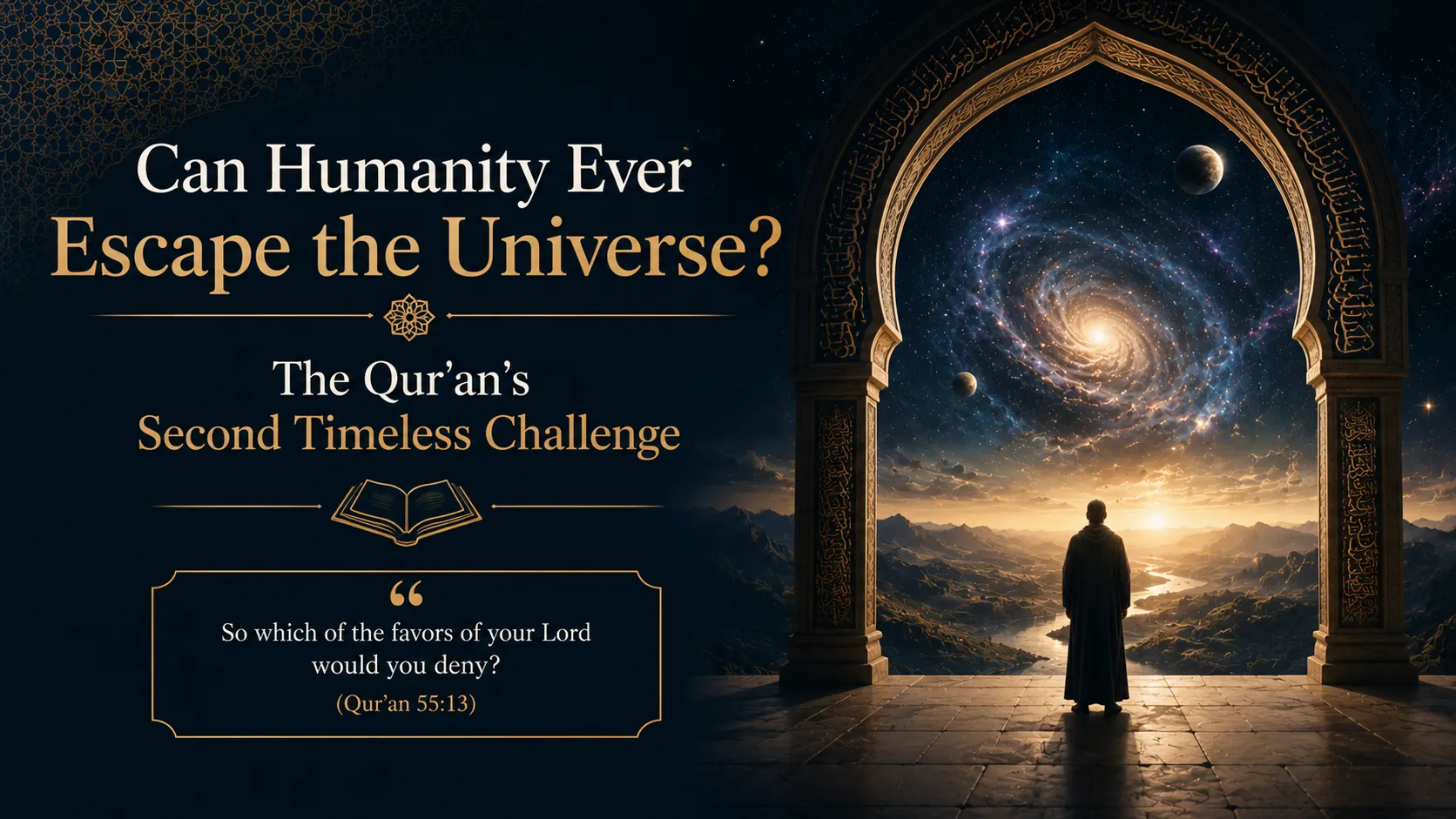

A Journey of Reflection — The Limits of Human Power and Knowledge
How much do we truly know about the universe we inhabit?
At first glance, modern science appears to have unraveled countless mysteries of the cosmos. We have landed probes on distant planets, photographed black holes, detected gravitational waves, and peered billions of light-years into deep space.
Yet, when we step back and look at the bigger picture, an astonishing reality emerges:
Despite all our scientific achievements, we understand only a tiny fraction of the universe.
More than fourteen centuries ago, the Qur'an issued a remarkable challenge—one that continues to provoke reflection in every generation.
To appreciate that challenge, we must first recognize how little we truly know.
The Universe We Barely Understand
According to the current standard model of cosmology, the observable universe consists of approximately:
- 68–69% dark energy
- 26–27% dark matter
- About 5% ordinary matter
Ordinary matter is everything we can directly observe—stars, planets, galaxies, oceans, mountains, trees, and even our own bodies.
The remaining 95% is composed of dark matter and dark energy.
Scientists have compelling evidence that both exist because of their observable effects on the universe. Yet their true nature remains one of the greatest unsolved mysteries in modern physics.
In other words, most of the universe consists of realities that we cannot directly see and do not yet fully understand.
And this description applies only to the observable universe—the portion of the cosmos from which light has had enough time to reach us since the beginning of cosmic expansion.
What lies beyond that horizon?
Science does not yet know.
Beyond the Observable Universe
Modern theoretical physics has proposed fascinating possibilities.
Ideas such as string theory, eternal inflation, and certain interpretations of quantum mechanics have led some physicists to explore the possibility of a multiverse—a reality containing many universes rather than just one.
These ideas remain speculative.
There is currently no direct observational evidence confirming the existence of other universes.
Nevertheless, they illustrate an important point:
The universe may be far greater than anything we presently comprehend.
As the famous Pashto poet Ghani Khan beautifully expressed, human beings often imagine they understand far more than they truly do.
The deeper we explore reality, the more we realize how much remains hidden.
Can We Even Reach the Edge of Our Own Galaxy?
Suppose humanity wished to travel to another universe.
Before asking whether such a journey is possible, we should ask a simpler question:
Can we even reach the limits of our own galaxy?
Our home is the Milky Way Galaxy, one among hundreds of billions—perhaps even trillions—of galaxies in the observable universe.
The nearest major galaxy to us is the Andromeda Galaxy, approximately 2.5 million light-years away.
Imagine traveling there.
If it were somehow possible to move at the speed of light—the fastest speed known in nature—it would still take about 2.5 million years to arrive.
Human beings, however, cannot travel anywhere near the speed of light.
The fastest human-made spacecraft travel at only a tiny fraction of that speed.
At such velocities, reaching Andromeda would require billions of years—far longer than the entire history of human civilization.
Our average lifespan is measured in decades.
The distances of the universe are measured in millions and billions of years.
The contrast is overwhelming.
If we cannot reach even our nearest galactic neighbor, how could we hope to leave the universe itself?
The Qur'an's Astonishing Challenge
Centuries before telescopes revealed the vastness of the cosmos, the Qur'an addressed both humanity and the jinn with these words:
"O assembly of jinn and humankind! If you are able to pass beyond the regions of the heavens and the earth, then pass beyond them. You will not pass beyond except with a sulṭān."
(Surah Ar-Raḥmān 55:33)
The verse is remarkable.
It does not merely speak of traveling across the earth.
It speaks of passing beyond the regions or boundaries of the heavens and the earth.
Then it presents a challenge:
If you are able, then do so.
But it immediately adds an important condition:
"You will not pass beyond except with a sulṭān."
What Does "Sulṭān" Mean?
The Arabic word sulṭān carries a rich range of meanings.
Classical scholars have interpreted it as:
- Authority
- Power
- Proof
- Divine permission
- God-given capability
The Qur'an itself does not restrict the word to a single interpretation.
Its broader message is clear:
Human beings cannot transcend the limits set by Allah through their own power alone.
Whatever knowledge, technology, or authority we possess ultimately comes only by His permission.
Every scientific breakthrough is itself part of the divine order established by the Creator.
A Challenge That Still Stands
When these verses were revealed in the seventh century, humanity had barely begun to understand the heavens.
Today we possess space telescopes, interplanetary missions, particle accelerators, and powerful mathematical models.
Yet despite these astonishing advances, we remain confined to a tiny corner of one galaxy.
The Qur'an's challenge remains unanswered.
Humanity has not escaped the bounds of the heavens.
Nor has it reached the edge of the observable universe.
The more we learn about creation, the more immense it appears—and the more evident become the limits of our own power.
Knowledge Begins with Humility
One of the greatest lessons of science is humility.
Every discovery answers one question while opening countless others.
Likewise, one of the greatest lessons of the Qur'an is humility before the Creator.
It reminds us that human knowledge, however remarkable, will always remain limited.
The universe is not merely vast in size.
It is vast in mystery.
Every new observation invites deeper reflection.
Every unanswered question points toward realities still beyond our grasp.
Perhaps that is precisely why the Qur'an repeatedly calls us to observe, think, and reflect—not so that we become arrogant in what we know, but so that we recognize the greatness of the One whose knowledge encompasses all things.
In our next reflection, we will explore another fascinating Qur'anic expression—its references to multiple "easts" and "wests"—and examine how these verses continue to inspire thoughtful contemplation of the universe.
And Allah knows best.
Comments (0)
Join the conversation! Please log in to share your thoughts.
Log In to CommentNo comments yet. Be the first to share your thoughts!