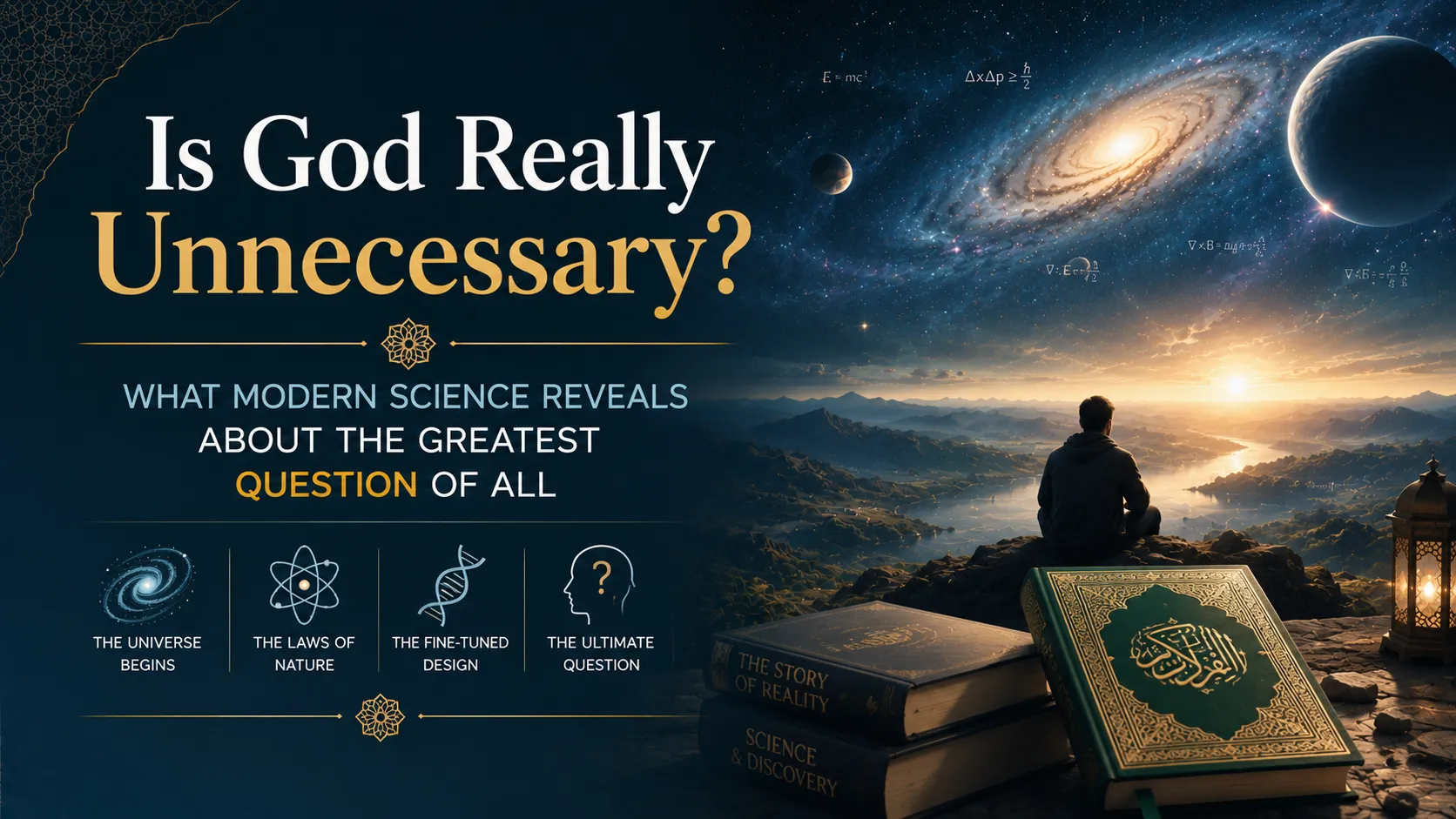

"Is God dead?"
Few questions have shaken modern thought as profoundly as this one.
For centuries, humanity has wrestled with the question of God's existence. In recent decades, however, atheism has gained increasing prominence, particularly under the influence of scientific advancement. Many people have come to believe that science has made God unnecessary—that once the laws of nature are understood, there is no longer any need for a Creator.
But is this really what science says?
Or has modern scientific discovery led us in the opposite direction?
This article is the beginning of a deeper exploration into one of the most important intellectual discussions of our time. It is not an appeal to emotion or blind faith. Rather, it is an invitation to reflect upon some of the most remarkable discoveries of modern science and to ask an honest question:
Do these discoveries point toward a purposeless universe—or toward an Intelligent Creator?
Understanding the Different Faces of Atheism
Before discussing the scientific evidence, it is helpful to recognize that not everyone who struggles with belief is the same.
Broadly speaking, three groups can be identified.
1. Philosophical or Scientific Atheists
The first group consists of those who sincerely reject the existence of God.
Their worldview is based upon a simple assumption: every effect has a natural cause. If science can eventually explain every cause through physical laws, then there is no need to invoke God.
They consider themselves rational, logical, deterministic, and committed to scientific reasoning.
For them, nature alone is sufficient.
2. Skeptical Believers
The second group is far larger than many realize.
These are people who outwardly identify as Muslims—or followers of another religion—but inwardly carry serious questions and doubts.
They wonder about evolution.
They question the origin of the universe.
They struggle with suffering, consciousness, free will, and countless other philosophical issues.
Yet they rarely ask these questions publicly.
Why?
Because many fear being judged instead of being understood.
Some worry that questioning will be mistaken for disbelief.
Others fear criticism, accusations, or even being labeled as lacking faith.
As a result, their questions remain buried, and over time they quietly drift further away from religion—not because they searched for answers, but because they felt unable to ask.
This article is especially for them.
The third category will be discussed separately in a future article.
When the World Thought Science Had Buried God
On April 8, 1966, the world's most influential news magazine, Time, published one of the most famous magazine covers in history.
Across a plain black background appeared four striking words:
"Is God Dead?"
The cover reflected the intellectual mood of the era.
Many believed that scientific progress had rendered belief in God obsolete.
Religion, they assumed, belonged to humanity's past.
Science would explain everything.
God would simply fade away.
History, however, took an unexpected turn.
Instead of eliminating the need for a Creator, many of the greatest scientific discoveries began raising profound questions that pointed in the opposite direction.
The Optimism of the 1960s Search for Life
Around that same era, the young science of astrobiology was full of optimism.
Influential figures such as astronomer Carl Sagan popularized the idea that life might be common throughout the universe, provided a planet met a small number of basic conditions—chiefly, orbiting the right kind of star at roughly the right distance to allow liquid water.
Given the vast number of stars and planets thought to exist—estimates for the observable universe run into the range of 10²⁴ or more planets—many scientists reasoned that even a tiny fraction being habitable would still mean life, and perhaps intelligent life, should be common.
This optimism gave birth to one of the largest scientific searches in history.
The Search for Intelligent Life
Scientists launched SETI (Search for Extraterrestrial Intelligence).
Using enormous radio telescopes, researchers spent decades listening for signals from intelligent civilizations beyond Earth.
Year after year...
Decade after decade...
The universe remained silent.
No confirmed signal.
No civilization.
No evidence of intelligent extraterrestrial life.
By 2014, despite decades of searching, the results remained exactly the same:
Nothing.
Science Discovers That Life Is Far More Complicated
Why did these early expectations fail to materialize?
Because as planetary science and astrobiology matured, researchers gradually realized something important.
Supporting complex life does not depend on merely one or two favorable conditions.
It depends on a great many, interacting in delicate balance.
Over the following decades, the list of relevant factors identified by researchers studying planetary habitability grew substantially—from a handful of basic requirements to a long and still-growing list of astronomical, geological, and chemical conditions.
Each newly identified requirement narrowed the range of planets that could realistically support complex life.
Even researchers involved in the search for extraterrestrial life have written candidly about this shift. In a 2006 piece for the Skeptical Inquirer, writer Peter Schenkel—a retired political scientist who has written extensively on the social implications of contact with extraterrestrial intelligence, though not himself an astrobiologist—argued that the early, highly optimistic estimates of alien civilizations "may no longer be tenable" in light of new findings, and called for a more sober reassessment of the odds. His piece is one example, among many voices in the field, of a broader and ongoing reappraisal of just how special the conditions for life may be.
A Long List of Conditions for Life
Astrobiologists studying planetary habitability have catalogued a long and growing list of factors that must fall within narrow ranges for a planet to support complex life.
Consider only a few examples:
- The correct type of star.
- The proper planetary mass.
- A stable orbit.
- A protective magnetic field.
- Plate tectonics.
- The presence of liquid water.
- The right atmospheric composition.
- A large stabilizing moon.
- Appropriate galactic location.
- Long-term stellar stability.
These are only a small fraction of the conditions researchers have identified. Different scientists and organizations propose different counts—ranging from dozens to, in some more expansive lists, several hundred—depending on how strictly each factor is defined, and these figures should be treated as illustrative rather than as a single agreed-upon scientific tally.
The deeper science investigates life, the more precise the conditions for it appear to be.
Fine-Tuning Goes Far Beyond Earth
Remarkably, planetary conditions are only the beginning.
The universe itself appears to be extraordinarily fine-tuned.
Modern physics identifies four fundamental forces that govern everything in existence:
- Gravity
- Electromagnetism
- The Strong Nuclear Force
- The Weak Nuclear Force
According to cosmology, the relative strengths of these forces were established within an unimaginably tiny fraction of a second after the Big Bang.
Had any one of these constants differed by even an incredibly small amount:
- Stars could never have formed.
- Atoms could never have existed.
- Chemistry would have been impossible.
- Planets would never have developed.
- Life could never have emerged.
In other words, the universe itself depends upon an astonishing level of precision. This is what physicists call the "fine-tuning" of the universe, and it is a genuine, actively discussed topic in cosmology and the philosophy of science—independent of the more speculative estimates of planetary habitability discussed above.
Can Such Precision Be Explained by Chance?
Imagine tossing a coin.
Now imagine tossing it many times in a row—and every single toss lands on heads.
Would anyone honestly attribute such an outcome to blind chance?
Of course not.
The remarkable precision found throughout physics appears even more extraordinary.
When numerous independent conditions all align with breathtaking exactness, random coincidence becomes increasingly difficult to accept as a satisfying explanation on its own—though it should be said that physicists have proposed other naturalistic explanations too, such as the multiverse hypothesis, which remains a live and contested topic rather than a settled matter.
Even Some Great Scientists Were Deeply Moved
The significance of fine-tuning has impressed scientists across different philosophical backgrounds.
Astronomer Sir Fred Hoyle, who remained a skeptic of traditional religion throughout his life, famously wrote in 1982 that "a common sense interpretation of the facts suggests that a super-intellect has monkeyed with physics, as well as with chemistry and biology, and that there are no blind forces worth speaking about in nature."
Physicist Paul Davies has likewise written extensively about the universe appearing "well designed" or carefully arranged, and has argued that this deserves serious philosophical reflection.
Even the well-known atheist Christopher Hitchens acknowledged, in public dialogue, that among all the arguments for God's existence, fine-tuning was the one he and other atheists found most intriguing and least trivial.
Oxford mathematician Dr. John Lennox has argued, across numerous books and public debates, that the deeper our scientific understanding grows, the more reasonable belief in an intelligent Creator becomes.
More recently, researchers have continued exploring mathematical formulations of fine-tuning, arguing that the extraordinary precision of the laws of nature deserves serious philosophical consideration rather than dismissal.
It is worth noting that these scientists disagree sharply with one another about what fine-tuning ultimately means—some see design, others prefer explanations like the multiverse, and others regard the question as presently unanswerable. Whatever conclusion one draws, the discussion itself demonstrates an important fact:
Modern science has not eliminated the debate about God.
It has intensified it.
Questions Science Still Cannot Fully Answer
Science has achieved extraordinary success in describing how the universe behaves.
Yet several of the deepest questions remain open.
1. What Caused the Big Bang?
The Big Bang model explains the early expansion of the universe with remarkable success.
But it does not answer a prior question:
Why did the universe begin at all?
Where did the initial state come from?
What caused the universe to exist rather than nothing?
Science currently has no experimentally verified answer.
2. How Did Life Begin?
The first living cell remains one of biology's greatest mysteries.
The leading naturalistic hypothesis is abiogenesis—the idea that life arose from non-living matter.
Yet despite decades of research, no laboratory has successfully demonstrated the complete transition from non-life to the first self-replicating living organism under realistic early-Earth conditions.
Abiogenesis remains an active field of research—not an experimentally completed explanation.
3. Where Does Consciousness Come From?
Perhaps the deepest mystery of all is consciousness.
Neuroscience can identify brain activity.
It can map neurons.
It can measure electrical signals.
But it still cannot explain why subjective experience exists.
Why do we possess awareness?
Why do thoughts, emotions, intentionality, and self-consciousness arise at all?
Philosophers call this the Hard Problem of Consciousness, a term coined by philosopher David Chalmers, and many leading scientists acknowledge that no consensus solution currently exists.
How Much of the Universe Do We Actually Know?
Modern cosmology tells us something profoundly humbling.
Approximately:
- 68% of the universe consists of dark energy.
- 27% consists of dark matter.
- Only about 5% is ordinary matter.
Even within that tiny fraction of ordinary matter, humanity has explored only a small portion.
Our observations are limited to the observable universe, itself only a part of the entire cosmos.
The reality is simple:
We understand only a tiny fraction of existence.
Can we honestly claim, on the basis of such limited knowledge, that no Creator exists?
Humility demands caution.
The Limits of Human Perception
Our own senses remind us of how limited we are.
The human eye sees only a narrow band of the electromagnetic spectrum.
Our ears detect only a limited range of sound frequencies.
Countless realities exist beyond our direct perception.
Our inability to perceive something is not evidence of its nonexistence.
Science itself depends upon instruments precisely because our senses are incomplete.
Following the Evidence Wherever It Leads
The arguments presented here—from fine-tuning, cosmology, abiogenesis, and consciousness—do not force belief.
Rather, they invite reflection.
If someone rejects belief because they believe science has disproved God, these questions deserve careful consideration.
They cannot simply be dismissed.
However, if someone rejects God solely because they do not wish to accept moral accountability or divine guidance, then no amount of evidence is likely to be persuasive.
The Qur'an repeatedly reminds us that disbelief is not always rooted in a lack of evidence.
Sometimes it arises from a reluctance to follow where the evidence leads.
This Is Only the Beginning
The scientific arguments discussed here represent only a small part of a much larger conversation.
The relationship between science, philosophy, and belief is vast, profound, and intellectually rich.
In the next part of this series, we will explore one of the most fascinating developments in modern science:
Quantum Physics.
Far from strengthening strict materialism or philosophical determinism, many of its discoveries have challenged long-held assumptions about reality itself and opened new avenues for contemplating the existence of an Intelligent Creator.
The journey has only just begun.
The universe still has many signs waiting to be understood—for those willing to reflect with sincerity, humility, and an open mind.
Comments (0)
Join the conversation! Please log in to share your thoughts.
Log In to CommentNo comments yet. Be the first to share your thoughts!