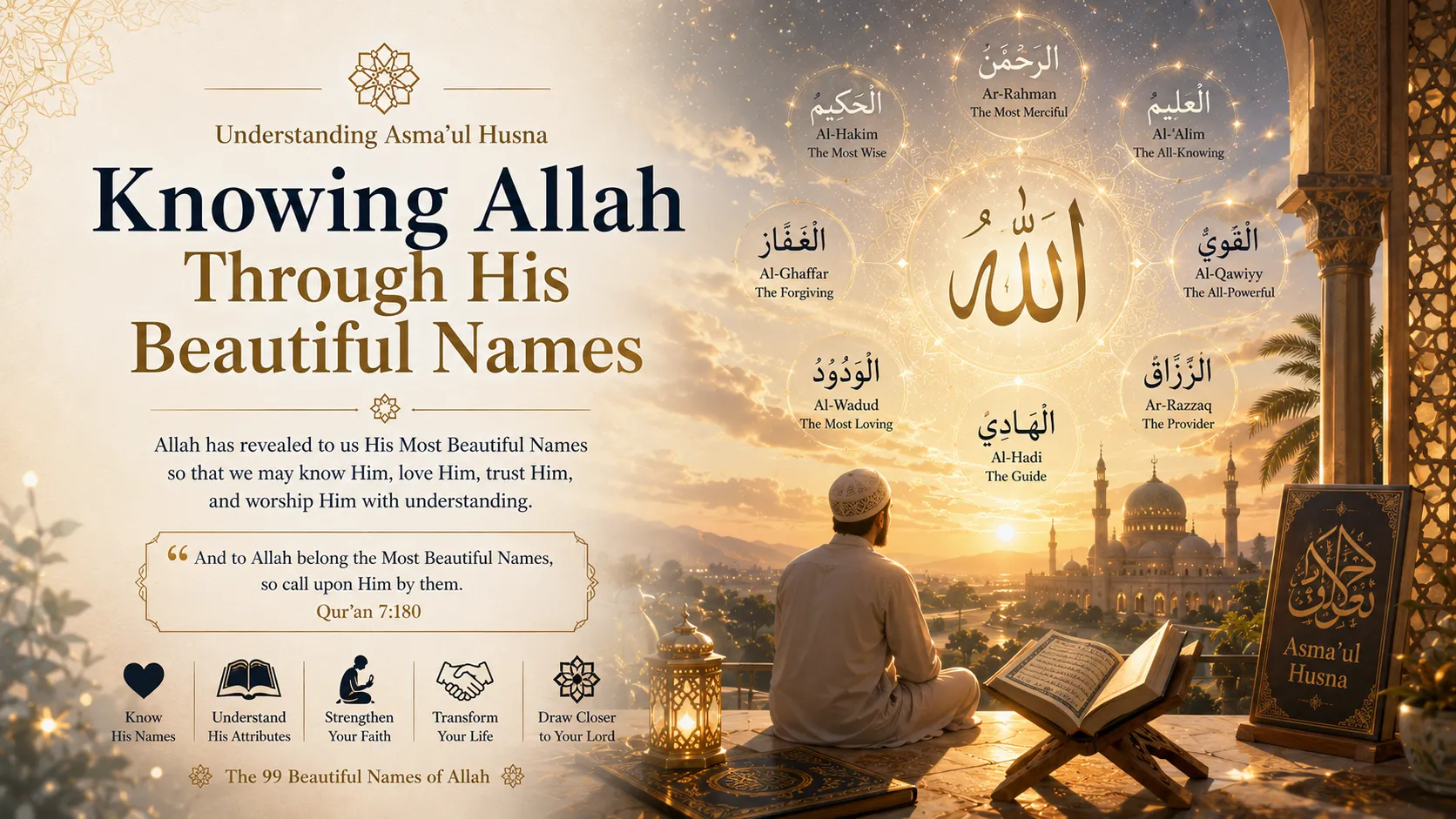

If someone were to ask, "How can we know Allah when we cannot see Him?" the answer lies in one of the greatest gifts Allah has given humanity: His Names and Attributes.
Allah has not left us to speculate about who He is. Out of His mercy, He has introduced Himself to us through His revelation. Throughout the Quran, Allah repeatedly calls our attention to His beautiful names and perfect qualities so that we may know Him, love Him, trust Him, and worship Him with understanding.
These names are known as Asma'ul Husna—the Most Beautiful Names.
Each name unveils a different aspect of Allah's perfection. Together, they paint a picture of a Lord whose greatness is beyond imagination, yet whose mercy is closer to us than we often realize.
The more deeply a person reflects on these names, the more their relationship with Allah transforms. Prayer becomes more meaningful. Trust becomes stronger. Gratitude becomes more natural. Even hardships begin to appear in a different light.
Allah says:
"And to Allah belong the Most Beautiful Names, so call upon Him by them."
(Quran 7:180)
This verse is not merely informing us that Allah has beautiful names. It is inviting us to build a relationship with Him through those names.
When you need mercy, you call upon Ar-Rahman (The Most Merciful).
When you seek forgiveness, you turn to Al-Ghaffar (The Constantly Forgiving).
When you feel weak and helpless, you remember Al-Qawiyy (The All-Powerful).
When life becomes confusing and uncertain, you place your trust in Al-Hakim (The Most Wise).
Every name opens a door to knowing Allah more intimately.
A Glimpse Into His Perfection
Among Allah's beautiful names are:
Ar-Rahman (The Most Merciful)
Allah's mercy encompasses all creation. Every blessing we enjoy—our health, families, opportunities, sustenance, and countless gifts we often overlook—is a manifestation of His mercy. Even those who deny Him continue to receive His provisions, demonstrating the vastness of His compassion.
Al-Khaliq (The Creator)
Everything we see, from the smallest particle to the largest galaxy, exists because Allah brought it into existence. He creates without effort, without assistance, and without limitation. Every sign in creation points back to the One who designed it with perfect wisdom.
Allah invites us to reflect:
"Do they not look at the camels, how they were created?"
(Quran 88:17)
The Quran constantly encourages observation and reflection because every aspect of creation carries signs of its Creator.
Al-'Alim (The All-Knowing)
Human knowledge is remarkably limited. Despite centuries of scientific discovery, we continue to uncover how little we truly know about ourselves, our world, and the universe.
Allah's knowledge, however, has no boundaries.
He knows what has happened.
He knows what is happening now.
He knows what will happen.
He knows what could have happened under different circumstances.
He knows what is hidden in every heart.
Nothing escapes His knowledge.
More Than Names—A Path to Transformation
The Names of Allah are not merely concepts to memorize or lists to recite.
They are invitations to reflection.
Every name teaches us something about Allah, but it also teaches us something about ourselves.
When we understand that Allah is Ar-Razzaq (The Provider), anxiety about sustenance begins to soften.
When we understand that Allah is Al-Hakim (The Most Wise), we learn patience during difficult times.
When we understand that Allah is As-Sami' (The All-Hearing), we realize that no prayer goes unheard.
When we understand that Allah is Al-Wadud (The Most Loving), we begin to appreciate the depth of His care for His servants.
The Names of Allah transform faith from a set of beliefs into a living relationship with the Creator.
Can We Embody Allah's Attributes?
At this point, an important question naturally arises:
If Allah possesses these attributes, are we meant to embody them as well?
The answer requires careful understanding.
Certain attributes belong exclusively to Allah and can never be shared by any created being.
Only Allah is:
- Al-Ahad (The One)
- Al-Awwal (The First)
- Al-Akhir (The Last)
- As-Samad (The Self-Sufficient)
- Al-Mubdi' (The Originator of creation)
These are among the attributes that belong exclusively to Allah and can never be shared by any created being.
However, Allah also possesses attributes whose reflections He loves to see in His servants.
Allah is Merciful, and He encourages us to show mercy.
Allah is Forgiving, and He encourages us to forgive.
Allah is Just, and He commands us to uphold justice.
Allah is Generous, and He encourages generosity.
Of course, there is an immeasurable difference between Allah's perfection and our limited efforts. His mercy is infinite; ours is limited. His justice is flawless; ours is imperfect. His generosity knows no bounds; ours is constrained by our human limitations.
Yet striving to embody these qualities brings us closer to Him.
It refines our character.
It improves our relationships.
And it transforms our hearts.
The Perfect Human Example
The greatest example of this transformation is Prophet Muhammad ﷺ.
No human being understood Allah better.
No human being loved Allah more deeply.
And no human being reflected Allah's beloved qualities more completely.
His life was a living demonstration of mercy, patience, humility, honesty, forgiveness, courage, and justice.
For this reason, Allah says:
"Indeed, in the Messenger of Allah you have an excellent example for whoever hopes in Allah and the Last Day and remembers Allah often."
(Quran 33:21)
And Allah further honored him by saying:
"And indeed, you are of a tremendous character."
(Quran 68:4)
The Prophet ﷺ did not merely teach people about Allah's attributes. He showed humanity what those attributes look like when reflected in the life of a devoted servant.
His mercy touched enemies before friends.
His forgiveness embraced those who wronged him.
His patience remained firm through hardship.
His humility increased despite his greatness.
His character became the living proof of what happens when a heart becomes deeply connected to Allah.
As you read the 99 Beautiful Names that follow, do not rush through them.
Pause.
Reflect.
Ask yourself:
What does this name teach me about Allah?
How has this attribute already manifested in my life?
What kind of servant would Allah want me to become in light of this name?
The journey of knowing Allah does not end with learning His names.
In many ways, that is where the journey truly begins.
Comments (0)
Join the conversation! Please log in to share your thoughts.
Log In to CommentNo comments yet. Be the first to share your thoughts!