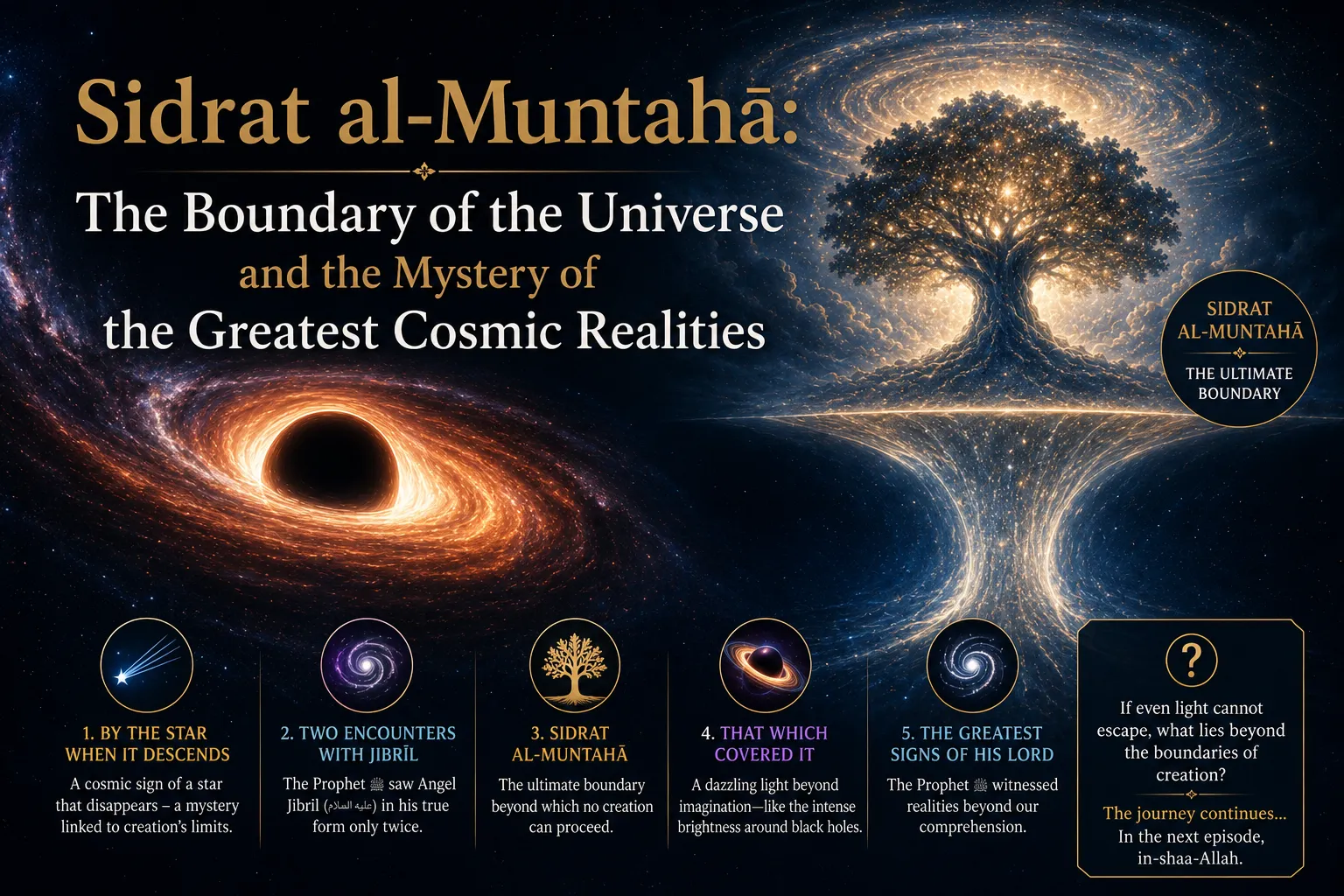

What is the connection between black holes, Angel Jibrīl (عليه السلام), and Prophet Muhammad ﷺ?
Why does Allah mention one of the greatest signs of the universe in Surah An-Najm and connect it with the Prophet’s ﷺ second encounter with Jibrīl (عليه السلام)?
To understand this, we must reflect deeply on the verses of Surah An-Najm.
We know that Prophet Muhammad ﷺ saw Angel Jibrīl (عليه السلام) in his original form only twice.
The first encounter occurred on Earth, before the revelation of the Qur’an began.
The second occurred during the event of Mi‘rāj, the miraculous ascension.
Both of these encounters are mentioned in Surah An-Najm.
What is remarkable is how this Surah begins.
Allah says:
“By the star when it descends.”
(Qur’an 53:1)
This is the same mystery we explored in the previous episodes.
When a massive star reaches the end of its life, its core can collapse, and from that collapse a black hole may form.
A hidden cosmic object — a star that has disappeared from ordinary observation.
And surprisingly, Surah An-Najm begins with an oath connected to the falling of a star.
Then the Surah discusses the first encounter of the Prophet ﷺ with Jibrīl (عليه السلام).
Later, from verse 13 onward, it begins describing the second encounter.
Allah says:
“And he certainly saw him another time, near Sidrat al-Muntahā.”
(Qur’an 53:13–14)
Then Allah says:
“Near it is the Garden of Refuge.”
(Qur’an 53:15)
And then:
“When there covered the Lote Tree that which covered it.”
(Qur’an 53:16)
The next verse says:
“The sight of the Prophet did not turn away, nor did it transgress.”
(Qur’an 53:17)
And finally:
“He certainly saw some of the greatest signs of his Lord.”
(Qur’an 53:18)
But what is Sidrat al-Muntahā?
What does it mean?
What is the reality behind this boundary?
Let us reflect step by step.
The word Sidrah refers to the lote tree.
A tree has a distinctive shape:
It spreads outward at the top and narrows downward.
Interestingly, when we visualize a black hole, we often see a similar funnel-like structure in scientific representations — a deep gravitational curve in spacetime.
Then comes the word:
Al-Muntahā
Meaning: the ultimate limit, the final boundary.
If it is called the final boundary, this suggests there were stages before it.
The Prophet ﷺ travelled through the heavens during Mi‘rāj — one heaven after another — until reaching Sidrat al-Muntahā.
A boundary beyond which no one proceeds.
There is another remarkable point.
According to authentic narrations, when Angel Jibrīl (عليه السلام) reached Sidrat al-Muntahā, he stopped.
He said that he could not go beyond that point.
This raises a profound question.
Why could an angel of such greatness not proceed further?
One possible way to reflect on this is through the concept of extreme cosmic limits.
As we discussed earlier, a black hole represents a region where gravity becomes extraordinarily powerful.
Its gravitational influence can be so extreme that even light cannot escape.
If Sidrat al-Muntahā represents a reality beyond ordinary creation, then it signifies a boundary unlike anything we experience in the physical universe.
But is there a connection between this and modern ideas about cosmic pathways?
Some physicists have discussed theoretical possibilities such as wormholes — hypothetical bridges through spacetime.
The famous physicist Stephen Hawking explored ideas related to black holes and the structure of the universe, including questions about whether black holes could be connected to deeper realities of spacetime.
These ideas remain part of theoretical physics and are not established pathways for travel, but they show how deeply mysterious black holes remain.
Another fascinating description in Surah An-Najm is:
“When there covered the Lote Tree that which covered it.”
What was that covering?
Modern astronomy tells us that around extremely massive black holes there can be intensely bright regions called accretion disks — glowing material heated to enormous temperatures as it spirals around the black hole.
Some of the brightest objects in the universe, known as quasars, are powered by supermassive black holes consuming surrounding matter.
A single quasar can shine brighter than entire galaxies.
The intensity of this cosmic brightness is beyond ordinary imagination.
Perhaps this helps us appreciate the verse:
“The sight did not turn away, nor did it transgress.”
A human being would be overwhelmed by such a sight, yet the Prophet ﷺ remained steady.
Another fascinating scientific discussion concerns the size and nature of our universe.
For many years, scientists explored the possibility of multiple universes.
Stephen Hawking’s later work also examined questions about the nature and limits of the multiverse.
The reality of the universe remains one of the greatest mysteries of modern science.
And the Qur’an invites humanity to reflect on these mysteries.
But one final question remains:
If a black hole is a place where ordinary matter cannot pass through…
If neither light, energy, nor physical objects can escape it…
Then what kind of journey could pass beyond the boundaries of creation?
Could any human being ever cross such limits?
What realities exist beyond what we can perceive?
These questions lead us to another profound chapter.
We will explore them in the next episode in-shaa-Allah
Comments (0)
Join the conversation! Please log in to share your thoughts.
Log In to CommentNo comments yet. Be the first to share your thoughts!