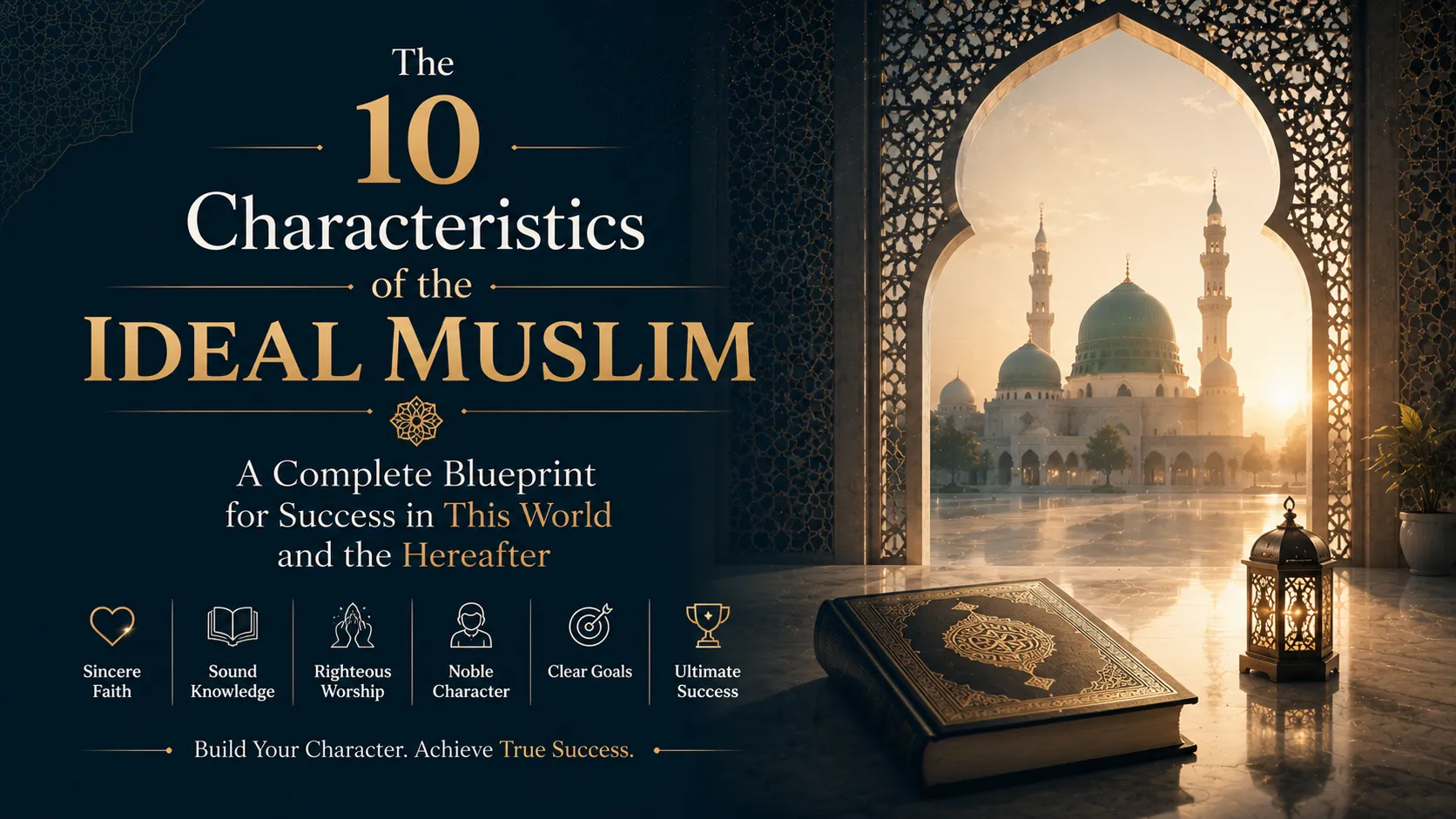

Islam's Holistic Framework for Building a Balanced Life
Why do some people possess knowledge yet lack discipline?
Why do others enjoy wealth but never experience inner peace?
Why do some pray regularly, yet still feel spiritually empty?
These questions point to a reality that many of us experience but rarely recognize.
Often, the problem is not a lack of effort. Nor is it necessarily a lack of good intentions.
The real problem is that we try to build our lives one piece at a time instead of following a complete system. We improve one area while neglecting another. We chase worldly success and find our spirituality fading. We devote ourselves entirely to spiritual pursuits while ignoring the responsibilities of worldly life. The result is imbalance, frustration, and a lingering sense that something is missing.
Islam, however, never teaches a fragmented way of living.
It presents a comprehensive way of life—one that nurtures the body, refines the character, enlightens the mind, strengthens faith, develops discipline, and inspires service to humanity.
Among those who beautifully summarized this balanced vision was Hassan al-Banna. He described the qualities that every Muslim should strive to develop into a remarkably concise yet comprehensive framework.
Far more than a list of virtues, these ten characteristics form a blueprint for personal transformation and lasting success—both in this life and in the Hereafter.
1. A Strong Body
The first characteristic may surprise many people.
Before speaking about worship, knowledge, or leadership, Imam Hasan al-Banna began with physical strength.
This is because the body is the vehicle through which every act of worship, every responsibility, and every noble ambition is carried.
A weak body often leads to diminished energy, reduced focus, emotional instability, and difficulty in fulfilling religious obligations. Even acts of worship such as standing in prayer, fasting, seeking knowledge, serving one's family, or helping others require physical well-being.
The Prophet ﷺ reminded us that physical strength has value in the sight of Allah when used for righteousness:
"The strong believer is better and more beloved to Allah than the weak believer, though there is good in both."
(Ṣaḥīḥ Muslim)
Caring for one's health is therefore not an act of vanity but an act of gratitude and responsibility. Our bodies are an amānah—a trust entrusted to us by Allah.
2. Noble Character
Character reveals itself not when life is comfortable but when life becomes difficult.
Anyone can remain pleasant when circumstances are favorable.
The true measure of character appears during moments of disappointment, anger, hardship, or conflict.
How do we respond when we are criticized?
How do we behave when we are exhausted?
How do we treat people who cannot benefit us?
The Prophet Muhammad ﷺ declared:
"The best among you are those who have the best character."
(Ṣaḥīḥ al-Bukhārī)
A believer's manners should not fluctuate with changing circumstances. Good character is a sign of a heart that has been trained through faith and patience.
3. An Enlightened and Cultured Mind
Islam has never been a religion of blind imitation.
From its earliest revelation, it called humanity to observe, reflect, question, and understand.
Throughout the Qur'an, Allah repeatedly asks:
"Will you not reflect?"
"Will you not reason?"
"Will you not understand?"
Knowledge protects sincerity from becoming misguidance.
It helps us distinguish priorities, make sound decisions, solve real problems, and appreciate the signs of Allah in revelation and creation alike.
A Muslim should strive to remain intellectually curious throughout life, continually seeking beneficial knowledge that strengthens both faith and wisdom.
4. The Ability to Earn a Lawful Living
Financial responsibility is part of Islamic excellence.
Islam encourages believers to earn through lawful means so they can support themselves, care for their families, preserve their dignity, and contribute positively to society.
The goal is not the pursuit of wealth for its own sake.
Rather, it is freedom from unnecessary dependence upon others and the ability to fulfill one's obligations with integrity.
A believer who earns honestly transforms everyday work into an act of worship when it is done with sincere intention.
5. Sound Faith
Every structure depends upon its foundation.
For the Muslim, that foundation is ʿaqīdah—correct belief.
Faith shapes our understanding of life, our response to hardship, our purpose, and our ultimate destination.
When belief is firm, external circumstances lose the power to shake the heart completely.
Trials may still come, but despair no longer dominates.
Hope remains because trust in Allah remains.
6. Correct Worship
Faith must naturally express itself through worship.
Prayer, fasting, charity, remembrance, and every act of obedience strengthen the believer's relationship with Allah.
Yet worship is far more than performing rituals correctly.
True worship is presence.
It is humility.
It is sincerity.
Many people complete their prayers without allowing their hearts to participate.
The goal is not merely to perform worship but to experience it—to stand before Allah with awareness, gratitude, and complete dependence upon Him.
When worship becomes a living relationship rather than a routine obligation, the heart begins to find genuine peace.
7. Mastery Over One's Desires
Perhaps the greatest battle every human being faces is the battle within.
The ego constantly seeks comfort, recognition, pleasure, and immediate gratification.
Sometimes temptation appears openly.
At other times it hides behind seemingly noble intentions:
The desire for praise.
The need to win every argument.
Showing off good deeds.
Seeking admiration from others.
The believer does not eliminate natural desires.
Rather, those desires are disciplined and brought under the guidance of revelation.
Self-control is not achieved overnight.
It is cultivated throughout a lifetime.
8. Careful Management of Time
Life itself is measured in moments.
Every passing second is a portion of our existence that can never be recovered.
The early scholars often reminded themselves that a human being is nothing more than a collection of passing breaths.
Once a breath leaves, it never returns.
This realization transforms our relationship with time.
Time is not merely something we spend.
It is something from which life itself is made.
The believer therefore guards time carefully, avoiding unnecessary distractions while investing every day in deeds that carry lasting value.
9. Organization in Every Affair
A meaningful life requires more than good intentions.
It requires order.
Responsibilities multiply as life progresses—family, work, worship, learning, finances, community, and personal development.
Without planning, these responsibilities begin competing against one another.
Organization brings clarity.
Planning creates consistency.
Discipline transforms aspirations into achievements.
The most productive believers are rarely those with the most free time.
They are often those who use their time most wisely.
10. Being Beneficial to Others
The final characteristic beautifully completes the entire framework.
Knowledge has little value if it is never shared.
Wealth loses its purpose if it benefits no one.
Strength becomes dangerous if it is used to oppress rather than serve.
The Prophet ﷺ said:
"The most beloved people to Allah are those who are most beneficial to people."
(Reported by al-Ṭabarānī; authenticated by several scholars as ḥasan)
Every blessing Allah grants us carries with it an opportunity to benefit His creation.
A truly successful Muslim does not ask only,
"What have I achieved?"
He also asks,
"Whose life became better because Allah allowed me to be part of it?"
A Blueprint for a Complete Life
Taken individually, each of these qualities is valuable.
Taken together, they form one of the most balanced models of personal development found in Islamic thought.
A strong body without faith may produce arrogance.
Knowledge without character may produce pride.
Wealth without generosity may produce greed.
Worship without discipline may become inconsistent.
Discipline without compassion may become harshness.
Islam does not seek isolated excellence.
It seeks balanced excellence.
This holistic framework reminds us that true success is not measured by a single achievement but by the harmonious development of every dimension of the human being—physical, intellectual, spiritual, moral, emotional, and social.
The journey toward becoming the ideal Muslim is not completed in a day.
It is a lifelong process of refinement.
Every sincere step taken for the sake of Allah is a step toward becoming the person He created us to be.
May Allah grant us strong bodies, enlightened minds, noble character, sincere faith, beautiful worship, disciplined souls, productive lives, and hearts that remain beneficial to His creation.
Āmīn.
Comments (0)
Join the conversation! Please log in to share your thoughts.
Log In to CommentNo comments yet. Be the first to share your thoughts!