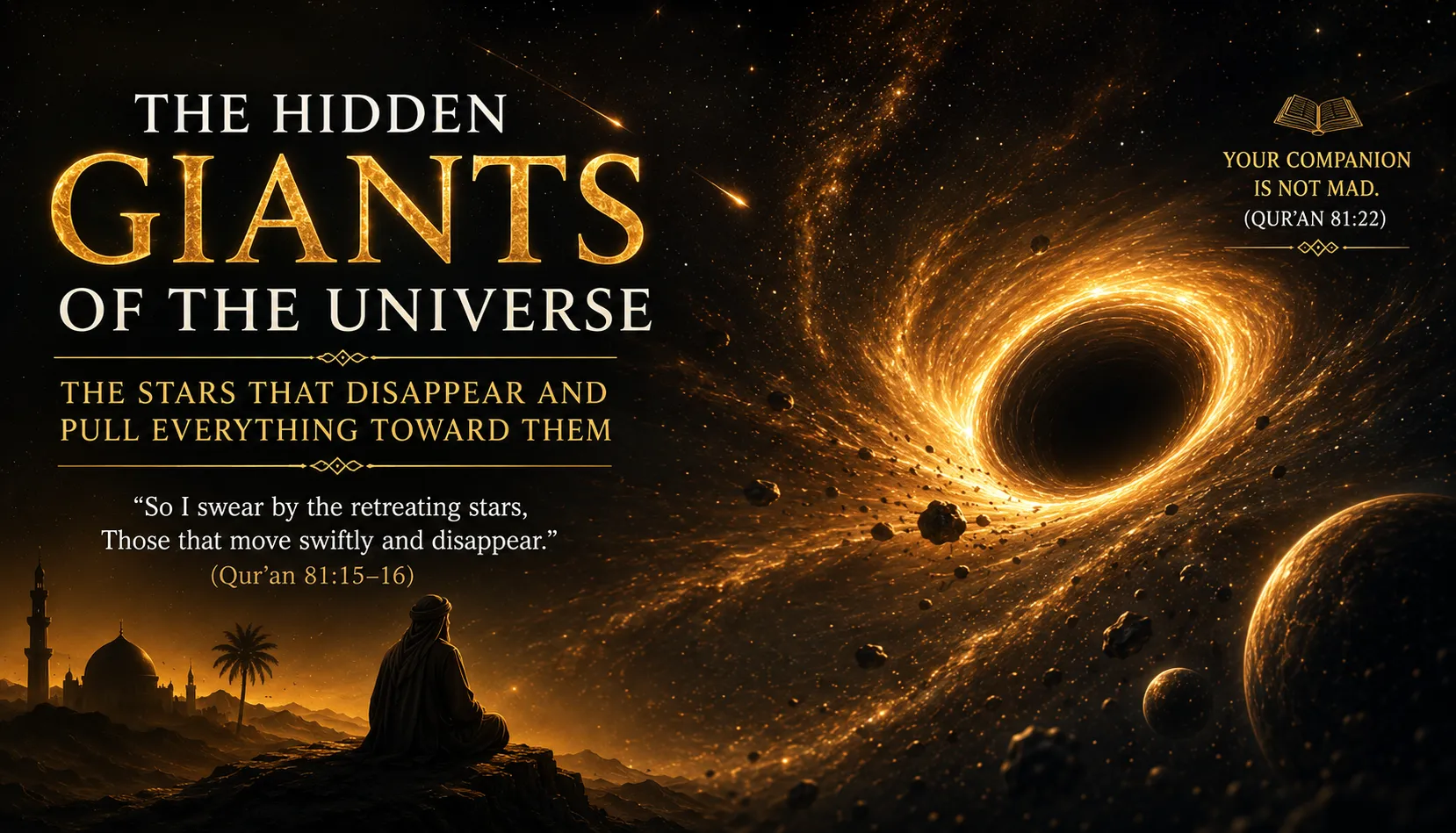

In Surah At-Takwir, the Qur’an describes the Day of Judgment — the ultimate end of the universe, the collapse of the cosmic order, and the transformation of the entire creation.
For fourteen consecutive verses, the Qur’an speaks about the events surrounding the end of the world.
Then, in the fifteenth and sixteenth verses, Allah takes an oath by something extraordinary:
“So I swear by the retreating stars,
Those that move swiftly and disappear.”
(Qur’an 81:15–16)
When I first heard this verse, a deep curiosity awakened within me.
What are these stars that move, retreat, and disappear?
Why did Allah choose to swear by them?
What is the hidden reality behind this description?
To understand this verse, we must carefully examine the Arabic words used.
Allah says:
فَلَا أُقْسِمُ بِالْخُنَّسِ الْجَوَارِ الْكُنَّسِ
The first word is “Al-Khunnas.”
Interestingly, the same root appears in Surah An-Nas, where Satan is described as “Al-Khannās” — the one who retreats, withdraws, and hides.
Then comes:
“Al-Jawār Al-Kunnas.”
The word “Jawār” refers to things that move or travel.
The word “Kunnas” carries the meaning of sweeping away, drawing in, or hiding.
It gives the image of something that moves, then withdraws and disappears, while pulling nearby things toward itself.
A fascinating description emerges:
A cosmic object that moves, hides from view, and draws everything in its surroundings toward itself.
If you remember the previous episode, we discussed how when a massive star reaches the end of its life, it collapses.
The outer layers of that star explode in a tremendous event called a supernova, scattering elements throughout space.
But the inner core can collapse further and form something even more mysterious:
A black hole.
A black hole is a place where gravity becomes so powerful that even light cannot escape.
Because it emits no light, it cannot be directly seen.
It is, in a sense, a hidden object — a star that has disappeared from ordinary sight.
And because its gravitational pull is unimaginably strong, anything that comes close enough is drawn toward it.
Like a cosmic vacuum, it gathers matter around itself.
This is why the description:
“Those that retreat and disappear, those that sweep and pull”
is so remarkable.
A black hole is a star that has withdrawn from visibility, yet continues to influence everything around it.
Modern astronomy tells us that black holes are among the most powerful objects in the universe.
Our universe contains billions of galaxies, and at the center of many galaxies lies a supermassive black hole.
Our own galaxy, the Milky Way, has a supermassive black hole at its center known as Sagittarius A*.
Its size is beyond ordinary imagination.
Our Sun is already so enormous that around 1.3 million Earths could fit inside it.
Yet Sagittarius A* is millions of times more massive than our Sun.
It is a giant hidden at the heart of our galaxy, controlling the motion of countless stars around it.
Scientists estimate that millions of black holes may exist throughout the universe, with supermassive black holes residing at the centers of many galaxies.
But what is the connection between black holes and the end of the universe?
That is something we will explore later in this journey.
After mentioning these hidden cosmic objects, the Qur’an then mentions the Angel Jibrīl (Gabriel, عليه السلام) and the Prophet Muhammad ﷺ:
“Your companion is not mad.”
(Qur’an 81:22)
Think about this.
Fourteen centuries ago, people were being told about stars that disappear, hide from observation, and pull everything around them toward themselves.
Even today, black holes remain among the greatest mysteries of modern astrophysics.
So how would people of that time react to such a description?
Many would consider it impossible.
That is why Allah reminds them:
“Your companion is not mad.”
The Prophet ﷺ was not speaking from imagination.
He was conveying knowledge revealed to him.
But this raises even deeper questions:
What is the connection between black holes, Angel Jibrīl عليه السلام, and Prophet Muhammad ﷺ?
Are black holes merely destructive objects, or do they have another role in the structure of the universe?
Could they be connected to realities beyond what we currently understand?
And if nothing — neither light, matter, nor energy — can escape a black hole, then what exactly is the meaning of the “path” or “destination” associated with such cosmic objects?
These questions open another door into the wonders of creation.
We will explore them in the next episode.
A‘ūdhu billāhi min ash-shayṭānir-rajīm
Bismillāhir-Raḥmānir-Raḥīm
In Surah At-Takwir, the Qur’an describes the Day of Judgment — the ultimate end of the universe, the collapse of the cosmic order, and the transformation of the entire creation.
For fourteen consecutive verses, the Qur’an speaks about the events surrounding the end of the world.
Then, in the fifteenth and sixteenth verses, Allah takes an oath by something extraordinary:
“So I swear by the retreating stars,
Those that move swiftly and disappear.”
(Qur’an 81:15–16)
When I first heard this verse, a deep curiosity awakened within me.
What are these stars that move, retreat, and disappear?
Why did Allah choose to swear by them?
What is the hidden reality behind this description?
To understand this verse, we must carefully examine the Arabic words used.
Allah says:
فَلَا أُقْسِمُ بِالْخُنَّسِ الْجَوَارِ الْكُنَّسِ
The first word is “Al-Khunnas.”
Interestingly, the same root appears in Surah An-Nas, where Satan is described as “Al-Khannās” — the one who retreats, withdraws, and hides.
Then comes:
“Al-Jawār Al-Kunnas.”
The word “Jawār” refers to things that move or travel.
The word “Kunnas” carries the meaning of sweeping away, drawing in, or hiding.
It gives the image of something that moves, then withdraws and disappears, while pulling nearby things toward itself.
A fascinating description emerges:
A cosmic object that moves, hides from view, and draws everything in its surroundings toward itself.
If you remember the previous episode, we discussed how when a massive star reaches the end of its life, it collapses.
The outer layers of that star explode in a tremendous event called a supernova, scattering elements throughout space.
But the inner core can collapse further and form something even more mysterious:
A black hole.
A black hole is a place where gravity becomes so powerful that even light cannot escape.
Because it emits no light, it cannot be directly seen.
It is, in a sense, a hidden object — a star that has disappeared from ordinary sight.
And because its gravitational pull is unimaginably strong, anything that comes close enough is drawn toward it.
Like a cosmic vacuum, it gathers matter around itself.
This is why the description:
“Those that retreat and disappear, those that sweep and pull”
is so remarkable.
A black hole is a star that has withdrawn from visibility, yet continues to influence everything around it.
Modern astronomy tells us that black holes are among the most powerful objects in the universe.
Our universe contains billions of galaxies, and at the center of many galaxies lies a supermassive black hole.
Our own galaxy, the Milky Way, has a supermassive black hole at its center known as Sagittarius A*.
Its size is beyond ordinary imagination.
Our Sun is already so enormous that around 1.3 million Earths could fit inside it.
Yet Sagittarius A* is millions of times more massive than our Sun.
It is a giant hidden at the heart of our galaxy, controlling the motion of countless stars around it.
Scientists estimate that millions of black holes may exist throughout the universe, with supermassive black holes residing at the centers of many galaxies.
But what is the connection between black holes and the end of the universe?
That is something we will explore later in this journey.
After mentioning these hidden cosmic objects, the Qur’an then mentions the Angel Jibrīl (Gabriel, عليه السلام) and the Prophet Muhammad ﷺ:
“Your companion is not mad.”
(Qur’an 81:22)
Think about this.
Fourteen centuries ago, people were being told about stars that disappear, hide from observation, and pull everything around them toward themselves.
Even today, black holes remain among the greatest mysteries of modern astrophysics.
So how would people of that time react to such a description?
Many would consider it impossible.
That is why Allah reminds them:
“Your companion is not mad.”
The Prophet ﷺ was not speaking from imagination.
He was conveying knowledge revealed to him.
But this raises even deeper questions:
What is the connection between black holes, Angel Jibrīl عليه السلام, and Prophet Muhammad ﷺ?
Are black holes merely destructive objects, or do they have another role in the structure of the universe?
Could they be connected to realities beyond what we currently understand?
And if nothing — neither light, matter, nor energy — can escape a black hole, then what exactly is the meaning of the “path” or “destination” associated with such cosmic objects?
These questions open another door into the wonders of creation.
We will explore them in the next episode in-sha-Allah.
Comments (0)
Join the conversation! Please log in to share your thoughts.
Log In to CommentNo comments yet. Be the first to share your thoughts!