
Perhaps our generation is the first generation in human history that possesses the scientific knowledge and understanding through which we can begin to appreciate some of the profound signs mentioned in the Qur’an — realities that may have remained beyond human understanding for centuries.
And this itself is a blessing from Allah.
Allah says:
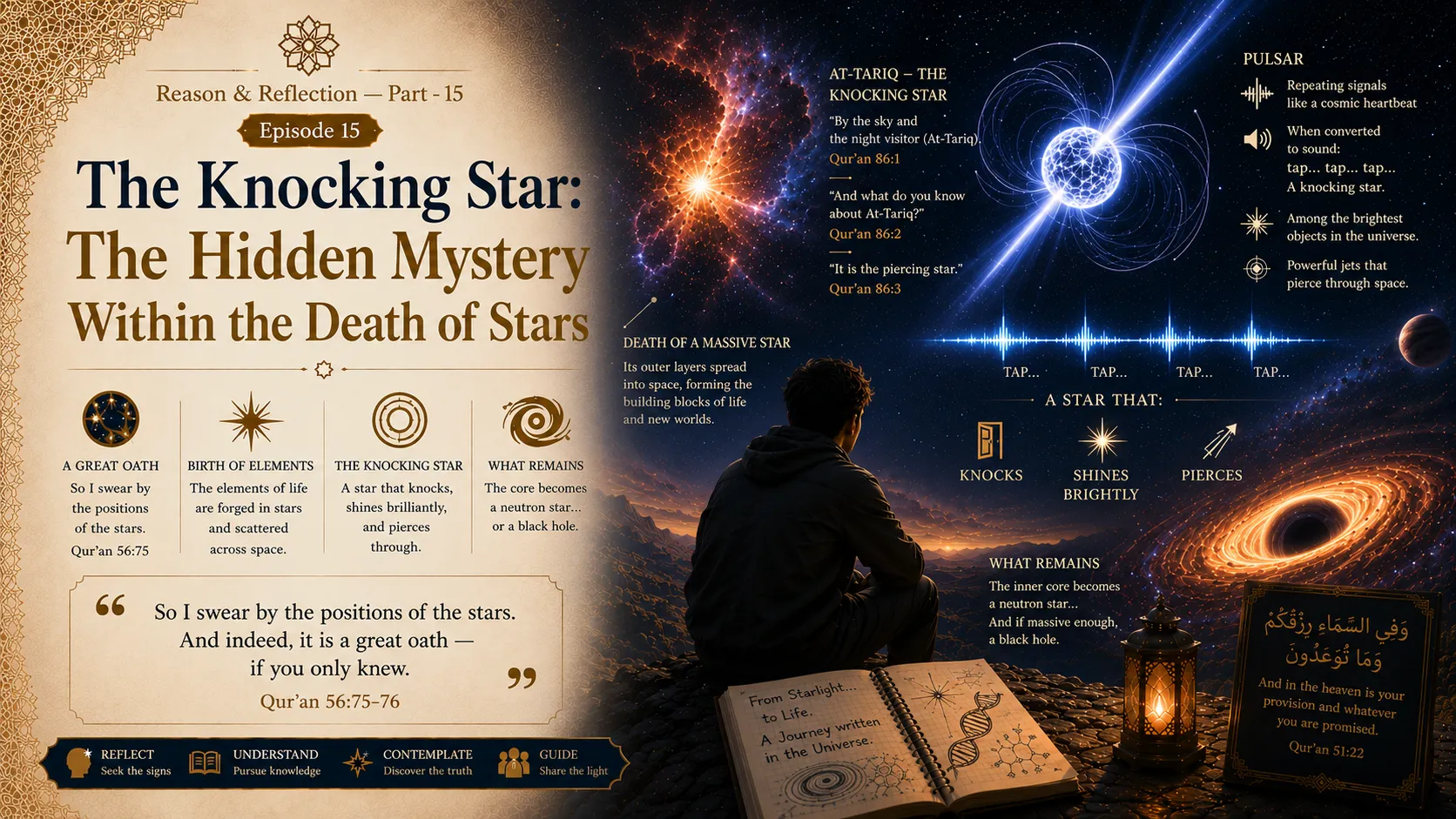
“So I swear by the positions of the stars…”
(Surah Al-Waqi‘ah 56:75)
And we discovered that when a massive star reaches the end of its life, its outer layers can become the very material from which we — and everything around us — are formed.
But what happened to the inner core of that dying star?
If Allah has called something a great oath, then surely there must be another hidden reality within it.
Let us explore it.
Allah takes another remarkable oath in the Qur’an, in Surah At-Tariq:
“By the sky and the night visitor (At-Tariq).”
(Surah At-Tariq 86:1)
But what is At-Tariq?
The Qur’an itself asks:
“And what do you know about At-Tariq?”
(Surah At-Tariq 86:2)
As I mentioned in the previous episode, during my journey of Hajj I carried several questions with me. I wanted to understand certain Arabic words by asking native Arabic speakers who could explain their meanings simply and naturally.
One of these words was Tariq.
When I met a young Arabic speaker named Oday, I asked him about its meaning.
Since his English was limited, he tried to explain it through gestures. Then, using a translator, he wrote its meaning.
I understood:
Tariq means something that knocks — something that comes with a striking sound, like a visitor knocking on a door.
But this raised another question:
Why would Allah swear by something that knocks?
Why did Allah first mention it and then ask:
“And what do you know about At-Tariq?”
Then comes the answer:
“It is the piercing star.”
(Surah At-Tariq 86:3)
Now we need to understand the word “Thaqib.”
In Arabic, Thaqib carries meanings such as:
- intensely bright,
- shining,
- something that pierces through.
Now the description becomes fascinating.
Allah is referring to:
A star that knocks.
A star that shines brilliantly.
A star that pierces.
For a long time, these descriptions remained a mystery.
But modern astronomy has revealed an astonishing discovery:
Pulsars.
Scientists discovered that some stars produce repeating signals — rhythmic pulses that can be detected from space.
Because space itself has no sound, scientists developed a method called sonification, converting these signals into sound.
And when the signals from pulsars are converted, they resemble a repeated knocking rhythm:
tap… tap… tap…
A cosmic heartbeat.
This is why these objects were named pulsars — because of their pulsing nature.
The first description begins to appear:
A knocking star.
But there is more.
Pulsars are among the brightest objects in the universe.
A pulsar can release enormous amounts of energy, far beyond what ordinary stars produce.
A star that shines with extraordinary brilliance.
The second description becomes clear.
But what about the third?
A piercing star.
To understand this, we must understand what a pulsar actually is.
A pulsar is a type of neutron star.
Neutron stars are among the densest objects known in the universe.
Their density is almost unimaginable.
A tiny amount of neutron star material would weigh an extraordinary amount compared to anything we experience on Earth.
Now remember what we discussed earlier about Einstein’s explanation of gravity.
According to the theory of relativity, space-time is like a fabric.
When a massive object is placed on this fabric, it bends it.
That bending creates what we experience as gravity.
The greater the mass, the deeper the curve.
Earth creates a small curve.
The Sun creates a much larger curve.
But a neutron star is incredibly dense, creating an extreme distortion in space-time.
Over time, these objects can become even more mysterious.
Their immense gravity can become so powerful that they affect space-time in extraordinary ways.
And in the most extreme cases, the result can become:
a black hole.
Now remember the journey we began in the previous episode.
A massive star dies.
Its outer layers spread through space.
From those remains, new worlds and life’s building blocks emerge.
But the inner core transforms into something else.
A neutron star.
And if the original star is massive enough:
A black hole.
So the question remains:
What exactly is a black hole?
If Allah has called the secrets of the stars a great sign, then what mysteries are hidden inside these cosmic objects?
Could the Qur’an have pointed toward them somewhere else?
This is what we will explore in the next episode in-sha-Allah.
Comments (0)
Join the conversation! Please log in to share your thoughts.
Log In to CommentNo comments yet. Be the first to share your thoughts!