
Nearly four centuries before the birth of Prophet Jesus (peace be upon him), an extraordinary scene unfolded in the Greek city of Athens.
A man named Socrates, often called the Father of Philosophy, was sentenced to death.
His crime was not theft.
It was not violence.
It was not rebellion.
His crime was teaching people—especially the youth—to think.
He encouraged them to question assumptions, challenge inherited beliefs, and search for truth through reflection.
According to tradition, Socrates would say:
Truth is not merely what others have taught you.
Truth is what you discover through sincere inquiry.
When the verdict was announced, his friends urged him to save himself.
“Apologize,” they said.
“Compromise.”
“Submit.”
But Socrates refused.
With remarkable calm, he is reported to have said:
I may die, but truth will remain alive.
For truth is that which can withstand questioning.
Then he drank the cup of poison and entered history.
His body perished.
His commitment to truth did not.
Truth Never Fears Questions
Those who stand upon truth do not fear questions.
They do not silence inquiry.
They encourage it.
They invite reflection.
They welcome examination.
And remarkably, this is also the method of the Qur'an.
Again and again, the Qur'an asks:
“Will you not reflect?”
“Will you not reason?”
“Will you not contemplate?”
In the previous part of this series, we explored how the Qur'an repeatedly emphasizes the importance of intellect.
It teaches that those who refuse to use their reason fall into the gravest error.
It describes wisdom as one of Allah’s greatest gifts.
And it informs us that among the reasons people regret their fate in the Hereafter is that they neglected to think, reflect, and understand.
But this leads to a crucial question:
If intellect is so important, where should it be directed?
What exactly does the Qur'an want us to think about?
The Invitation of the Universe
The great Pashtun poet and philosopher Ghani Khan expressed this beautifully.
He suggested that if human beings truly understood the secrets hidden within the heavens and the earth, they would no longer worship merely out of habit.
They would fall into prostration spontaneously, overwhelmed by awe and wonder.
A similar idea appears in the poetry of Allama Muhammad Iqbal.
In one of his most beautiful poems, Iqbal imagines the moment when the human soul first arrives upon the earth.
The earth welcomes humanity and says:
Open your eyes.
Look at the earth.
Look at the sky.
Look at the horizons.
Observe the sun rising from the east.
Witness the unveiled splendor hidden within creation.
The earth becomes a teacher.
It points humanity toward the signs scattered throughout existence.
The mountains.
The oceans.
The winds.
The clouds.
The stars.
The galaxies.
The vast order of the universe.
And it asks:
Do you think all of this exists without meaning?
Do you imagine there is no wisdom behind it?
What Does the Qur'an Ask Us to Reflect Upon?
The Qur'an does not merely command us to think.
It directs our attention toward specific realities worthy of contemplation.
Among the most beautiful passages in the Qur'an is the following verse:
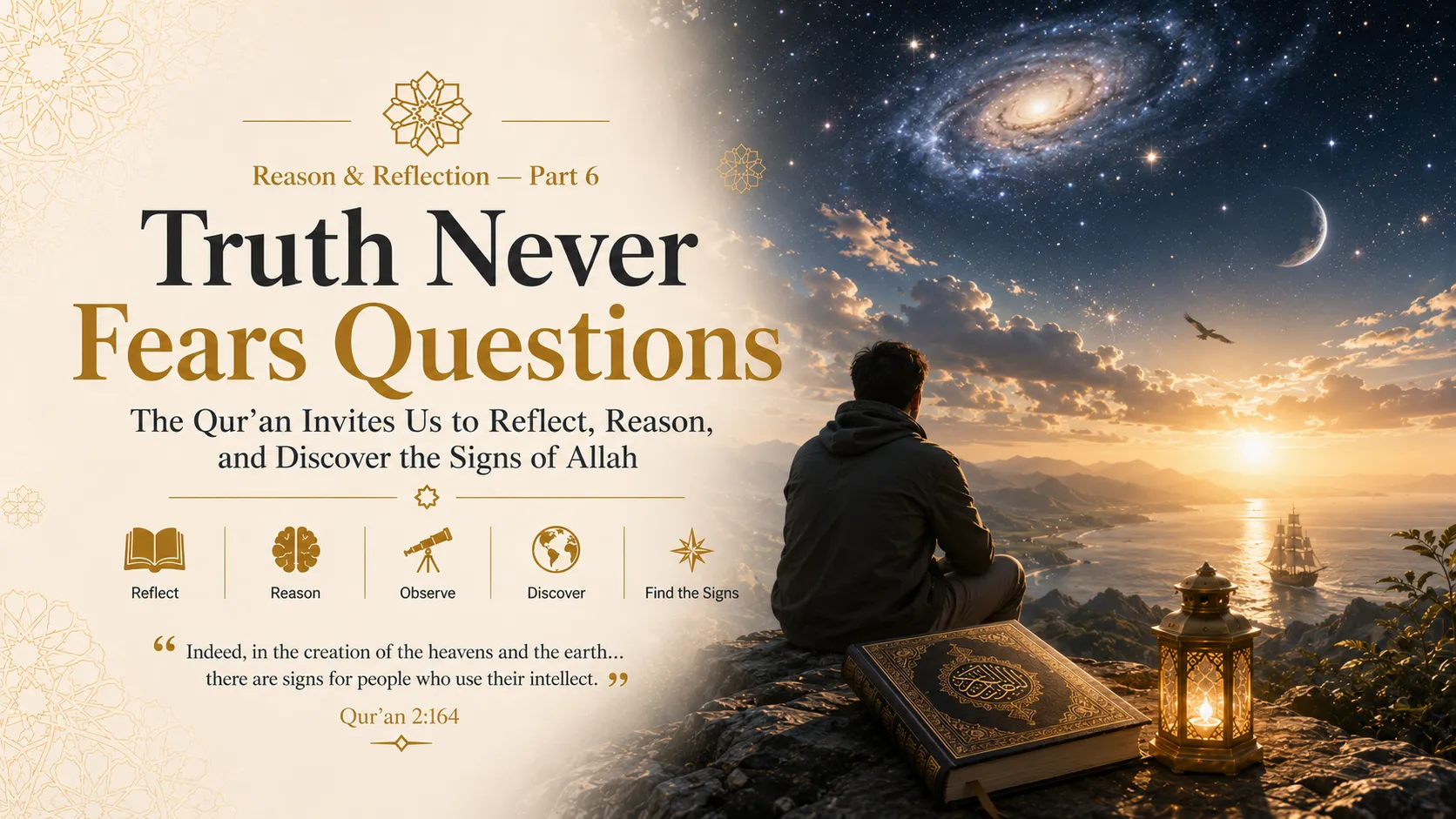
“Indeed, in the creation of the heavens and the earth, in the alternation of night and day, in the ships that sail through the sea carrying that which benefits people, in the water that Allah sends down from the sky thereby reviving the earth after its death, in the creatures He has dispersed throughout it, in the changing of the winds, and in the clouds controlled between the sky and the earth—there are signs for people who use their intellect.”
(Qur'an 2:164)
Notice what the Qur'an is doing.
It is teaching humanity where to direct its curiosity.
Reflect upon creation.
Study the universe.
Observe nature.
Investigate the laws governing existence.
Examine the world around you.
Every one of these phenomena is presented as an ayah—a sign pointing beyond itself.
A sign toward its Creator.
These signs are not for everyone.
The Qur'an specifies who benefits from them:
“For people who use their intellect.”
For those who truly think.
For those who refuse to be intellectually blind despite possessing sight.
For those who refuse to be spiritually deaf despite possessing hearing.
Questions the Qur'an Wants Us to Ask
The Qur'an repeatedly trains the human mind through questions.
Consider the powerful questions posed in Surah Al-Ghashiyah:
“Do they not look at the camel—how it was created?
And at the sky—how it was raised high?
And at the mountains—how they were firmly set?
And at the earth—how it was spread out?”
(Qur'an 88:17–20)
These are not merely rhetorical questions.
They are invitations.
Invitations to investigate.
To wonder.
To study.
To seek understanding.
The Qur'an does not ask humanity to abandon reason in favor of faith.
Rather, it repeatedly calls people to use reason as a pathway toward faith.
It directs the human mind toward creation so that it may discover the Creator.
When Reflection Becomes Worship
There is a profound difference between worship performed out of habit and worship born from understanding.
Many people pray because they were taught to pray.
Many people perform acts of worship because they inherited those practices from their families.
But when a person begins to recognize the signs of Allah throughout creation, something changes.
Worship is no longer routine.
It becomes a response.
A response to beauty.
A response to order.
A response to wisdom.
A response to truth.
At that point, prostration is no longer an obligation reluctantly fulfilled.
It becomes the natural posture of a heart overwhelmed by wonder.
The Signs Are Everywhere
The Qur'an teaches that the universe is not silent.
Every star.
Every mountain.
Every ocean.
Every living creature.
Every law of nature.
Every breath we take.
All of them point toward a deeper reality.
The question is not whether the signs exist.
The question is whether we are willing to see them.
Whether we are willing to think.
Whether we are willing to reflect.
Whether we are willing to follow the evidence wherever it leads.
A Question for the Next Part
If the heavens and the earth contain signs of Allah, then an even deeper question emerges:
How did the universe itself come into existence?
Was it created?
If so, how does its creation point us toward its Creator?
Can modern scientific discoveries help us better understand the signs that the Qur'an invites us to contemplate?
These are the questions we will begin exploring in the next part of our journey.
Until then, reflect upon the world around you.
Observe carefully.
Think deeply.
And ask yourself:
Could a universe filled with such precision, beauty, and order truly be without purpose?
May the peace, mercy, and blessings of Allah be upon you.
Comments (0)
Join the conversation! Please log in to share your thoughts.
Log In to CommentNo comments yet. Be the first to share your thoughts!