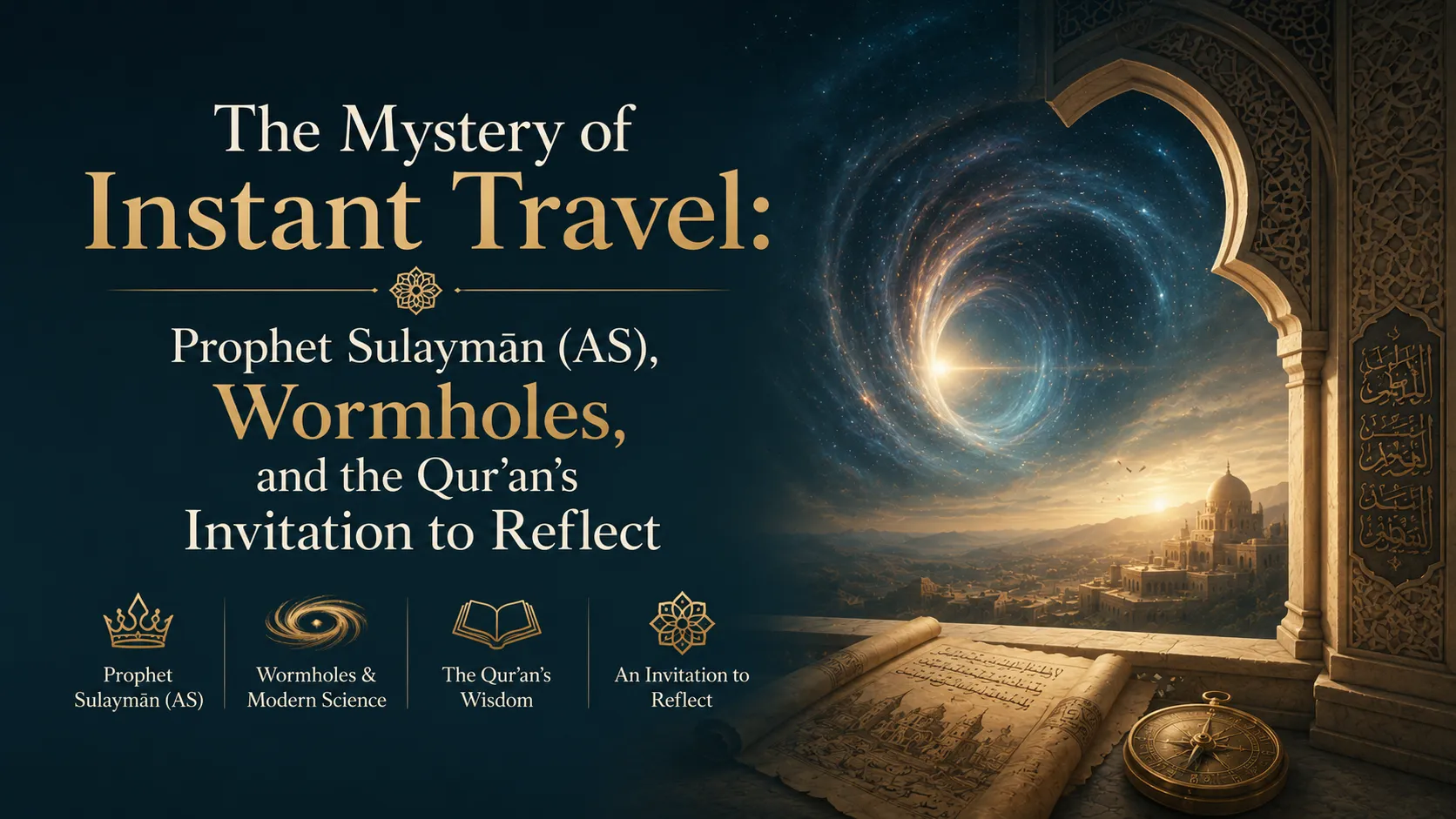

Can a journey of thousands of kilometers take place in the blink of an eye?
For centuries, such an idea would have been dismissed as impossible.
Yet the Qur'an narrates an extraordinary event that continues to inspire reflection among believers, scholars, and even those fascinated by the mysteries of the universe.
In Surah An-Naml, Allah describes an incident from the life of Prophet Sulaymān (Solomon) عليه السلام. After receiving news about the Queen of Sheba and her kingdom, Prophet Sulaymān asked those gathered in his royal court:
"Which of you will bring me her throne before they come to me in submission?"
(Qur'an 27:38)
This simple question was followed by one of the most remarkable events recorded in the Qur'an.
Two Extraordinary Responses
Allah had granted Prophet Sulaymān عليه السلام a unique kingdom unlike any other. Human beings, jinn, and birds were all under his command by Allah's permission.
Among those present, a powerful jinn responded first:
"I will bring it to you before you rise from your place."
(Qur'an 27:39)
Transporting a magnificent throne from the Kingdom of Sheba—located in present-day Yemen—to Palestine within a few hours was itself an astonishing claim.
But before anyone could fully appreciate this offer, another voice spoke.
The Qur'an says:
"The one who had knowledge from the Book said, 'I will bring it to you before your glance returns to you.'"
(Qur'an 27:40)
And before Prophet Sulaymān's gaze could return, the throne stood before him.
What had just happened?
The Qur'an deliberately leaves the mechanism unexplained.
Instead, it shifts our attention from how it happened to Who made it possible.
Prophet Sulaymān immediately declared:
"This is by the grace of my Lord, to test me whether I will be grateful or ungrateful."
(Qur'an 27:40)
The miracle pointed toward Allah—not merely toward an extraordinary phenomenon.
Who Was the Man with Knowledge from the Book?
The Qur'an does not identify this individual by name.
Many classical exegetes mention him as Āṣif ibn Barkhiyā, a righteous servant and trusted advisor of Prophet Sulaymān عليه السلام, although the Qur'an itself simply describes him as:
"One who had knowledge from the Book."
This description is significant.
His distinction was not physical strength.
It was not political authority.
It was knowledge.
The Qur'an repeatedly elevates knowledge as one of the greatest gifts bestowed upon humanity.
Yet the precise nature of the knowledge possessed by this man remains part of the unseen.
The Qur'an does not explain the mechanism, and therefore any attempt to describe exactly how the throne was transported remains a matter of interpretation rather than established fact.
Could Modern Physics Offer an Analogy?
Modern theoretical physics has introduced fascinating ideas about the structure of space and time.
According to Albert Einstein's General Theory of Relativity, space and time together form a four-dimensional continuum commonly called space-time.
Rather than being an empty stage upon which the universe exists, space-time itself can bend, curve, and be distorted by gravity.
Building upon Einstein's equations, Einstein and Nathan Rosen proposed in 1935 a theoretical concept now known as the Einstein–Rosen bridge.
Today, this idea is commonly referred to as a wormhole.
A useful analogy is to imagine a sheet of paper.
Suppose two distant points are drawn on it.
Traveling across the surface from one point to the other takes time.
But if the paper is folded so that the two points touch, the distance between them effectively disappears.
A tunnel connecting those points would represent the idea of a wormhole—a hypothetical shortcut through space-time.
According to theoretical physics, if traversable wormholes were ever possible, they could dramatically shorten journeys across vast cosmic distances.
However, it is important to note that wormholes remain theoretical constructs. No traversable wormhole has ever been observed or experimentally demonstrated.
A Reflection—Not a Scientific Claim
This naturally raises an intriguing question.
Could the extraordinary transportation of the throne described in Surah An-Naml have occurred through a reality that resembles, in some way, what modern physics imagines as shortcuts through space-time?
The Qur'an does not say this.
Classical tafsīr does not describe it in these terms.
Therefore, such a comparison should be understood only as a reflection, not as an explanation.
The unseen realities through which Allah performs extraordinary events are far beyond the limits of current scientific knowledge.
Science explores the laws that normally govern creation.
Miracles occur by the permission and power of the Creator of those laws.
The Night Journey and the Pathways of Ascent
These reflections also invite us to think about another remarkable event in Islamic history:
The Night Journey and Ascension (Al-Isrāʾ wal-Miʿrāj) of Prophet Muhammad ﷺ.
The Qur'an tells us that Allah took His Messenger ﷺ on an extraordinary journey in a single night.
Likewise, Surah Al-Maʿārij speaks of "the pathways of ascent" through which the angels and the Spirit ascend by Allah's command.
Some contemporary writers have wondered whether modern concepts such as wormholes might provide analogies for understanding these descriptions.
Such ideas are intellectually stimulating, but they remain speculative.
The Qur'an itself does not identify Al-Maʿārij with any physical structure known to science.
Their true nature belongs to the unseen, and Allah alone possesses complete knowledge of them.
The Greater Lesson
Perhaps the greatest lesson in this passage is not about wormholes or theoretical physics.
It is about knowledge.
Notice whom Allah chose to highlight in this remarkable event.
Not the strongest jinn.
Not the most powerful warrior.
But a servant described only by one quality:
"He had knowledge from the Book."
Knowledge transformed an ordinary human being into someone through whom Allah manifested an extraordinary event.
This should inspire every believer.
The Qur'an repeatedly calls humanity to observe, reflect, reason, and seek understanding.
Modern scientists devote their lives to uncovering the mysteries of the universe through observation and experimentation.
Many remarkable discoveries have emerged from that pursuit.
As Muslims, we possess something equally precious: revealed knowledge.
But possessing revelation is not enough if we neglect to reflect upon it.
The ideal believer combines both:
A heart illuminated by revelation.
A mind engaged in thoughtful inquiry.
When revealed knowledge and sincere intellectual exploration come together, they deepen—not diminish—our appreciation of the Creator.
A Final Reflection
The Qur'an is not a textbook of physics.
Nor is physics a substitute for revelation.
Each has its own purpose.
Science seeks to understand how the universe works.
The Qur'an teaches us why the universe exists and guides us toward the One who created it.
Sometimes, modern discoveries invite us to look again at verses we have read countless times.
They remind us that the universe still holds mysteries beyond our imagination.
Perhaps that is precisely what the Qur'an intends.
Not to satisfy every curiosity.
But to awaken it.
Because every sincere question, when pursued with humility, ultimately leads the believer closer to the One whose knowledge encompasses all things.
"And above every possessor of knowledge is One more knowing." (Qur'an 12:76)
Comments (0)
Join the conversation! Please log in to share your thoughts.
Log In to CommentNo comments yet. Be the first to share your thoughts!