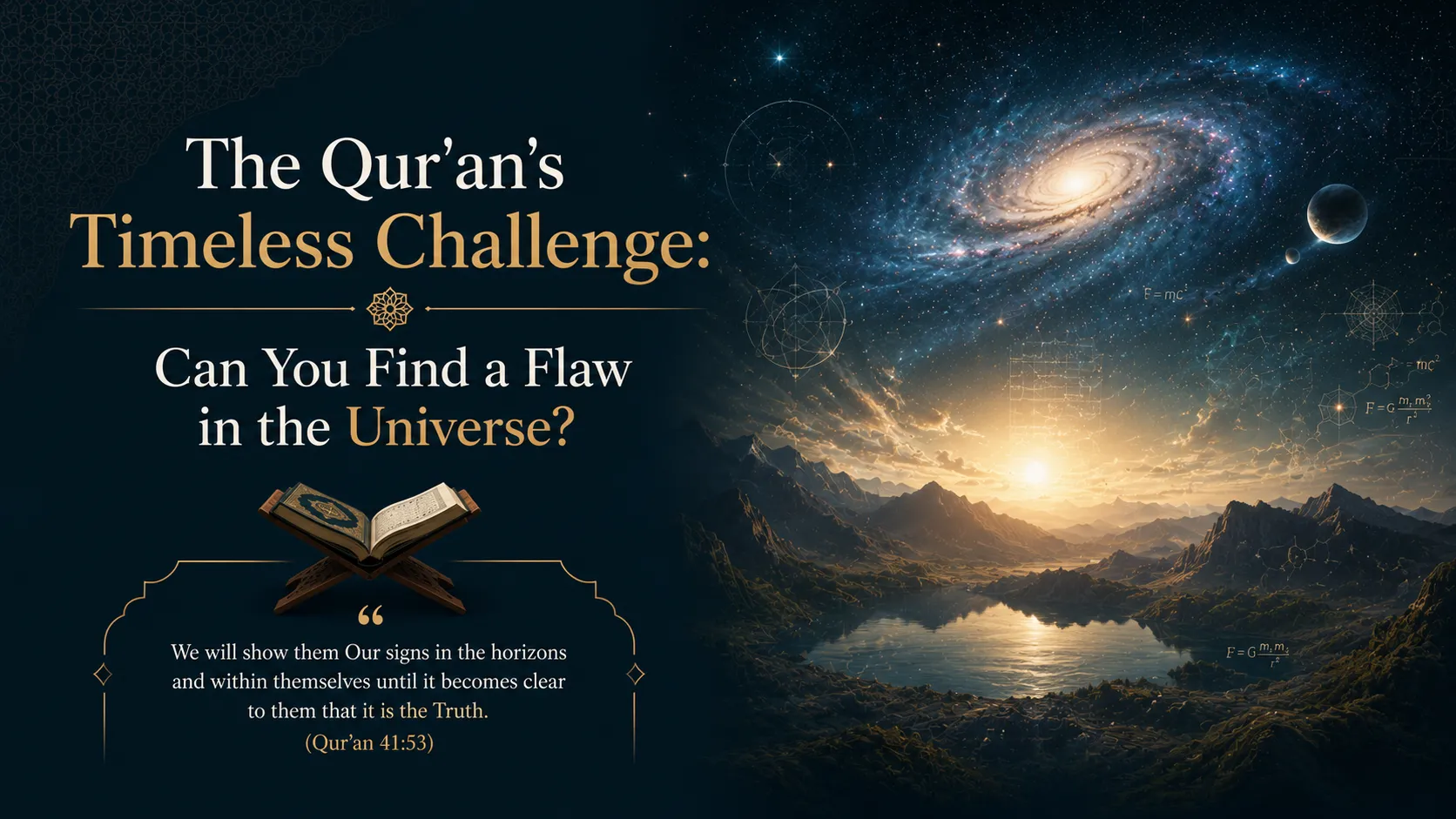

A Journey of Reflection — The Fine-Tuning of Creation
More than fourteen centuries ago, the Qur'an presented humanity with a series of remarkable intellectual challenges—challenges that remain open to every generation until the end of time.
These are not challenges of language alone.
Nor are they limited to a particular nation or era.
They are invitations to observe, to investigate, and to reflect upon the universe itself.
The first of these challenges begins with a simple yet profound question:
Can you find a flaw in Allah's creation?
The Remarkable Precision of the Universe
Modern science has revealed that our universe operates according to extraordinarily precise laws.
At the heart of these laws lie quantities known as fundamental physical constants.
A physical constant is a fixed numerical value that describes some of the most basic properties of nature. These values are regarded as universal—they do not appear to change from place to place or from one moment in cosmic history to another.
Among the best-known examples are:
- The speed of light
- The gravitational constant
- Planck constant
- The cosmological constant
- The mass of the electron
- The strengths of the fundamental forces of nature
Modern physics depends upon these constants.
Without them, the mathematical framework describing the universe would simply not work as we know it.
One of the most fascinating aspects of these constants is that, despite decades of increasingly precise measurements, scientists have found them to be extraordinarily stable.
Why these constants have the values they do remains one of the profound questions in fundamental physics.
A Universe Balanced with Extraordinary Precision
The laws governing the universe are not merely consistent—they are astonishingly precise.
Consider the strong nuclear force, one of the four fundamental forces of nature.
It is responsible for binding protons and neutrons together inside atomic nuclei.
If this force were only slightly weaker, stable atomic nuclei would not form, and the chemistry necessary for stars, planets, and life would never emerge.
If it were significantly stronger, the universe would evolve in dramatically different ways, with profound consequences for the formation of elements essential to life.
This remarkable balance is one example of what many physicists and philosophers refer to as the fine-tuning of the universe.
The same discussion extends to numerous other physical constants whose measured values appear to fall within ranges that allow a complex and life-permitting universe to exist.
Whether this fine-tuning points to necessity, chance, a multiverse, or intentional design remains one of the most significant debates in modern cosmology and the philosophy of science.
The Qur'an's Extraordinary Invitation
Long before modern physics began measuring the constants of nature, the Qur'an directed humanity to examine creation with careful observation.
Allah says:
"He is the One who created the seven heavens, one above another. You will not see any inconsistency in the creation of the Most Merciful. So look again: do you see any flaw? Then look again and yet again. Your sight will return to you humbled and weary, unable to find any defect."
(Surah Al-Mulk 67:3–4)
This is one of the Qur'an's most remarkable intellectual invitations.
Rather than asking people to abandon reason, it encourages them to use it.
Observe the universe.
Study it carefully.
Examine it repeatedly.
Search for inconsistencies.
The Qur'an does not discourage investigation.
It challenges it.
A Challenge That Grows Stronger with Scientific Discovery
For centuries, human beings have explored the heavens with increasingly sophisticated instruments.
From powerful telescopes to particle accelerators, from quantum experiments to deep-space observatories, science has examined the universe with extraordinary precision.
Again and again, researchers have measured the constants that govern nature.
They have searched for variations across enormous distances and vast spans of cosmic history.
Thus far, these constants appear remarkably stable within the limits of observational precision.
Every new discovery reveals additional layers of order and mathematical harmony woven into the fabric of the cosmos.
The more deeply science explores creation, the more astonishing that order appears.
A Question Worth Reflecting Upon
The fine-tuning of the universe has prompted serious discussion among scientists, philosophers, and theologians alike.
Some regard it as evidence of intentional design.
Others seek explanations through theories such as the multiverse or deeper physical principles that remain undiscovered.
Even outspoken critics of religion, including Christopher Hitchens, acknowledged that the apparent fine-tuning of the universe represents one of the most significant philosophical questions confronting naturalistic explanations, although he did not accept it as proof of God's existence.
The debate continues.
Yet one fact remains striking:
The universe exhibits an extraordinary degree of order, consistency, and mathematical precision.
The Qur'an's Challenge Remains
More than fourteen centuries ago, the Qur'an invited humanity to examine creation for itself.
That invitation remains as relevant today as it was when these verses were first revealed.
Every generation acquires better instruments.
More powerful telescopes.
More precise measurements.
More advanced theories.
Yet the challenge remains unchanged:
Look again.
Look carefully.
Look repeatedly.
Can you find a flaw?
The Qur'an does not fear investigation.
It calls for it.
Because every sincere search through the signs of creation has the potential to lead the human heart toward the One who fashioned them with perfect wisdom.
The universe is not merely a collection of stars and galaxies.
It is also a book of signs—waiting to be read by those who are willing to reflect.
In our next journey of reflection, we will explore another remarkable challenge presented by the Qur'an—one that continues to invite humanity to think, investigate, and discover in-sha-Allah.
Comments (0)
Join the conversation! Please log in to share your thoughts.
Log In to CommentNo comments yet. Be the first to share your thoughts!