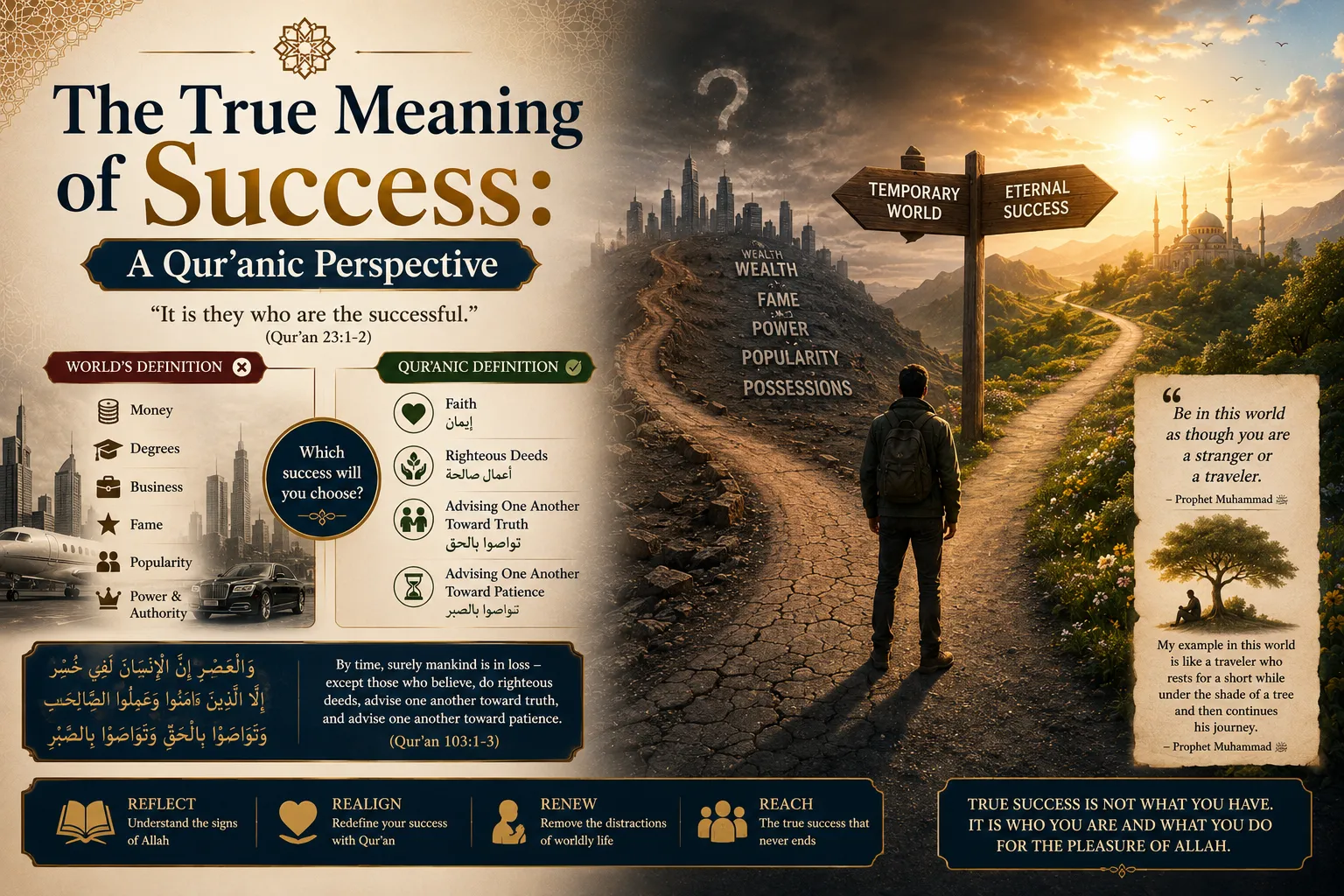

What are the standards of success that have settled deep within our minds?
Success means money.
Success means degrees.
Success means business.
Success means fame.
Success means popularity.
Success means authority and power.
These are the standards that shape our thinking.
The wealthier a person is, the more successful we consider him.
The more famous someone becomes, the more successful we assume he is.
The more popular a person becomes, the greater we think his achievement is.
The one who reaches a position of power is called successful.
The one who builds a great business empire is considered successful.
The one who accumulates large properties and possessions is seen as successful.
This is the foundation upon which our entire race for worldly achievement is built.
Because whatever your definition of success is, your life will revolve around achieving it. Your struggles, your efforts, your energy, and your sacrifices will all be directed toward that goal.
And this is exactly the concept of success that the Qur’an challenges.
True success is not wealth.
True success is not fame.
True success is not power, authority, or control.
True success is:
Faith.
Righteous deeds.
Encouraging one another toward truth.
Encouraging one another toward patience.
Reflect upon this change of perspective — this transformation in attitude. This shift in the way a person thinks can completely revolutionize human personality.
Now ask yourself:
If success was measured by wealth, then Qarun would have been the most successful person.
If success was measured by power and authority, then Pharaoh and Nimrod would have been among the greatest successes of history.
But they were not.
A person may reach the wealth of Qarun, the dominance of Pharaoh, and the power of kings — yet still be a complete failure, a loser, and one who has suffered the greatest loss.
On the other hand, a person like Abu Dharr al-Ghifari (رضي الله عنه) may possess almost nothing of worldly wealth and still be among the truly successful.
He had no great palace.
No vast possessions.
No worldly status.
The Prophet ﷺ described certain servants of Allah whose worldly position is so insignificant in the eyes of people that:
If they enter a gathering, they are not given importance.
If they seek marriage, people may not consider them worthy.
If they try to speak on behalf of someone, their words may not even be heard.
Yet their rank with Allah is so عظیم that if they swear by Allah regarding something, Allah honors their sincerity and does not let their words be dishonored.
This is the real difference.
Understand this carefully:
Accepting this truth is easy. Saying “SubḥānAllāh” upon hearing it is easy.
But changing your own definition of success according to this truth is extremely difficult.
Why?
Because human beings are deeply influenced by their surroundings.
When you see a magnificent palace, you may feel a sense of admiration.
When a luxurious, expensive car passes silently beside you, something inside you reacts:
“These people must be extremely fortunate.”
“These people must be truly successful.”
But you do not know the reality.
Perhaps what appears to be the greatest success is actually the greatest failure.
If this understanding settles firmly in the heart, everything changes.
This is why the Qur’an repeatedly says:
“It is they who are the successful.”
Allah says:
“O you who believe, bow, prostrate, worship your Lord, and do good deeds so that you may succeed.”
(Qur’an 22:77)
Notice carefully:
The Qur’an connects success not with wealth, status, or worldly achievements, but with worship, obedience, and righteous action.
This is the greatest lesson:
If this truth becomes firmly established in our hearts, our entire life changes.
Our mornings and evenings change.
Our struggles change.
Our priorities change.
Our entire value system changes.
Something that once appeared extremely important may suddenly become insignificant.
The Prophet ﷺ beautifully described the reality of this world:
“What do I have to do with this world? My example in this world is like a traveler who rests for a short while under the shade of a tree and then continues his journey.”
The traveler does not build his permanent home under that tree.
The tree is not his destination.
Likewise, this world is not our permanent home.
We say:
“Indeed, we belong to Allah, and indeed to Him we will return.”
We are travelers.
We came from Allah, and to Allah we will return.
The Prophet ﷺ also advised:
“Be in this world as though you are a stranger or a traveler.”
But this mindset becomes possible only when the Qur’anic reality settles deep inside us:
“By time, surely mankind is in loss — except those who believe, do righteous deeds, advise one another toward truth, and advise one another toward patience.”
(Qur’an 103:1–3)
This is the essence of success.
The companions of the Prophet ﷺ used to remind each other of this truth because human beings are constantly influenced by their surroundings.
Imagine snowfall.
When snow falls on your clothes, it begins to gather. You shake your clothes to remove it.
Similarly, while living in this world, the desires and distractions of worldly life settle upon our hearts. We need constant reminders to remove them.
And one of the greatest reminders is this:
Do not forget what true success really is.
The glitter and attraction of this world can deceive you. It can capture your attention and make you forget your ultimate destination.
Iqbal beautifully expressed this difference:
“The sign of the disbeliever is that he is lost in the universe,
while the sign of the believer is that the universe is contained within him.”
Do not become lost in the world.
Do not allow worldly attraction to dominate your heart.
Keep renewing your understanding.
Keep reminding yourself:
Success is not wealth.
Success is not possessions.
Success is not authority.
Success is not fame.
True success is:
Faith.
Righteous deeds.
Advising one another toward truth.
Advising one another toward patience.
These are the four foundations upon which the true garment of success is built.
Comments (0)
Join the conversation! Please log in to share your thoughts.
Log In to CommentNo comments yet. Be the first to share your thoughts!