
One of the most common questions people ask is:
"If Allah exists, why can't we see Him?"
At first glance, it may seem like a simple question. Yet behind it lies a deeper assumption: that something must be visible in order to be real.
But is that actually true?
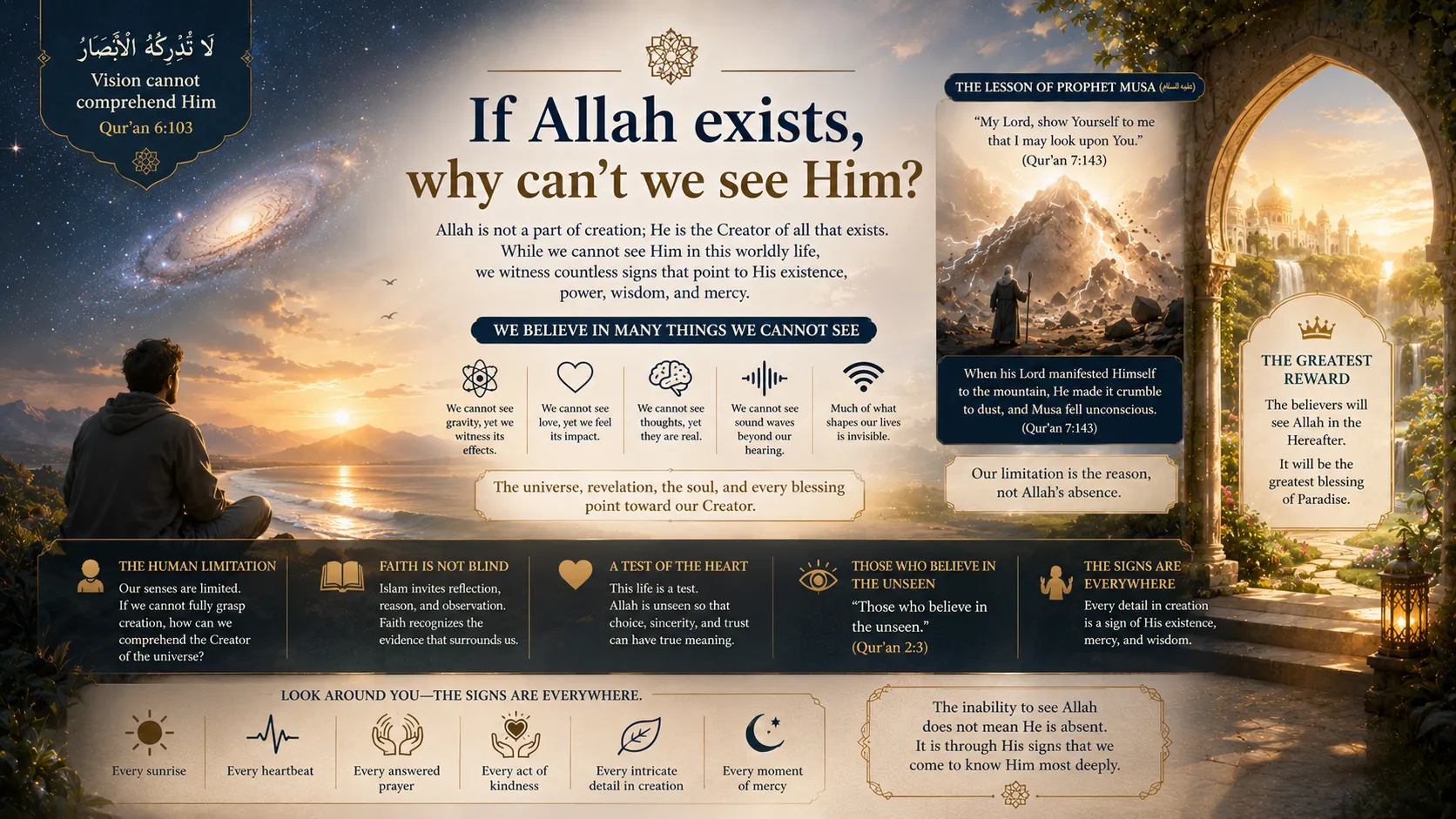
We believe in many things we cannot see.
We cannot see gravity, yet we witness its effects everywhere.
We cannot see love, yet we feel its impact in our lives.
We cannot see our thoughts, memories, or consciousness, yet no one doubts their existence.
In reality, much of what shapes our lives is invisible.
We often recognize things not by seeing them directly, but by observing their signs, effects, and manifestations.
The existence of Allah is no different.
While we cannot see Allah in this worldly life, we witness countless signs of His existence, power, wisdom, and mercy throughout creation.
The universe points toward Him.
Revelation points toward Him.
The human soul points toward Him.
And every blessing we experience points toward Him.
The Human Limitation
Part of the answer lies in understanding our own limitations.
Human beings are remarkably capable, yet profoundly limited.
Our eyes can only perceive a tiny portion of reality.
There are wavelengths of light we cannot see.
There are sounds we cannot hear.
There are countless realities around us that remain beyond our natural perception.
If our senses cannot fully grasp the created universe, how can they encompass the Creator of the universe?
Allah is not a physical object within creation that can be observed, measured, or examined.
He is the One who created all physical laws, dimensions, and realities.
The finite cannot fully encompass the Infinite.
The created cannot completely comprehend the Creator.
The Lesson of Prophet Musa (Moses) عليه السلام
The Quran beautifully illustrates this reality through the story of Prophet Musa (Moses) عليه السلام.
Out of his immense love and longing for Allah, Musa asked:
"My Lord, show Yourself to me that I may look upon You."
(Quran 7:143)
Allah responded:
"You will not see Me. But look at the mountain; if it remains in its place, then you will see Me."
Then Allah manifested a glimpse of His glory to the mountain.
The Quran tells us:
"When his Lord manifested Himself to the mountain, He made it crumble to dust, and Musa fell unconscious."
(Quran 7:143)
This was not a rejection of Musa's faith.
Nor was it a denial of Allah's existence.
Rather, it demonstrated that the human condition in this worldly life is not capable of bearing the direct vision of Allah.
The limitation lies not with Allah, but with us.
Faith Is Not Blind
Some people assume that believing in Allah without seeing Him is blind faith.
Islam teaches the opposite.
Blind faith accepts without reflection.
Islam repeatedly invites reflection.
The Quran constantly asks humanity to observe, think, reason, and contemplate.
Look at the heavens.
Look at the earth.
Look at yourselves.
Look at history.
Look at the order and balance within creation.
Faith in Islam is not the absence of evidence; it is the willingness to recognize the evidence that surrounds us.
The believer does not claim to have seen Allah.
Rather, the believer sees the countless signs that point toward Him.
Just as footprints indicate a traveler and a building indicates a builder, the universe points toward its Creator.
A Test of the Heart
There is also profound wisdom behind Allah remaining unseen in this life.
This worldly life is a test.
A test only has meaning when choice exists.
If Allah were visible to every human being in the same undeniable way that we see the sun, faith would no longer be a matter of sincere belief, reflection, and submission.
The Quran describes the believers as:
"Those who believe in the unseen."
(Quran 2:3)
This is one of the first qualities Allah mentions about the righteous.
They recognize that reality extends beyond what their eyes can perceive.
They trust the truth revealed by Allah even when it lies beyond immediate observation.
This trust is not weakness.
It is a sign of spiritual maturity.
The Greatest Reward Awaiting the Believers
Although Allah cannot be seen in this worldly life, Islam teaches something extraordinary:
The believers will be granted the honor of seeing Allah in the Hereafter.
This will be the greatest blessing of Paradise.
Greater than its rivers.
Greater than its gardens.
Greater than its palaces and delights.
The Prophet Muhammad ﷺ said that when the people of Paradise behold their Lord, they will realize that nothing they have ever received compares to that moment.
Imagine longing for someone your entire life.
Loving them.
Worshipping them.
Calling upon them in moments of joy and sorrow.
Trusting them through every trial.
And then finally being granted the honor of seeing them.
This is the ultimate hope of the believer.
The Signs Are Everywhere
Until that day arrives, Allah has not left humanity without guidance.
His signs surround us.
Every sunrise.
Every heartbeat.
Every answered prayer.
Every moment of mercy.
Every act of kindness.
Every intricate detail within creation.
Each one whispers the same truth:
There is a Creator.
There is a Sustainer.
There is a Lord who knows you, hears you, and cares for you.
The inability to see Allah in this life is not a barrier to knowing Him.
In many ways, it is through reflecting on His signs that we come to know Him most deeply.
For those who sincerely seek Him, the entire universe becomes a reminder of His presence, His wisdom, and His love.
And every sign brings the heart one step closer to its Creator.
Comments (0)
Join the conversation! Please log in to share your thoughts.
Log In to CommentNo comments yet. Be the first to share your thoughts!