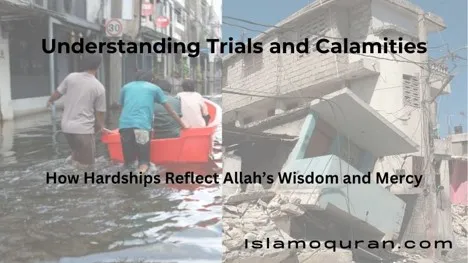
If Allah is All-Merciful and All-Powerful, why do innocent people suffer? Why do children experience pain, good people face terrible losses, and disasters destroy lives without warning? Explore the Islamic perspective on suffering, free will, divine wisdom, and the hope of the Hereafter.
Introduction: The Question That Can Shake Our Understanding of Life
A child lies in a hospital bed, fighting for life. A family loses its home in a natural disaster. An honest person struggles for years to escape poverty, while someone who exploits others seems to prosper. A mother weeps over the loss of her child. A person who has spent a lifetime trying to do good suddenly finds themselves facing an illness, betrayal, or tragedy they never imagined.
In moments like these, one question can rise from the depths of the human heart:
If Allah is the Most Merciful, the Most Compassionate, and the All-Powerful, why does He allow so much suffering in the world?
This is not a trivial question. Nor should it be dismissed as a sign of weak faith. It is a question that touches our deepest assumptions about justice, goodness, human existence, and the nature of God.
For some people, suffering becomes a reason to question whether a merciful Creator exists at all. If Allah can prevent suffering but does not always do so, they ask, how can His mercy be reconciled with the pain we see around us?
Others struggle with a more personal question: Why is this happening to me? Have I done something wrong? Has Allah abandoned me? Will my suffering ever make sense?
Islam does not require us to pretend that suffering is pleasant, that grief does not hurt, or that every tragedy can be explained by a simple answer. The Qur’an acknowledges fear, hunger, loss, sorrow, injustice, and the struggles that accompany human life. It presents the world not as a place where every desire is fulfilled, but as a temporary existence in which human beings face moral choices and are ultimately accountable to Allah.
To approach this subject meaningfully, we must distinguish between several questions.
-
Does the existence of suffering logically disprove the existence of Allah?
-
Why would Allah create a world in which hardship is possible?
-
What role do human choices, injustice, and natural events play in suffering?
-
Can hardship contribute to spiritual growth without being something we should seek or celebrate?
-
How does belief in the Hereafter change our understanding of justice?
-
What should we do when we cannot understand why a particular tragedy has occurred?
The Qur’anic perspective offers important insights into these questions. It does not promise that we will understand the full wisdom behind every event. Instead, it invites us to consider the purpose of our existence, the limits of our knowledge, our responsibilities towards one another, and the ultimate justice of Allah.
Let us explore ten important insights that can help us approach this difficult subject with greater clarity, compassion, and faith.
1. Does the Existence of Suffering Disprove the Existence of Allah?
One of the most common objections to belief in God is the argument from suffering.
The argument can be expressed simply:
If Allah is All-Powerful, He can prevent suffering. If He is All-Merciful, He would want to prevent suffering. Yet suffering exists. Therefore, how can Allah possess both unlimited power and perfect mercy?
This question deserves a serious response rather than a dismissive one.
The first point to consider is that the existence of something painful does not, by itself, establish that it is without purpose or that its existence is incompatible with divine wisdom.
Imagine a medical operation. From the patient's immediate perspective, the incision, pain, and discomfort may appear undesirable. Yet the procedure may be necessary to treat a serious condition. The pain is real, but its immediate unpleasantness does not establish that the procedure is pointless or that the surgeon lacks compassion.
Of course, this example does not explain every kind of suffering. Some suffering is not comparable to a medical procedure, and we should not assume that we know the purpose of another person's pain. The analogy simply illustrates a logical point: something can be painful without being purposeless.
The same distinction applies when we consider the world as a whole.
We do not possess complete knowledge of every cause, consequence, or possibility associated with every event. Our understanding is limited by our circumstances, our information, and our position within time. We often judge an event by what we can see immediately, without knowing all its consequences.
The Qur’an directs our attention to the purposeful nature of creation:
“We did not create the heaven and earth and everything between them in play.”
— Qur’an 21:16, Surah Al-Anbiya
This verse rejects the idea that creation is a meaningless exercise. It invites us to consider the universe within a framework of purpose rather than assuming that whatever we cannot immediately understand must be purposeless.
However, there is an important distinction here. The existence of suffering does not independently prove that Allah exists. Nor does every painful event provide an obvious demonstration of His wisdom. Rather, the argument from suffering must be considered alongside the broader questions of existence, morality, consciousness, purpose, and the nature of divine attributes.
A believer's response is not that pain is imaginary or unimportant. It is that the reality of pain does not, by itself, settle the question of whether an All-Wise and All-Merciful Creator exists.
The lesson: An event may be difficult to understand without being meaningless. Recognising the limits of our knowledge should encourage thoughtful inquiry rather than premature conclusions.
2. To Understand Hardship, We Must First Understand the Purpose of Life
Before asking why Allah allows suffering, we must ask a more fundamental question:
What kind of world did Allah create, and what is human life meant to accomplish?
If the purpose of earthly life were to provide uninterrupted comfort, perfect health, permanent security, and the immediate fulfilment of every desire, then suffering would appear to contradict that purpose.
But the Qur’an describes a different purpose.
Allah says:
“He who created death and life to test you as to which of you is best in deed—and He is the Almighty, the Most Forgiving.”
— Qur’an 67:2, Surah Al-Mulk
This verse places human life within a framework of moral responsibility.
Life is not merely about acquiring possessions, avoiding discomfort, pursuing pleasure, or extending our physical existence for as long as possible. It is also about the choices we make, the character we develop, the way we treat others, and whether we respond to guidance with sincerity.
Consider how many qualities become relevant only when life presents us with difficult choices.
Patience becomes meaningful when something tests our endurance. Courage becomes necessary when we must confront fear. Honesty is tested when deception would bring an advantage. Compassion becomes especially important when another person's suffering demands something from us. Justice becomes difficult when we must act fairly towards someone we dislike.
This does not mean that suffering is good in itself, or that every person must experience every possible hardship to develop these qualities. Nor does it mean that people who suffer more are necessarily more righteous.
It means that a world in which human beings have responsibilities and face genuine challenges is different from a world designed solely to satisfy every immediate preference.
The Qur’an states:
“Do people think that they will be left to say, ‘We believe,’ and they will not be tried?”
— Qur’an 29:2, Surah Al-Ankabut
The verse reminds believers that faith is not merely a declaration. It is something expressed through choices and conduct.
Yet trials are not limited to pain and loss. Wealth, health, influence, intelligence, and success can also test us. Will we become grateful or arrogant? Will we use our resources to help others or exploit them? Will we remain honest when dishonesty becomes profitable?
A person who is financially secure may face a serious test of generosity and responsibility. A person experiencing poverty may face different challenges, including the struggle to meet basic needs. Neither circumstance alone reveals a person's standing before Allah.
The lesson: Earthly life is not a promise of uninterrupted happiness. It is an opportunity to live responsibly, respond to guidance, and make choices for which we are accountable.
3. Hardship Does Not Mean That Allah Has Abandoned You
When suffering enters our lives, one of the most painful questions we may ask is whether Allah is displeased with us.
A person experiencing illness may wonder whether they are being punished. Someone who loses a loved one may fear that Allah has turned away from them. A family facing financial hardship may feel that their prayers have gone unanswered.
Such thoughts can add emotional pain to an already difficult situation.
The Qur’an offers an important perspective: hardship is part of human life, but we should not assume that every hardship has the same meaning.
Allah says:
“We will surely test you with something of fear and hunger and a loss of wealth and lives and fruits, but give good tidings to the patient.”
— Qur’an 2:155, Surah Al-Baqarah
The verse explicitly mentions fear, hunger, and loss. It acknowledges that these experiences occur in human life and connects them with the possibility of responding through patience.
It does not tell us to pretend that we are not afraid, hungry, or grieving. Nor does it say that every individual who experiences a particular loss has committed a particular sin.
The Qur’an also recounts the suffering of earlier prophets. Prophet Ayyub (Job), peace be upon him, experienced severe affliction and turned towards Allah in supplication:
“Great harm has afflicted me and You are the Most Merciful of the merciful.”
— Qur’an 21:83, Surah Al-Anbiya
Ayyub's words acknowledge the reality of suffering while affirming his trust in Allah's mercy.
This is a valuable distinction. Faith does not require us to deny pain. We can admit that something hurts, seek relief, ask for help, and still maintain our relationship with Allah.
It is also important not to judge another person's faith by their circumstances. Wealth does not prove that Allah is more pleased with someone, and poverty does not prove that He has rejected them. Health and illness, worldly success and failure, are not simple measurements of spiritual worth.
If you are suffering, you do not need to invent a reason for your hardship or assume that you deserve it. You can seek forgiveness for known mistakes without blaming yourself for every misfortune.
You can also seek medical care, financial assistance, emotional support, and practical solutions. Trust in Allah does not require abandoning the means through which help may be obtained.
The lesson: Do not interpret every hardship as evidence of divine rejection. Turn towards Allah, seek appropriate help, and allow yourself to face difficulty without adding unfounded accusations against yourself.
4. Allah's Names and Attributes Help Us Understand Mercy, Care, and Relief
The Qur’an repeatedly introduces us to Allah through His names and attributes, including His mercy, wisdom, knowledge, forgiveness, justice, and power.
Reflecting on these attributes can deepen our understanding of our relationship with Him.
Consider Allah's mercy. We experience many forms of goodness in life: nourishment, human affection, opportunities to learn, moments of peace, the natural world, and the ability to help one another. These blessings do not eliminate the reality of suffering, but they form part of the wider reality in which human life unfolds.
Consider Allah as the Provider. Food, water, and other necessities sustain our lives. Recognising provision can encourage gratitude, while recognising the needs of others can motivate us to share what we have.
Consider Allah's forgiveness. When we make mistakes, we are not required to pretend that we have never done wrong. We can acknowledge our failures, repent, repair harm where possible, and seek Allah's forgiveness.
Consider Allah's justice. Human judgments are frequently incomplete, and injustice is sometimes left unresolved in this world. Belief in divine justice directs our attention towards the reality that human wrongdoing is not beyond Allah's knowledge or ultimate judgment.
These reflections do not mean that every illness is followed by recovery, every loss is compensated in a way we can see, or every apparent injustice is corrected during our lifetime. We should not claim knowledge of a particular divine purpose when the revelation does not give us that knowledge.
Rather, the names and attributes of Allah help believers understand why they can continue to hope, pray, act justly, and seek relief even when circumstances are painful.
The Prophet Muhammad, peace and blessings be upon him, taught the importance of Allah's names. Sahih al-Bukhari, Hadith 2736, reports the well-known narration concerning Allah's ninety-nine names and the virtue of enumerating them.
Learning these names should not be reduced to memorisation alone. It should influence our understanding and conduct. Belief in divine mercy should encourage us to show mercy. Belief in divine justice should make us more careful about injustice. Belief in divine forgiveness should encourage sincere repentance rather than despair.
The lesson: Reflecting on Allah's attributes can help sustain hope and shape our character, even when we cannot explain the reason for a particular hardship.
5. The Hereafter Changes How We Understand Justice and Suffering
One of the most important elements of the Islamic response to suffering is belief in the Hereafter.
If earthly life were the whole of human existence, many injustices would remain permanently unresolved.
Some people die after years of suffering. Some victims never receive justice in court. Some wrongdoers escape accountability. Some people spend their lives caring for others while receiving little recognition or material reward.
If there were no existence beyond death, these unfinished stories would raise profound questions about the ultimate fate of justice.
Islam teaches that earthly life is not the complete story.
Allah says:
“Every soul will taste death. And you will only be given your full compensation on the Day of Resurrection.”
— Qur’an 3:185, Surah Ali 'Imran
The verse places worldly life within a larger horizon of accountability and recompense.
This does not make injustice acceptable. It does not mean that victims should remain silent, that society should ignore suffering, or that people should wait passively for the Hereafter rather than work for justice in the present.
On the contrary, belief in accountability gives moral seriousness to our actions. If we are answerable to Allah, we cannot dismiss the rights of others merely because we possess power or can escape human punishment.
The Hereafter also changes the question of whether suffering is the final word on a person's existence. From the Islamic perspective, death is not the end of the human story, and the injustices that remain unresolved in this world are not beyond Allah's knowledge.
We must be careful, however, not to speculate about the exact reward or punishment of a particular individual without sound evidence. The general promise of divine justice is not permission to claim that we know the full meaning of every person's life or suffering.
The essential point is that Islam does not ask us to measure the ultimate justice of existence solely by what happens between birth and death.
The lesson: Belief in the Hereafter encourages us to pursue justice in this world while recognising that our present lives do not reveal the complete outcome of every human story.
6. Contrast Can Teach Gratitude, but Suffering Should Never Be Romanticised
Have you ever recovered from an illness and suddenly appreciated the ordinary pleasure of feeling well? Have you ever experienced the relief of finding water after being thirsty, the warmth of shelter after exposure to cold, or the comfort of a loved one after a period of separation?
Contrast can sharpen our awareness of blessings we previously took for granted.
When life is comfortable, we may gradually begin to regard comfort as something we are automatically entitled to. We stop noticing the many things that make our lives possible.
A difficult experience can interrupt that habit and encourage us to become more grateful.
The Qur’an reminds us of the relationship between hardship and ease:
“For indeed, with hardship comes ease. Indeed, with hardship comes ease.”
— Qur’an 94:5–6, Surah Ash-Sharh
These verses offer reassurance that hardship does not have to define the whole of our experience. They encourage us to recognise the possibility of relief and to avoid assuming that present difficulty is the end of the story.
Yet we should not turn this lesson into the claim that people must suffer in order to appreciate blessings, or that those who have experienced terrible pain should be grateful for the pain itself.
A person can appreciate health without having suffered a serious illness. We can teach children compassion without exposing them to cruelty. We can recognise the value of peace without first experiencing war.
Nor should we tell a grieving parent that their loss is simply necessary to make them appreciate life. Such a statement may deepen their pain rather than offer comfort.
Gratitude and grief can coexist. A person may be thankful for the blessings they still have while mourning what they have lost.
The purpose of reflection is to help us recognise goodness more clearly, not to deny the reality of suffering.
The lesson: Let hardship, when it occurs, remind you of the blessings that remain and the importance of gratitude. Never use gratitude as a reason to dismiss another person's pain.
7. Could a Difficulty Contain Wisdom We Cannot Yet See?
One of the hardest aspects of suffering is uncertainty.
We may ask why an illness occurred, why a relationship ended, why a disaster struck a particular community, or why a sincere effort failed. Sometimes, with time, we understand part of what happened. At other times, the reasons remain unclear.
Islam encourages trust in Allah's wisdom, but trust must be distinguished from pretending to know the specific purpose behind every event.
Consider a person who loses a job. The immediate consequences may be frightening: bills remain unpaid, family responsibilities continue, and the future becomes uncertain. In some cases, the person may eventually find a more suitable opportunity or discover new strengths. In other cases, the consequences may remain difficult for a long time.
We cannot assume that every job loss will lead to something better in worldly terms. We can, however, recognise that a difficult experience does not necessarily determine every future possibility.
The Qur’an states:
“Perhaps you dislike a thing and it is good for you; and perhaps you love a thing and it is bad for you. And Allah knows, while you know not.”
— Qur’an 2:216, Surah Al-Baqarah
The immediate context of this verse concerns the obligation of fighting, but its wording also highlights a broader principle about the limits of human knowledge: what we desire or dislike does not always correspond to what is ultimately best.
We should not take this principle as a licence to label every tragedy a blessing. The death of a loved one, a child's illness, or an experience of abuse should not be casually explained away by someone who does not know the circumstances.
Rather, the verse encourages humility. Our understanding is incomplete, and we should be cautious about making absolute judgments concerning outcomes we cannot fully see.
Trust in Allah means that we do not need to know every hidden reason before continuing to pray, act responsibly, and seek what is good.
It also means that we should not stop trying to improve difficult circumstances. If a situation can be changed for the better, taking appropriate action may be part of our responsibility.
The lesson: Acknowledge what hurts, work to improve what can be improved, and remain humble about the aspects of divine wisdom that are beyond your knowledge.
8. Trials Can Become Opportunities for Spiritual Growth
Difficult experiences can reveal aspects of our character that remain hidden during easier times.
A person may discover that they need to develop patience, seek help more readily, become less judgmental, or learn to depend less on material security. Another may discover a deeper appreciation for family, a stronger commitment to justice, or a renewed determination to help others.
The Prophet Muhammad, peace and blessings be upon him, said:
“If Allah wants to do good to somebody, He afflicts him with trials.”
— Sahih al-Bukhari 5645
This hadith is a source of reflection for believers. It indicates that affliction can occur within a context of divine care rather than necessarily indicating rejection.
But the hadith should be understood carefully. It does not give us permission to declare that every person who suffers is being specially rewarded, nor does it establish that we know why a particular individual has been afflicted.
It also does not mean that we should seek suffering for its own sake or refuse available treatment and support.
Spiritual growth is not measured by how much pain a person experiences. It is more appropriately reflected in how we respond to life's circumstances, including how we treat others and whether we remain committed to what is right.
Sometimes growth means learning patience while an illness is treated. Sometimes it means having the courage to leave an abusive situation. Sometimes it means asking for help rather than trying to bear everything alone. Sometimes it means supporting someone whose burden is heavier than our own.
Trials can also reveal whether our understanding of faith has become too dependent on comfort. Can we remain grateful without becoming complacent? Can we continue to do good without immediate recognition? Can we remain compassionate when we ourselves are struggling?
These are meaningful questions, but the answers should be approached with humility and care.
The lesson: If hardship enters your life, look for constructive ways to respond. Seek relief where possible, maintain your responsibilities, and allow the experience to deepen your patience and compassion rather than harden your heart.
9. The World's Suffering Is Not All Caused by the Same Thing
When discussing suffering, it is tempting to search for one explanation that accounts for everything. But suffering arises through many different circumstances, and responsible reflection requires us to distinguish among them.
Some suffering results directly from human wrongdoing.
War, abuse, exploitation, corruption, cruelty, and deliberate violence are examples of suffering caused by human choices. In such cases, it is important to recognise the role of the person who commits the wrong rather than treating the victim's pain as merely an unavoidable part of life.
The ability to make meaningful choices carries moral responsibility. A person who harms another cannot excuse that conduct simply by claiming that everything happens within Allah's knowledge and power.
Islam's emphasis on accountability makes it necessary to condemn injustice, protect victims, and work to prevent harm.
Other suffering arises from natural events, including earthquakes, floods, droughts, and disease. These events can cause immense loss without being the result of a particular victim's wrongdoing.
A further complication is that natural hazards and human decisions often interact. The impact of a flood, for example, may depend not only on the rainfall but also on housing, infrastructure, planning, poverty, and access to emergency assistance.
The Qur’an acknowledges that human beings experience the consequences of their actions:
“And whatever strikes you of disaster—it is for what your hands have earned; but He pardons much.”
— Qur’an 42:30, Surah Ash-Shura
This verse invites moral reflection on human responsibility. However, it should not be used to conclude that every person who experiences a disaster must have committed a particular sin. The Qur’an itself describes the testing of human beings through fear, hunger, and loss, and its accounts of the prophets demonstrate that hardship cannot be reduced to a simple equation between suffering and personal wrongdoing.
We should therefore avoid blaming victims without evidence.
If someone becomes ill, our first responsibility is not to speculate about their sins. If a family loses its home, we should not assume that the loss is a punishment. If a community experiences a natural disaster, our immediate concern should include protecting lives, providing assistance, and addressing the damage.
Understanding that human choices contribute to some suffering should make us more responsible, not more judgmental. Recognising that natural events can cause suffering should motivate us to prepare, prevent avoidable harm, and support those affected.
The lesson: Do not treat all suffering as if it has one cause. Distinguish human wrongdoing from natural events, avoid unsupported judgments about victims, and take responsibility for reducing suffering wherever possible.
10. The Islamic Response to Suffering Is Not Passive Acceptance but Compassionate Action
Perhaps the most important practical question is not simply why suffering exists, but how we should respond when we encounter it.
Imagine seeing a hungry family. Would it be enough to explain that hunger is a test? Imagine meeting someone who is ill. Would it be sufficient to tell them to be patient while refusing to help them obtain treatment? Imagine witnessing an act of injustice. Would faith require you to remain silent?
No.
Belief in divine wisdom does not remove our responsibility towards other people. If anything, it makes that responsibility more serious.
When we encounter hunger, we should help provide food where we can. When someone is ill, we should support access to appropriate care. When people experience grief, we should offer compassion rather than simplistic explanations. When injustice occurs, we should seek lawful and constructive ways to protect those affected and hold wrongdoers accountable.
Patience does not mean approving of oppression. Trust in Allah does not mean refusing to take action. Acceptance of what cannot immediately be changed does not mean abandoning every effort to improve a situation.
The Qur’an describes the importance of cooperation in righteousness:
“And cooperate in righteousness and piety, but do not cooperate in sin and aggression.”
— Qur’an 5:2, Surah Al-Ma’idah
This principle gives our response to suffering a practical direction.
We can reduce avoidable hardship by acting honestly, caring for vulnerable people, supporting those in need, improving public safety, seeking medical treatment, and challenging injustice.
We can also make a difference through smaller acts: listening to someone who feels alone, helping a struggling student, assisting an elderly neighbour, or offering financial support to a family facing difficulty.
We may not be able to prevent every tragedy, but that does not make our efforts meaningless.
Nor should we presume to know why Allah has allowed a particular person to suffer. Often, the most compassionate response is to acknowledge their pain, ask what support they need, and help without pretending to possess an explanation for everything.
The Islamic understanding of suffering should therefore lead to both humility before Allah and responsibility towards creation.
The lesson: Do not use divine wisdom as an excuse for human indifference. When you encounter suffering, ask what you can do to relieve it.
A Question Worth Asking: Why Does Allah Not Prevent Every Act of Suffering?
After considering these ten insights, a difficult question remains: If Allah is All-Powerful, why does He not simply prevent every instance of suffering before it occurs?
The Islamic response begins by recognising that the world operates within an order in which human actions have consequences, people face genuine choices, and natural events can produce real effects.
A world in which people can choose between honesty and deception, generosity and selfishness, or justice and oppression is a world in which those choices matter. Meaningful moral responsibility cannot be understood as though actions and their consequences are irrelevant.
Human beings are also limited in their knowledge and power. We cannot always predict every consequence of our actions, and we cannot control every event around us.
Belief in Allah's power does not require us to claim that we know why every possible intervention does or does not occur. The Qur’an repeatedly directs us towards Allah's knowledge and wisdom while reminding us of our own limitations.
This does not make the emotional difficulty disappear. A parent who loses a child may still grieve deeply. A victim of injustice may still struggle to understand what happened. A person living with a serious illness may still ask difficult questions.
Faith should not require us to silence those questions or pretend to possess answers that have not been revealed.
Rather, it gives us a framework within which we can continue to seek understanding, remain committed to justice, ask Allah for help, and hold on to the hope that earthly life is not the final measure of existence.
It also reminds us that we are not merely spectators of suffering. We have responsibilities to one another, and many forms of hardship can be reduced through knowledge, cooperation, compassion, and responsible action.
The question of suffering is profound partly because it involves both what we do not understand and what we are capable of doing.
We may not know why every tragedy occurs. But we can still know that cruelty should be opposed, that people in pain deserve compassion, that seeking treatment is worthwhile, and that our choices matter.
Conclusion: When We Cannot Understand Every Trial, Where Do We Turn?
Why does Allah allow suffering?
The answer cannot be reduced to a single sentence that explains every illness, loss, disaster, or injustice. The Qur’anic perspective is broader: earthly life is a place of moral responsibility and testing; human knowledge is limited; wrongdoing carries consequences; hardship does not automatically indicate divine rejection; and the Hereafter places human existence within a larger framework of accountability and justice.
These teachings do not ask us to celebrate pain or dismiss the suffering of others. They invite us to understand hardship within a wider perspective while responding to it with patience, compassion, and responsibility.
When you face a difficult period, remember that you do not need to understand every aspect of your circumstances before seeking Allah's help.
You can acknowledge your pain without losing hope.
You can seek medical care without compromising your trust in Allah.
You can pursue justice without surrendering to hatred.
You can grieve the loss of someone you love without assuming that your grief reflects weak faith.
You can admit that you do not know why something happened while continuing to believe that your life has purpose.
And when someone else suffers, you can offer kindness instead of judgment, practical assistance instead of empty explanations, and companionship instead of telling them how they ought to feel.
Perhaps one of the most important lessons is that the question of suffering is not only about understanding what Allah allows. It is also about examining what we, as human beings, are called to do.
Will we allow hardship to make us indifferent, or will it deepen our compassion? Will we use our blessings only for ourselves, or will we help those who have less? Will we respond to injustice with indifference, or will we work towards what is right?
We may not be able to answer every question about suffering in this world. But we can strive to live with greater wisdom, patience, justice, and mercy.
The Qur’an reminds us that hardship and ease are both part of the human experience, that our choices matter, and that our present lives do not reveal the complete outcome of every story.
So when suffering raises difficult questions in your heart, do not be afraid to reflect, seek knowledge, ask for help, and turn to Allah.
Let your questions lead you towards deeper understanding rather than despair. Let your faith encourage you to relieve the suffering of others rather than explain it away. And let your awareness of life's uncertainties inspire you to use the time, strength, and blessings you have with greater purpose.
We may not always understand why suffering occurs, but we can choose how we respond to it—with faith, humility, compassion, and a sincere commitment to what is right.
May Allah grant relief to those who are suffering, healing to those who are ill, comfort to those who grieve, protection to the vulnerable, justice to those who have been wronged, and patience and strength to everyone facing hardship. May He guide us towards understanding His Book, living by its guidance, and showing mercy to His creation. Ameen.
If you found this article beneficial, consider sharing it with someone who may be struggling with questions about suffering, faith, or the purpose of life. A thoughtful discussion, a compassionate word, or a helping hand may be more valuable than we realise.
Comments (0)
Join the conversation! Please log in to share your thoughts.
Log In to CommentNo comments yet. Be the first to share your thoughts!