بِسْمِ اللهِ الرَّحْمٰنِ الرَّحِيْمِ
In the name of God, the Most Gracious, the Most Merciful.
What is the purpose of life?
This single question leads us back to one of the most profound verses of the Qur’an:
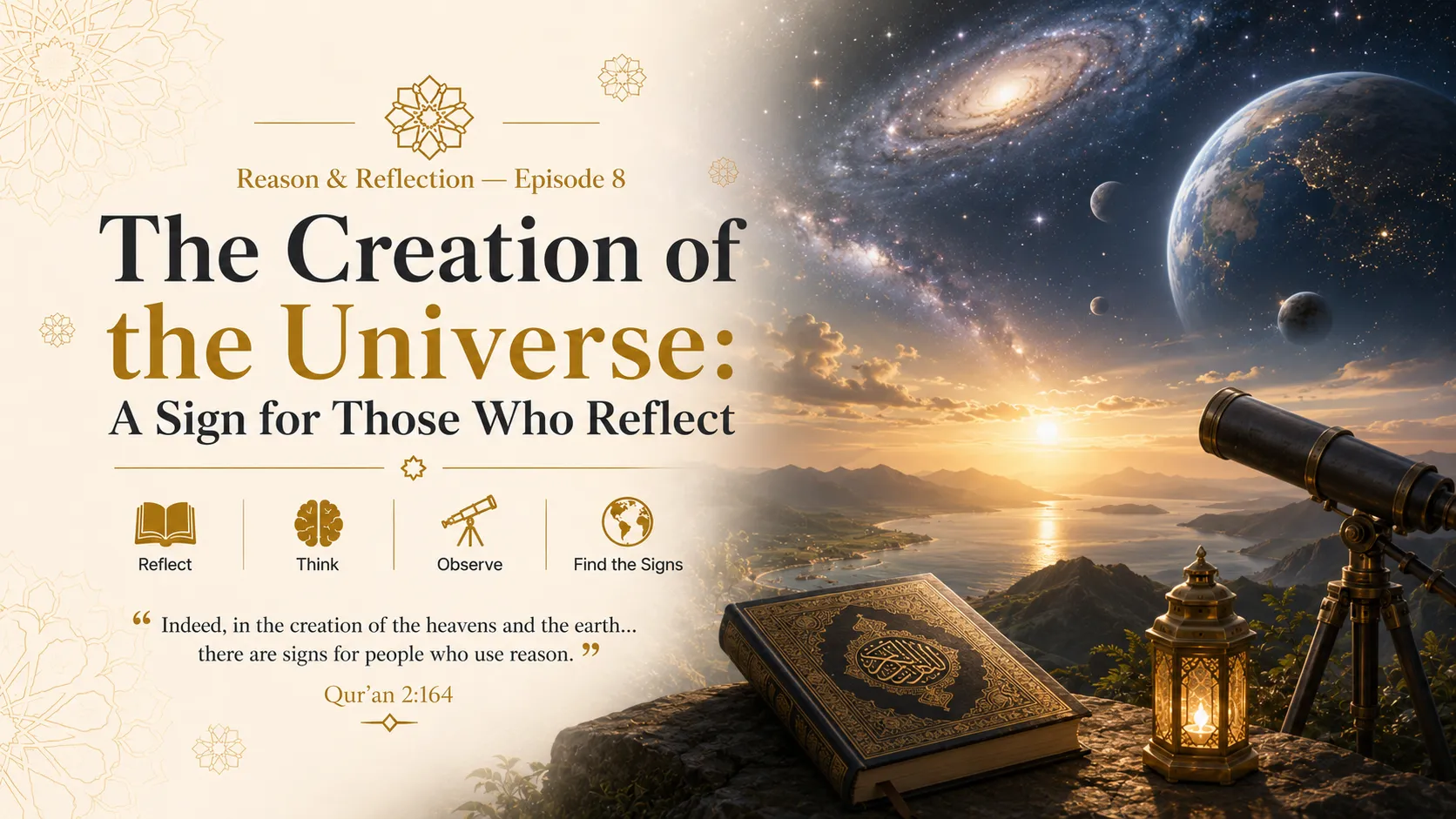
“Indeed, in the creation of the heavens and the earth, and the alternation of the night and the day, and the ships that sail through the sea with what benefits people, and the rain which Allah sends down from the sky, giving life thereby to the earth after its death, and the dispersing of every creature therein, and the changing of the winds and the clouds controlled between the heaven and the earth — are signs for people who use their reason.”
(Qur’an 2:164)
The Qur’an points toward something remarkable:
The entire universe is filled with signs.
But these signs are not recognized by everyone.
They are recognized by those who truly think.
Every human being possesses intelligence. Yet every human being also possesses free will. A person can either use this intelligence for meaningless distractions, or they can direct it toward the purpose for which it was given.
Those who use their intellect correctly discover that the universe is not empty.
It is full of signs.
As Allama Iqbal beautifully expressed:
“If there is someone worthy, countless signs are revealed to him.”
The problem is not the absence of signs.
The problem is the absence of reflection.
So let us begin our reflection with the first part of this Qur’anic verse:
The Creation of the Universe.
To understand the universe, we must answer three fundamental questions:
- Was this universe created, or has it always existed?
- If it was created, what existed before it?
- How did this universe come into existence?
Was the Universe Always There?
Imagine looking at the sky not merely as a scientist, but as an artist.
Every moment it changes.
The colors of dawn.
The movement of clouds.
The endless stars.
The galaxies stretching beyond imagination.
It appears like a masterpiece constantly being painted.
The British artist and thinker John Ruskin once described nature as a display of endless beauty.
Such beauty naturally forces a question upon the human mind:
Was all of this always here?
Or was it created?
One of the greatest scientific minds of modern history, Stephen Hawking, spent his life studying the mysteries of the universe, black holes, and cosmology.
Despite severe physical limitations, he continued exploring the deepest questions of existence through his intellect.
His life itself demonstrated something important:
The greatest strength of humanity is not physical power.
It is the power of the mind.
In his famous lecture “The Beginning of Time”, Hawking discussed the idea that the universe did not exist forever.
He considered the discovery that the universe had a beginning one of the most remarkable achievements of science.
But centuries before modern cosmology reached this conclusion, the Qur’an had already pointed toward this reality:
The universe is not eternal.
It is created.
And within that creation are signs for those who reflect.
This raises a profound question:
How could a scripture revealed more than fourteen centuries ago speak about a reality that modern cosmology only recently explored?
Is it merely coincidence?
What Was Before the Universe?
Now we reach the second question:
If the universe was created, what existed before it?
Modern science tells us that before the beginning of the universe, the familiar concepts of space, time, and matter as we understand them did not exist.
But then another question appears:
How can something come from nothing?
What existed before existence itself?
Stephen Hawking acknowledged the difficulty of explaining why the universe began the way it did.
In his book A Brief History of Time, he discussed how difficult it is to explain the origin of the universe without considering a deeper cause behind its existence.
This is a fascinating point because Hawking himself did not accept belief in God.
Yet the question remained:
If nothing existed, how did something begin?
The Qur’an addresses this question with a powerful word.
In Surah Al-Baqarah, Allah says:
“The Originator of the heavens and the earth. When He decrees a matter, He only says to it: ‘Be,’ and it is.”
(Qur’an 2:117)
The Arabic word used here is:
Badi‘ (بديع)
But what does it mean?
The Meaning of Badi‘ — A Creation Without Previous Material
During my pilgrimage journey in 2023, I carried several questions with me.
One of them was:
What exactly does the Qur’anic word Badi‘ mean?
I wanted to understand it not through complicated scientific terminology, but through the simplicity of the Arabic language.
During that journey, I met a young Arabic speaker from Jordan.
He was not a scientist.
He did not approach the word through modern theories.
He simply explained the linguistic meaning.
The meaning was:
To bring something into existence in a completely unique way, without using previously existing material.
A creation without a previous model.
A creation without raw material.
Something that did not exist before, then suddenly exists.
Modern discussions sometimes describe a similar idea with the phrase:
Creation ex nihilo — creation from nothing.
Human beings cannot truly create in this way.
When we make something, we use existing materials.
A chair requires wood.
A glass requires glass material.
A house requires bricks and resources.
Human creation is transformation.
We rearrange what already exists.
But the Qur’anic concept of Badi‘ points toward something beyond human ability:
The bringing of existence into being without dependence upon pre-existing material.
And Allah describes this creation:
“The Originator of the heavens and the earth…”
Meaning:
The heavens and the earth were not merely rearranged.
They were brought into existence by the command of the Creator.
“Be — And It Is”
The Qur’an repeatedly uses the expression:
“Kun fayakun” — “Be, and it is.”
This does not mean that creation is like a human command or a physical process.
Rather, it expresses the absolute power and will of Allah.
When Allah wills something to exist, no obstacle can prevent it.
The universe, with all its complexity, beauty, and order, exists because Allah brought it into existence.
And this raises another powerful reflection:
The Qur’an mentioned this reality more than 1,400 years ago.
Modern science continues exploring the deepest mysteries of cosmic origins.
The question remains:
How did everything begin?
What existed before existence?
How did the universe emerge?
These are among the greatest questions humanity has ever asked.
A Universe Full of Signs
The Qur’an does not present the universe as a meaningless collection of objects.
It presents creation as a sign.
The stars.
The galaxies.
The earth.
The oceans.
The changing skies.
The laws of nature.
All point beyond themselves.
The universe is not worshipped.
The universe is a creation.
Its beauty and order direct the thoughtful mind toward its Creator.
The real purpose of studying creation is not merely to collect information.
It is to recognize the One who created it.
The Journey Continues
This was the eighth episode of our journey of Reason & Reflection.
We began by asking:
Who are we?
Why are we here?
What is our purpose?
And the Qur’an guided us toward a deeper understanding:
Human beings were created with intelligence.
They were given free will.
They were invited to reflect.
And when they use their intellect sincerely, the universe itself becomes a book filled with signs.
In the next episode, we will explore the third great question:
How was the universe created?
The earth was not here.
The heavens were not here.
The sun and the moon were not here.
So how did this vast creation come into existence?
Until then, reflect.
Observe.
And continue searching for the signs.
May Allah guide us toward truth and wisdom.