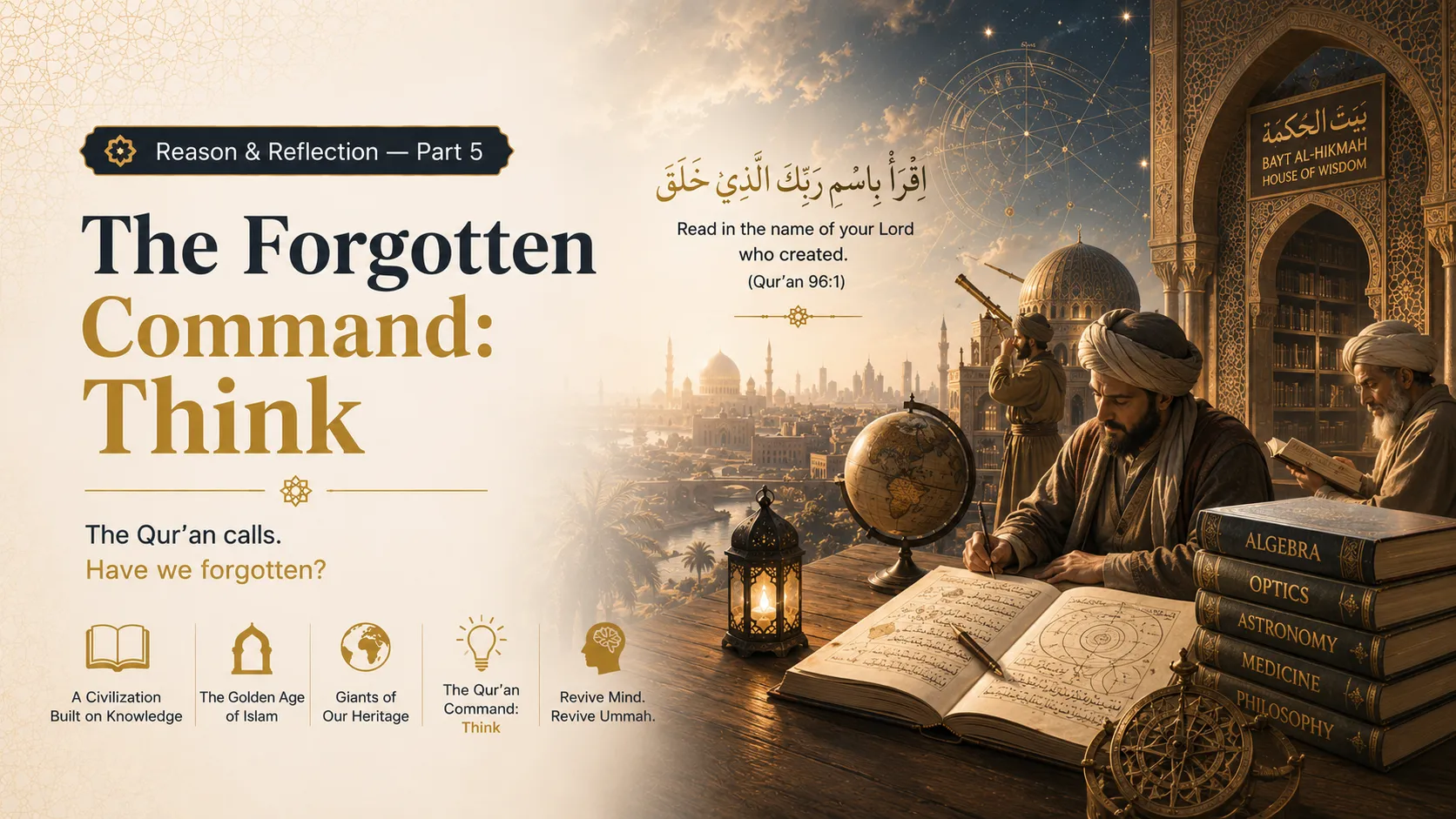

Allama Muhammad Iqbal once addressed the Muslim youth with words (paraphrased) that still echo across generations :
Have you ever truly reflected, O young Muslim,
Upon the vast universe of which you are but a fallen star?
You were nurtured by a civilization
That once wore the crown of leadership upon its brow.
These lines point toward a painful reality.
Many Muslims today inherit the legacy of a magnificent civilization, yet know very little about what made that civilization great.
We speak proudly of our past.
But do we understand the principles that produced it?
Do we know why Muslim civilization once stood at the forefront of human knowledge?
And perhaps more importantly:
Do we understand why it no longer does?
The Golden Age of Islam
The Qur'an was revealed to Prophet Muhammad ﷺ in the seventh century.
In the centuries that followed, something remarkable happened.
A civilization emerged that transformed the intellectual landscape of the world.
From the eighth century to the fourteenth century, Muslim scholars, scientists, philosophers, physicians, mathematicians, engineers, and astronomers stood at the center of global scholarship.
Historians often refer to this period as the Golden Age of Islam.
During these centuries, Europe remained largely trapped in intellectual stagnation while the Muslim world became a beacon of learning, discovery, and innovation.
Knowledge flourished.
Research flourished.
Curiosity flourished.
And the results changed human history.
The Giants of Islamic Civilization
Long before modern science emerged in Europe, Muslim scholars were laying its foundations.
In the twelfth century, Al-Khazini explored the relationship between mass, weight, and gravity through his work The Balance of Wisdom, centuries before Newton's famous formulation of gravitational theory.
In the thirteenth century, Nasir al-Din al-Tusi developed the mathematical model known as the Tusi Couple, which later influenced astronomical theories associated with Copernicus and Kepler.
The very foundations upon which modern computing and artificial intelligence stand would have been impossible without the revolutionary mathematical work of Al-Khwarizmi, whose contributions to algebra transformed the scientific world.
Every time we use a computer, solve an equation, or interact with digital technology, we benefit from ideas rooted in his discoveries.
When you take a photograph with your smartphone, you are benefiting from principles first investigated by Ibn al-Haytham in the eleventh century.
His pioneering work on optics, reflection, and refraction became the foundation of modern cameras, lenses, fiber optics, and laser technologies.
The engineer Al-Jazari designed sophisticated machines, automated devices, and mechanical systems that would inspire later developments in robotics and engineering.
Al-Biruni calculated the Earth's circumference with remarkable accuracy centuries before modern instruments existed.
Abbas Ibn Firnas dreamed of flight and conducted early experiments that anticipated humanity's eventual conquest of the skies.
And in the ninth century, Fatima al-Fihri established what is widely recognized as the world's oldest continuously operating university.
These were not isolated achievements.
They were products of an intellectual culture.
A culture rooted in the pursuit of knowledge.
Baghdad: The House of Wisdom
There was a time when Iraq was not merely a country.
It was one of the intellectual capitals of the world.
From the eighth to the thirteenth century, Baghdad was home to the legendary Bayt al-Hikmah—the House of Wisdom.
Scholars traveled there from every corner of the known world.
Greek texts were translated into Arabic.
Persian works were studied and expanded.
Indian mathematics was analyzed and developed.
Scientific, philosophical, and medical knowledge from numerous civilizations was gathered, preserved, critiqued, and improved.
The House of Wisdom became one of humanity's greatest centers of learning.
It symbolized a civilization that viewed knowledge not as a luxury but as a sacred responsibility.
What Happened to Us?
This history forces us to confront an uncomfortable question.
If Muslim civilization once illuminated the world with knowledge, what happened?
Why did the civilization that pioneered scientific inquiry gradually fall into intellectual decline?
Why did a culture of investigation give way to intellectual paralysis?
Why did scholarship lose its central place?
Why did emotional reactions begin to replace thoughtful analysis?
Why did unity fragment into endless divisions?
Why did many debates become consumed by accusations rather than understanding?
The poet Habib Jalib captured this frustration beautifully (paraphrased):
Do not distract me with side issues.
Tell me why the caravan was plundered.
I do not blame the thieves.
I question the leadership.
These are important questions.
And every thoughtful Muslim should reflect upon them.
But our focus today lies elsewhere.
Before asking how we declined, we must first understand what made us rise.
What Sparked This Intellectual Revolution?
What was it about Islam that ignited such a passion for knowledge?
What was it about the Qur'an that inspired generations of Muslims to study the heavens, investigate nature, develop mathematics, advance medicine, and seek wisdom wherever it could be found?
The answer may surprise many modern Muslims.
Because it lies within teachings that countless people have forgotten.
In the previous installment, we explored Dr. Jeffrey Lang's observation that the story of Adam in Surah Al-Baqarah highlights humanity's unique capacity for learning and understanding.
But does the Qur'an emphasize knowledge elsewhere?
Does it consistently elevate intellect and reflection?
The answer is unmistakably yes.
The First Command
Consider a remarkable fact.
What was the very first word revealed in the Qur'an?
Iqra.
Read.
Learn.
Seek knowledge.
The first revelation did not begin with a command to conquer.
It did not begin with a command to accumulate wealth.
It did not begin with a command to seek political power.
It began with a command to learn.
This single word established a civilizational principle.
Knowledge became an act of worship.
Learning became a pathway to faith.
Investigation became a means of drawing closer to Allah.
Human beings were invited to observe, think, question, analyze, and understand.
A Book That Demands Reflection
The Qur'an repeatedly challenges its readers:
"Will you not reflect?"
"Will you not reason?"
"Will you not contemplate?"
Again and again, the Qur'an calls upon humanity to think.
Throughout the Qur'an, variations of these invitations appear more than seventy times.
The message is clear:
Faith is not meant to be blind.
Faith is meant to be thoughtful.
Islam does not fear questions.
Islam encourages them.
Islam does not discourage reflection.
It commands it.
The Greatest Blessing
The Qur'an goes even further.
Allah says:
"He grants wisdom to whom He wills, and whoever has been granted wisdom has certainly been given abundant good."
(Qur'an 2:269)
Notice the significance of this statement.
Allah describes wisdom as "abundant good"—a tremendous blessing and one of the greatest gifts a human being can receive.
Not wealth.
Not status.
Not power.
But wisdom.
The ability to understand reality correctly.
The ability to distinguish truth from falsehood.
The ability to make sound judgments.
The ability to see beyond appearances.
The Worst of Creatures
The Qur'an also delivers a warning.
Allah says:
"Indeed, the worst of living creatures in the sight of Allah are the deaf and dumb who do not use their intellect."
(Qur'an 8:22)
Reflect on the seriousness of this statement.
The criticism is not directed at those who lack intelligence.
Rather, it is directed at those who refuse to use the intelligence they have been given.
The problem is not ignorance.
The problem is intellectual negligence.
The problem is abandoning the gift of reason.
The Regret of the People of Hell
The Qur'an even describes what some inhabitants of Hell will say on the Day of Judgment.
They will confess:
"Had we only listened or used our reason, we would not have been among the inhabitants of the Blaze."
(Qur'an 67:10)
Their tragedy was not merely disbelief.
Their tragedy was the failure to think.
The failure to reflect.
The failure to use the faculties Allah had granted them.
In essence, they admit that they ignored one of the greatest gifts they possessed:
The ability to reason.
A Wake-Up Call
These verses should awaken us.
Especially those who spend their lives trapped in endless cycles of routine.
Working.
Earning.
Consuming.
Repeating.
Living without reflection.
Living without purpose.
Living without asking why.
The Qur'an repeatedly calls us to something greater.
To think.
To understand.
To seek wisdom.
To question inherited assumptions.
To pursue knowledge with sincerity and humility.
This intellectual awakening was one of the foundations of Islamic civilization's rise.
And perhaps it is also one of the keys to its renewal.
Looking Ahead
This was Part 5 of our Reason & Reflection series.
Through this journey, we hope to revive a culture of reflection, inquiry, and meaningful engagement with the Qur'an.
But an important question still remains.
If Allah repeatedly commands us to think and reflect, what exactly are we supposed to think about?
Where should we direct our intellect?
What subjects deserve our deepest contemplation?
And how does the Qur'an guide the human mind toward truth?
These questions will lead us into the next stage of our journey.
Until then, reflect deeply.
Ask questions.
Seek wisdom.
And never forget that one of the greatest acts of worship is to use the mind that Allah has given you.
May the peace, mercy, and blessings of Allah be upon you.