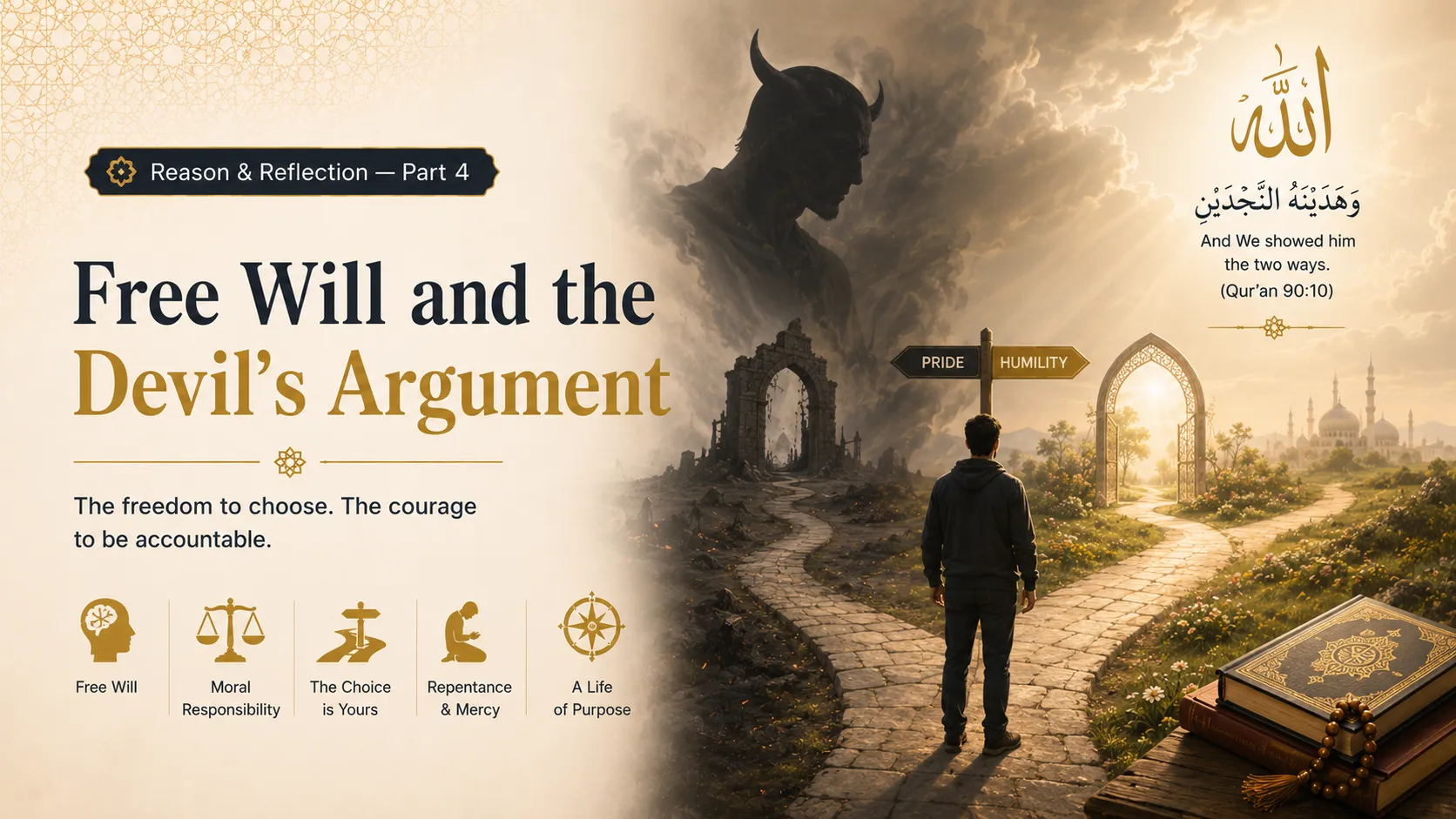

Have you ever heard of what may be called "The Devil's Argument"?
This expression finds powerful illustration in the writings of the great Muslim sage Jalal al-Din Rumi, particularly in his Masnavi, where he presents an imagined dialogue with Iblis (Satan).
In Rumi's poetic depiction, Satan is asked a simple yet profound question:
Why did you disobey Allah?
Why did you refuse to prostrate before Adam when Allah commanded you to do so?
Iblis responds with characteristic arrogance and cunning:
"What could I have done? I was compelled.
The path I walked had already been written for me.
I merely acted according to my destiny."
In other words, Satan attempts to excuse his rebellion by claiming that he had no real choice.
He shifts responsibility away from himself and places it upon destiny.
Centuries later, Allama Muhammad Iqbal portrayed a similar conversation between Allah and Iblis in one of his famous poems.
In the poem, Iblis says:
O Lord of Creation, I bore no personal hatred toward Adam.
Pride itself could not stand before Your Majesty.
Yet my refusal to prostrate was part of Your decree;
It was Your will that I should not bow.
Again, the same argument emerges.
Satan seeks to absolve himself of responsibility by claiming that his actions were predetermined.
His sin, he suggests, was not truly his own.
This line of reasoning is what we may call the Devil's Argument.
It is the excuse that has accompanied human wrongdoing throughout history.
It is the philosophy through which people transfer the burden of their mistakes onto someone else.
It is the comforting narrative that allows individuals to blame fate, circumstances, society, or destiny instead of confronting their own choices.
By doing so, the conscience falls asleep.
Responsibility disappears.
And accountability is avoided.
A Simple Question
Consider this carefully.
If human beings possess no freedom to choose evil, then they also possess no freedom to choose good.
If every action is predetermined in such a way that choice is merely an illusion, then why should goodness be rewarded?
Why should wrongdoing be punished?
Why should anyone be held accountable?
In that case, virtue loses its meaning.
As a great poet and philosopher suggested, goodness that arises from compulsion is not truly goodness at all.
If a person has no alternative but to act righteously, then where is the moral value in that action?
True virtue requires the possibility of choosing otherwise.
Without choice, there can be no moral responsibility.
Without freedom, there can be no genuine test.
But is this really what Islam teaches?
Does the Qur'an portray human beings as helpless creatures carried along by destiny?
Or does it affirm that human beings possess free will?
To answer these questions, we must once again turn to Revealed Knowledge.
Dr. Jeffrey Lang's Observation
At this point, the reflections of Professor Dr. Jeffrey Lang become particularly important.
Dr. Lang argues that human beings are creatures of choice.
According to him, the Qur'an presents humanity as a morally responsible creation entrusted with freedom and placed within a test.
But what led him to this conclusion?
Was his understanding supported by the Qur'an itself?
The answer is striking.
When we study the verses discussed in the previous article, we discover something remarkable.
Immediately after the verses describing Adam's knowledge and intelligence, the Qur'an introduces verses that point directly toward human freedom and moral choice.
It is almost as though Allah wants us to understand these two realities together:
Intelligence and Free Will.
The Choice of Iblis
Allah says:
"And when We said to the angels, 'Prostrate before Adam,' they all prostrated except Iblis. He refused, became arrogant, and was among the disbelievers."
(Qur'an 2:34)
Notice carefully what happened.
Iblis was not forced into disobedience.
He refused.
He chose arrogance.
He chose rebellion.
The Qur'an consistently describes his action as a deliberate decision.
This point is significant because Iblis was not an angel.
He belonged to the jinn.
And among Allah's creation, both human beings and jinn possess free will.
Unlike angels, they can choose obedience or disobedience.
Humility or pride.
Truth or falsehood.
The first act of rebellion in history was therefore an exercise of free will.
Iblis chose his path.
And then attempted to blame destiny for it.
The Choice of Adam
The next verses illuminate the same principle from a different perspective.
Allah said to Adam and his wife:
"O Adam, dwell, you and your wife, in Paradise and eat freely from wherever you wish, but do not approach this tree, lest you become among the wrongdoers."
(Qur'an 2:35)
The command was clear.
The boundary was clear.
The guidance was clear.
Now consider the implication.
If Adam possessed no free will, there would have been no possibility of disobedience.
The command itself would have been meaningless.
Yet what happened?
Satan whispered.
Temptation appeared.
A choice emerged.
And Adam approached the forbidden tree despite the warning.
This was not a mechanical event.
It was a decision.
A moment of choice.
A demonstration of human freedom.
Adam exercised free will.
Then something equally important happened.
He repented.
He turned back to Allah.
And Allah forgave him.
The story teaches not only that human beings possess freedom, but also that they possess the capacity for repentance, growth, and redemption.
Escaping the Devil's Argument
If Muslims truly understood these verses, they would free themselves from the Devil's Argument.
We would stop blaming destiny for our conscious choices.
We would stop attributing our sins to fate.
We would stop hiding behind excuses.
The Qur'an repeatedly teaches that human beings are intelligent creatures capable of making choices.
More importantly, they are accountable for those choices.
Every day we choose:
Truth or falsehood.
Justice or oppression.
Gratitude or arrogance.
Obedience or rebellion.
Goodness or evil.
And these choices matter because they are genuinely ours.
This is why accountability exists.
This is why reward and punishment exist.
This is why life is a test.
Understanding the Limits of Choice
Of course, not everything is within our control.
We did not choose where we were born.
We did not choose our parents.
We did not choose our genetics.
We did not choose the era into which we entered the world.
These realities belong to Allah's decree.
However, the discussion of free will concerns something different.
It concerns the choices that lie within our sphere of responsibility.
How we respond.
How we act.
How we treat others.
How we use the opportunities we have been given.
These are matters for which we are accountable.
And these are the matters that shape our ultimate destiny.
Questions Still Remain
By now, perhaps the concept of free will has become clearer.
Yet important questions remain unanswered.
How do we determine what is truly right and wrong?
What defines good and evil?
How can we know whether a choice is morally correct?
And what role does human intelligence play in discovering those answers?
We also have not yet fully addressed a question raised in earlier parts of the series:
Is intelligence really as important as the Qur'an seems to suggest?
And if it is, how should we use it?
Where should it lead us?
These questions will guide the next stage of our journey.
Looking Ahead
This was Part 4 of our Reason & Reflection series.
The discussion is not over.
The questions are not exhausted.
In the next article,in-sha-Allah we will explore how the Qur'an defines truth and falsehood, why intelligence occupies such a central place in Islam, and how human beings are meant to use their God-given reason in the search for guidance.
Until then:
Reflect.
Think deeply.
And strive to know yourself.
For understanding the self is often the first step toward understanding the purpose for which we were created.
May the peace, mercy, and blessings of Allah be upon you.