
A poet once wrote:
There is unrest throughout the universe.
No, the universe itself is unrest.
From countless stars and galaxies
To the dance of the smallest atoms,
Everything moves in restless orbit.
Every existence is unsettled.
Everywhere, there is longing.
These lines point toward a profound reality: the inner restlessness, unease, and yearning that every conscious human being experiences when they lose sight of life's purpose—or never discover it in the first place.
In truth, every human being feels this restlessness.
Some encounter it in moments of silence.
Some feel it in the middle of success.
Some experience it despite wealth, fame, and achievement.
Yet most people spend their lives trying to suppress it.
They bury it beneath worldly pursuits, endless distractions, social media feeds, career ambitions, entertainment, and the constant noise of modern life.
The discomfort remains.
But we become experts at ignoring it.
A great poet described this condition beautifully when he spoke of humanity's inner anxiety and spiritual unease.
To confront this restlessness requires courage.
Real courage.
Because once we stop running, we are forced to face questions that many spend their entire lives avoiding.
Who am I?
Why am I here?
What is the purpose of my existence?
This series is an attempt to face those questions honestly.
In the previous article, we searched for the purpose of life through human reasoning and acquired knowledge. We examined philosophy, poetry, and intellectual traditions.
Yet despite centuries of inquiry, acquired knowledge could not provide a definitive answer.
So we turned toward another source of knowledge:
Revealed Knowledge.
And we asked:
Has anyone ever asked God why humanity was created?
A Remarkable Conversation in the Qur'an
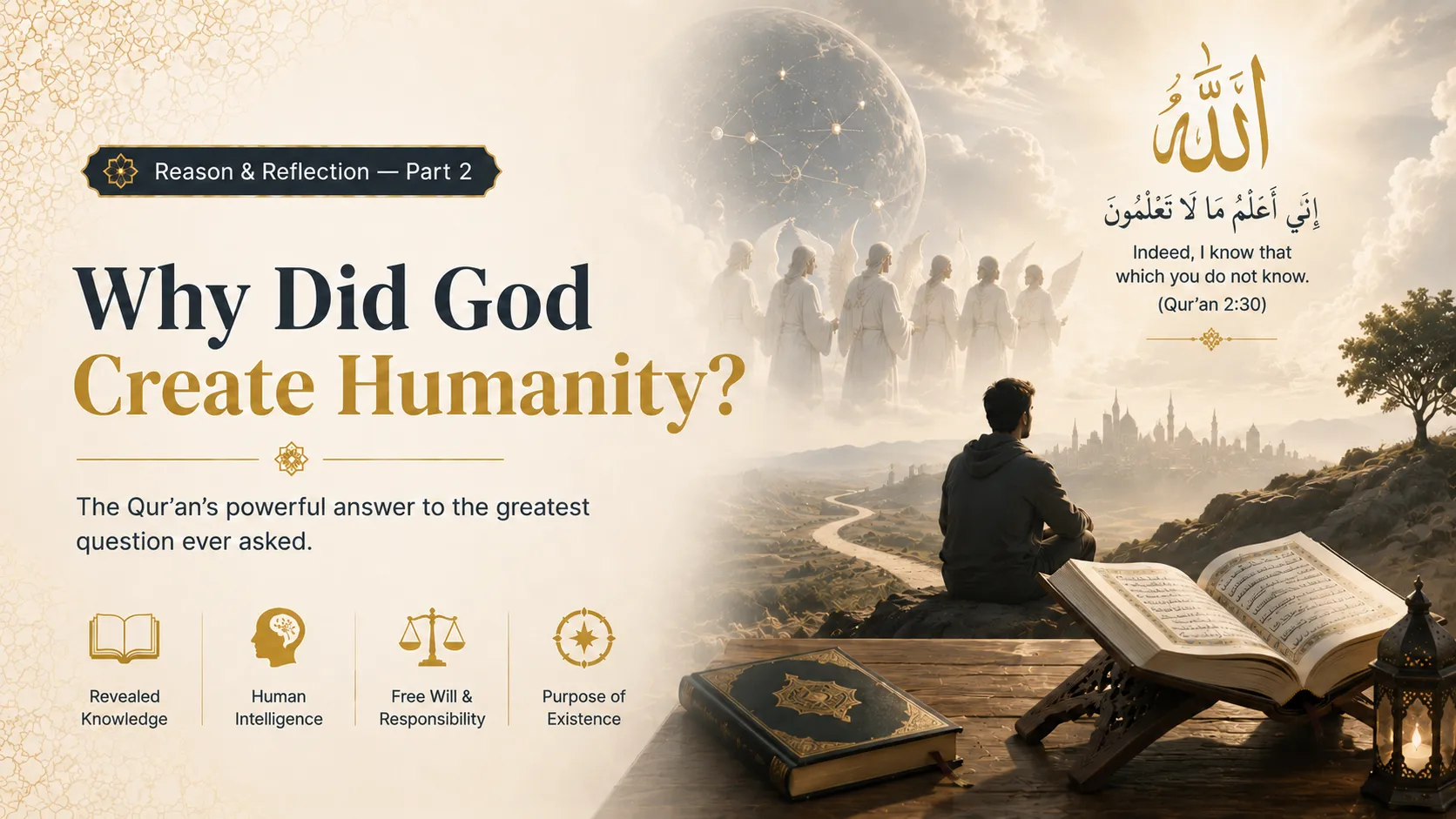
If you pick up the Qur'an and turn only a few pages, you will encounter one of the most remarkable conversations in all of scripture.
In Surah Al-Baqarah, Allah says:
"And when your Lord said to the angels, 'Indeed, I will place upon the earth a vicegerent (khalifah).'"
(Qur'an 2:30)
For a moment, pause and reflect upon this scene.
Allah informs the angels that He intends to create a new being and appoint him as His representative upon the earth.
What follows is extraordinary.
The angels—who never disobey Allah and execute His commands without hesitation—ask a question:
"Will You place therein one who will spread corruption and shed blood, while we glorify You with praise and sanctify You?"
(Qur'an 2:30)
The angels recognized something about humanity.
They foresaw conflict.
They foresaw wrongdoing.
They foresaw bloodshed.
And so they asked:
Why create such a being?
After all, they themselves continuously worshipped Allah, glorified Him, and obeyed Him perfectly.
Why create humanity at all?
Allah's Mysterious Reply
Allah responded:
"Indeed, I know that which you do not know."
(Qur'an 2:30)
This brief response contains immense depth.
The question was profound.
The answer was equally profound.
Allah was telling the angels that there was something about humanity they could not yet see.
Something hidden.
Something unique.
Something that justified humanity's existence despite its flaws.
But what was it?
The Qur'an continues:
"And He taught Adam the names of all things."
(Qur'an 2:31)
Then Allah presented these realities before the angels and asked them to identify them.
The angels replied:
"Glory be to You. We have no knowledge except what You have taught us. Indeed, You alone are the All-Knowing, the All-Wise."
(Qur'an 2:32)
They acknowledged their limitations.
Their humility.
Their dependence upon Divine knowledge.
Allah then instructed Adam:
"O Adam, inform them of their names."
(Qur'an 2:33)
And Adam did.
He demonstrated a capacity that the angels had not been given.
A unique ability to learn, understand, conceptualize, and engage with knowledge.
After Adam informed them, Allah said:
"Did I not tell you that I know the unseen realities of the heavens and the earth?"
(Qur'an 2:33)
The Answer Hidden Within the Story
At first glance, these verses may appear to be simply the story of humanity's creation.
But many scholars have pointed out that they contain something far deeper.
Embedded within this conversation is the answer to the angels' question.
Why create humanity?
Why create a being capable of both greatness and corruption?
Why create a creature who can rise higher than angels or fall lower than beasts?
The answer lies in humanity's unique potential.
The ability to know.
To learn.
To choose.
To discover.
To grow.
To seek truth.
To develop wisdom.
To willingly recognize and worship its Creator.
Unlike the angels, whose obedience is inherent, humanity is given freedom.
And it is precisely this freedom that gives meaning to knowledge, virtue, and moral responsibility.
Why Many of Us Miss This Message
The reality is that many of us recite the Qur'an regularly.
We honor it.
We cherish it.
We keep it in our homes.
Yet often we read it habitually rather than reflectively.
We recite its words but fail to explore their depths.
As a result, profound answers remain hidden in plain sight.
For centuries, scholars have written magnificent commentaries explaining these verses in great detail.
Their insights are invaluable.
Yet sometimes a particular perspective opens a door that we had never noticed before.
An Unexpected Guide
Interestingly, one of the people who helped me appreciate the depth of these verses was not a Muslim scholar.
He was an English professor raised within Christianity.
Like many thoughtful people, he became troubled by the same existential restlessness we discussed earlier.
The same unease.
The same longing.
The same questions.
In his search for answers, he eventually abandoned Christianity and embraced atheism.
Yet the questions never disappeared.
The restlessness remained.
His journey continued.
And eventually, while reflecting upon these very verses from the Qur'an, he found something he had been searching for all along:
A coherent understanding of humanity's purpose.
A reason for existence.
A framework that made sense of life, knowledge, freedom, and responsibility.
The same verses that many Muslims read routinely transformed his entire worldview.
A Question for the Next Article
What exactly did he discover in these verses that so many of us overlook?
What insight convinced him that he had finally found an answer to the question of human existence?
And does that insight align with other passages throughout the Qur'an?
In the next part of this series, we will explore his perspective in greater detail and examine whether the Qur'an consistently presents the same vision of humanity's purpose across its many chapters and verses.
For now, let us leave with a question worth reflecting upon:
If Allah created humanity despite knowing its capacity for corruption, what unique role did He intend for human beings to fulfill?
That is the question we will continue to explore.
Until next time,
May the peace, mercy, and blessings of Allah be upon you.