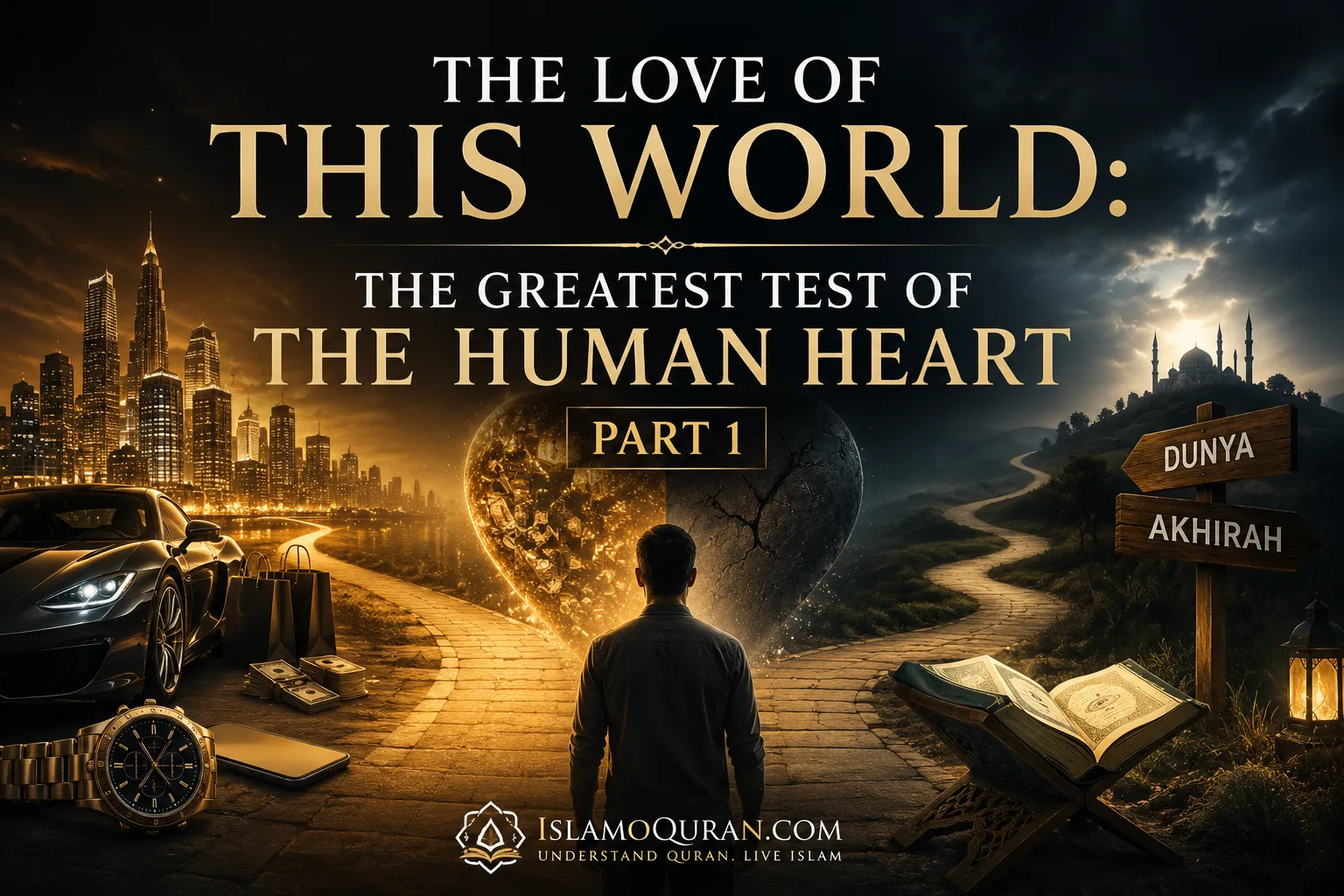
Why the Qur'an Warns Us Against Loving the Dunya More Than the Hereafter
"Rather, you love the immediate life, while the Hereafter is better and more lasting."
(Qur'an 75:20–21)
Introduction: The Greatest Test Is Not Poverty or Wealth—It Is the Heart
If you truly wish to understand a person, do not begin by examining what they own. Instead, observe what they desire.
What occupies their thoughts?
What are they willing to sacrifice everything for?
What makes them happiest—and what devastates them when it is lost?
The answers to these questions reveal where the heart truly resides.
Islam teaches that every human being lives with countless desires. We desire comfort, recognition, wealth, influence, beauty, security, and success. None of these desires are inherently evil. In fact, many of them are natural gifts placed within us by Allah. The real question is not whether we possess these desires, but whether they possess us.
The Qur'an repeatedly reminds humanity that the greatest spiritual danger is not merely earning wealth or enjoying worldly blessings. Rather, it is allowing the temporary world to become the ultimate object of love.
This subtle shift is what transforms blessings into distractions and opportunities into trials.
The Qur'an calls this attachment ḥubb al-dunyā—the excessive love of this worldly life.
It is a disease that affects kings and laborers alike, the wealthy and the poor, the educated and the uneducated. It is one of the greatest tests every believer must confront before meeting Allah.
The Qur'an Diagnoses the Human Heart
One of the remarkable qualities of the Qur'an is that it does not merely describe human actions—it exposes the motivations behind them.
Allah says:
"No! Rather, you love the fleeting life of this world and neglect the Hereafter."
(Qur'an 75:20–21)
This verse is astonishing in its honesty.
Allah does not simply say that people commit sins or become distracted. He identifies the root cause:
They love the immediate.
Human beings naturally gravitate toward what is visible, tangible, and instant.
The pleasures of this world can be seen.
Its luxuries can be touched.
Its praise can be heard.
Its rewards are immediate.
The Hereafter, however, requires faith, patience, and certainty in what lies beyond human sight.
The tragedy is not that people enjoy worldly blessings.
The tragedy is that they begin preferring them over eternal success.
Allah repeats this warning elsewhere:
"But you prefer the life of this world, while the Hereafter is better and more enduring."
(Qur'an 87:16–17)
Notice the wording.
The Qur'an does not say you possess the world.
It says you prefer it.
That single word defines the entire issue.
Islam does not condemn wealth.
It condemns misplaced priorities.
Islam Does Not Ask You to Abandon the World
One of the greatest misconceptions about Islam is the belief that righteousness requires abandoning worldly life altogether.
This is not the teaching of the Qur'an.
Islam does not command believers to withdraw from society, reject commerce, abandon family life, or embrace unnecessary hardship.
The Prophet Muhammad ﷺ was a merchant before Prophethood.
Many of his Companions were successful businessmen.
Some were among the wealthiest individuals in Arabia.
Their wealth itself was never condemned.
What mattered was the position that wealth occupied within their hearts.
Islam does not prohibit owning the world.
It warns against allowing the world to own you.
A believer works, earns, builds, invents, studies, travels, marries, raises children, and contributes to society—but all while remembering that this life is not the final destination.
The world is a means.
It is never the end.
A Marketplace You Were Never Meant to Settle In
The Messenger of Allah ﷺ taught us to view this world with a perspective that completely transforms how we live.
One day, Abdullah ibn Umar (رضي الله عنهما) narrated that the Prophet ﷺ took hold of his shoulders and said:
"Be in this world as though you were a stranger or a traveler passing along a path."
(Sahih al-Bukhari, 6416)
A traveler never mistakes the road for his destination.
He may stop to rest beneath a tree, eat from its provisions, or benefit from what he finds along the way—but he knows he is only passing through. His heart remains fixed on where he is going, not where he happens to be for a short while.
The Prophet ﷺ also illustrated the fleeting nature of worldly life with a profound example. He said:
"What have I to do with this world? My example and the example of this world are like that of a rider who rests under the shade of a tree, then leaves it and continues on his journey."
(Jami' at-Tirmidhi 2377 – Hasan Sahih)
This is the believer's relationship with the dunya.
He earns wealth, but does not let wealth possess his heart.
He enjoys Allah's lawful blessings, but never becomes enslaved by them.
He works, builds, marries, and strives for excellence, yet he remembers that every blessing is a trust and every possession is temporary.
The world is a place of provision—not permanence.
It is a field in which we sow deeds, not the home in which we remain forever.
Every house will one day be left behind.
Every title will eventually disappear.
Every achievement will fade.
Every worldly pleasure will come to an end.
But every sincere deed performed for the sake of Allah continues to benefit its owner long after this world has vanished.
The wise believer, therefore, walks through this worldly marketplace with open hands but a heart attached only to Allah. He takes what helps him on his journey to the Hereafter, while never allowing the attractions of the road to make him forget his true destination.
Imagine walking through a busy marketplace.
People are buying and selling.
Some become captivated by beautiful displays.
Others lose themselves among endless attractions.
But your purpose is simply to pass through.
You are not there to settle permanently.
The believer's relationship with the world should resemble that traveler.
He benefits from it.
He uses it.
He appreciates its blessings.
Yet he never mistakes it for home.
Every possession remains temporary.
Every achievement eventually fades.
Every success eventually ends.
Only what is done for Allah continues forever.
The Beauty of This World Is the Test
One of the Qur'an's most profound verses explains why this world is so attractive.
Allah says:
"Indeed, We have made whatever is upon the earth an adornment for it so that We may test them as to which of them is best in deeds."
(Qur'an 18:7)
This verse changes how a believer views everything around him.
The breathtaking landscapes.
The glittering cities.
Technological innovation.
Luxury.
Fashion.
Architecture.
Entertainment.
Success.
Influence.
All of these are part of the examination.
The beauty itself is not the problem.
The attachment to that beauty is the real test.
Allah intentionally made the world attractive.
If it possessed no appeal, choosing the Hereafter would require no sacrifice.
The examination exists precisely because the world is alluring.
Every desire asks a question.
Will you pursue Allah through this blessing?
Or will you forget Him because of it?
Perhaps No Generation Has Been Tested Like Ours
Every generation faces unique challenges.
But few civilizations have lived in a world as visually captivating and materially abundant as ours.
Never before has humanity possessed such easy access to comfort, entertainment, luxury, travel, communication, and endless consumption.
Every screen competes for attention.
Every advertisement competes for desire.
Every platform promises happiness through acquisition.
Success is measured by followers.
Identity is measured by possessions.
Self-worth is measured by appearance.
The modern world constantly whispers the same message:
"You need more."
More money.
More recognition.
More luxury.
More influence.
More status.
The Qur'an, however, teaches the opposite.
It reminds believers that true success is not determined by how much they accumulate but by what they refuse to let control their hearts.
The real examination has never changed.
Only its appearance has.
A Question That Changed a Companion's Life
Among the most beautiful narrations illustrating this reality is the famous hadith recorded from Sahl ibn Sa'd al-Sa'idi (رضي الله عنه).
A man once approached the Messenger of Allah ﷺ with a remarkable request.
He did not ask for wealth.
He did not ask for status.
He did not ask for miracles.
Instead, he asked:
"O Messenger of Allah, guide me to an action which, if I do it, Allah will love me and people will love me."
Imagine receiving advice directly from the Prophet ﷺ.
Out of all the countless possibilities, what would he choose?
The Prophet ﷺ replied:
"Renounce attachment to this world, and Allah will love you. Renounce what people possess, and people will love you."
This concise statement contains a complete philosophy of life.
The Prophet ﷺ did not command absolute poverty.
He instructed freedom from attachment.
There is a profound difference between owning little and needing little.
One may possess vast wealth yet remain detached from it.
Another may own almost nothing yet spend every waking moment longing for what others have.
The issue is not the size of one's bank account.
It is the condition of one's heart.
Comments (0)
Join the conversation! Please log in to share your thoughts.
Log In to CommentNo comments yet. Be the first to share your thoughts!