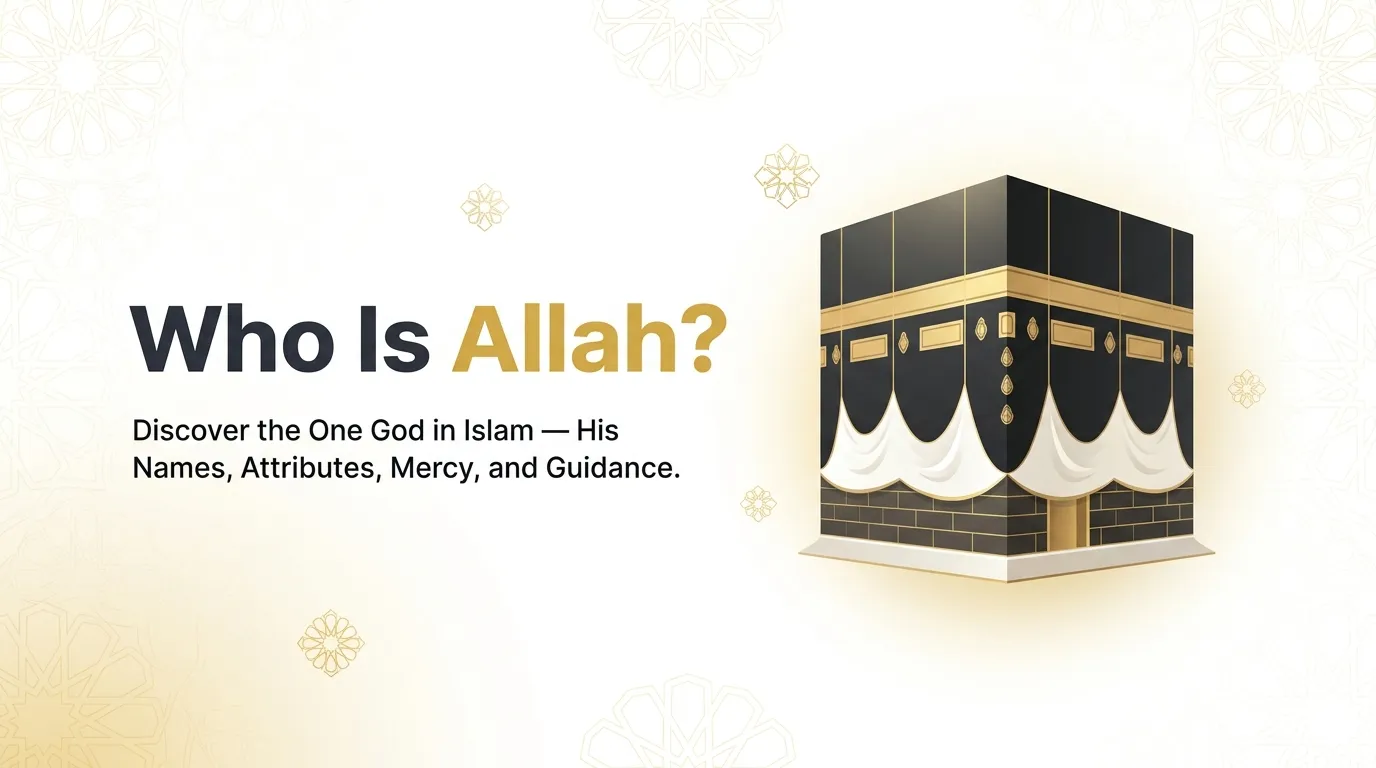

Every human being, regardless of culture, background, or belief, eventually encounters certain questions that refuse to remain silent:
Who created me?
Why am I here?
What is the purpose of this vast universe?
Where am I ultimately heading?
These questions have occupied the minds of philosophers, scientists, scholars, and ordinary people throughout history. Yet if we follow them far enough, they all lead to one central question—the most important question a person can ever ask:
Who Is Allah?
At first glance, the question may seem simple. Yet it is unlike any other question we ask.
When we seek to understand a mountain, a river, a star, or even another human being, we are studying something that exists within creation—something limited by time, space, matter, and countless other constraints.
Allah is different.
He is not a part of creation.
He is the Creator of creation.
He is not subject to the laws that govern the universe.
He is the One who brought those laws into existence.
For this reason, understanding Allah does not mean trying to fit Him into human definitions or imagining Him through the lens of our limited experiences. Rather, it means coming to know Him through the perfect descriptions He has given of Himself in the Quran and through the teachings of His Messenger, Muhammad ﷺ.
The more deeply a person comes to know Allah, the more clearly they begin to understand life itself—its purpose, its trials, its blessings, and its ultimate destination.
This is not merely an intellectual journey.
It is a journey of the heart.
A journey of reflection.
A journey that has the power to transform the way we see ourselves, the world around us, and our relationship with the One who created us.
Allah: The One Unlike Anything Else
At the very heart of Islam lies a truth so profound, so pure, and so powerful that it forms the foundation of everything else:
Allah is One.
Not one among many.
Not one part of a greater whole.
Not one force competing with another force.
He is the One and Only God—perfect, unique, eternal, and without equal.
This reality is beautifully and perfectly summarized in one of the shortest chapters of the Quran:
"Say: He is Allah, the One. Allah, the Eternal Refuge. He neither begets nor is born. And there is none comparable to Him."
(Quran 112:1–4)
Though only a few verses long, this chapter contains some of the most profound truths ever revealed about the Creator of the heavens and the earth.
Let us pause and reflect on what it teaches us.
Allah Is Absolutely One
The oneness of Allah—Tawhid—is the cornerstone of Islamic belief.
Allah is One in His essence.
One in His authority.
One in His perfect attributes.
One in His right to be worshipped.
He has no partners.
No rivals.
No equals.
No offspring.
No associates.
No one shares His divine nature, His sovereignty, or His power.
Everything that exists is dependent.
Allah alone is completely independent.
Everything in creation ultimately depends on Allah, while Allah depends on nothing.
This truth liberates the human heart from every false object of worship and directs it toward the One who alone deserves complete love, trust, hope, and devotion.
Allah Is As-Samad: The One Upon Whom All Depend
One of the most profound descriptions of Allah found in Surah Al-Ikhlas is As-Samad.
This beautiful name carries meanings so vast that entire books have been written explaining it.
Allah is the One who is perfectly self-sufficient.
The One who needs nothing.
The One upon whom all creation depends.
Every human being experiences need.
We need food.
We need water.
We need sleep.
We need shelter.
We need companionship.
We need countless things simply to survive from one day to the next.
Even the strongest person depends upon things beyond their control.
Allah alone is different.
He was never in need.
He is not in need.
And He will never be in need.
Every blessing we enjoy, every opportunity we receive, every breath we take, every heartbeat within our chest is ultimately sustained by Him.
Whether people recognize it or not, every created being is dependent upon Allah at every moment of its existence.
Allah Is Not Like His Creation
One of the most important principles in understanding Allah is recognizing that He is fundamentally unlike anything we can imagine.
Everything around us has a beginning.
Every human being is born.
Every animal comes into existence.
Every mountain was formed.
Every star was ignited.
Every galaxy emerged at a particular point in cosmic history.
Allah is not like that.
He was never born.
He did not come into existence.
There was never a moment when He was absent.
And there will never be a moment when He ceases to exist.
He is the Eternal One whose existence is not dependent on anything else.
While everything in creation receives existence, Allah is the One who grants existence.
Nothing Can Be Compared to Him
Human beings naturally understand the world through comparison.
We compare one thing to another in order to grasp its qualities.
We compare beauty, intelligence, strength, and greatness.
But when it comes to Allah, comparison reaches its limit.
Allah says:
"There is nothing whatsoever like Him, and He is the All-Hearing, the All-Seeing."
(Quran 42:11)
This verse establishes a principle that every believer should carry in their heart:
Allah possesses perfect attributes, yet nothing in creation resembles Him.
Human beings may possess qualities that share names with some of Allah's attributes—we can know, hear, see, show mercy, forgive, and love—but our qualities are limited, imperfect, and dependent.
Allah's attributes are infinite, perfect, and free from every deficiency.
We learn gradually.
Allah's knowledge is eternal and complete.
We hear some things and miss others.
Allah hears every sound, every prayer, and every whisper.
We see only what is within our limited range.
Allah sees everything that is apparent and everything that is hidden.
The similarity is only in the wording.
The reality is entirely different.
His perfection belongs to Him alone.
Beyond Time, Space, and Physical Reality
Everything we know exists within time and space.
Our bodies change over time.
Our lives unfold within physical dimensions.
Every created thing is governed by laws and limitations.
But Allah is not bound by the realities He created.
He created time.
He created space.
He created matter.
He created every law that governs the universe.
Modern cosmology suggests that time and space themselves began with the universe. Before the beginning of the cosmos, time—as we understand it—did not exist.
Long before humanity developed modern theories about the origins of the universe, the Quran introduced us to a profound reality about Allah.
He is:
Al-Awwal — The First.
The One before whom there was nothing.
And He is:
Al-Akhir — The Last.
The One after whom there will be nothing.
Everything begins.
Allah does not.
Everything ends.
Allah does not.
Everything changes.
Allah does not.
Everything depends.
Allah does not.
The Creator cannot be confined by the creation He brought into existence.
The Universe: A Sign Pointing Toward Its Creator
Look around you for a moment.
The earth is perfectly suited for life.
The laws of nature operate with astonishing precision.
The human body performs trillions of complex processes every second.
The stars move through space according to intricate laws.
The oceans, mountains, ecosystems, and even microscopic cells reveal extraordinary order and design.
The Quran repeatedly calls our attention to these realities.
Allah says:
"Do the disbelievers not see that the heavens and the earth were once joined together, then We separated them, and We made from water every living thing? Will they not then believe?"
(Quran 21:30)
The purpose of such verses is not merely to provide scientific information.
Their purpose is far greater.
They invite us to reflect.
To think.
To wonder.
To ask deeper questions.
Why does anything exist at all?
Why is there order instead of chaos?
Why are the laws of nature so remarkably consistent?
Why is the universe so finely balanced for life?
For the believer, these questions point beyond creation itself.
The universe is not divine.
It is not worthy of worship.
It is a sign.
And every sign points toward its Creator.
From the smallest particle hidden from human sight to the largest galaxy spanning unimaginable distances, creation silently bears witness to the wisdom, knowledge, power, and majesty of Allah.
Why Knowing Allah Changes Everything
Learning about Allah is not merely a theological exercise or an academic pursuit.
It is the foundation upon which an entire life is built.
When a person truly begins to know Allah, everything starts to look different.
Life is no longer seen as a random accident.
Trials are no longer viewed as meaningless suffering.
Blessings are no longer taken for granted.
Success is no longer measured solely by worldly achievements.
The believer begins to see life as a purposeful journey guided by a Lord who is infinitely wise, infinitely merciful, and perfectly aware of every detail.
The more we know Allah, the more we recognize our dependence upon Him.
The more we recognize His mercy, the more hope fills our hearts.
The more we recognize His wisdom, the more we trust Him during uncertainty.
The more we recognize His greatness, the more sincerely we worship Him.
And the more we know Him, the more we understand ourselves.
For this reason, there is no knowledge more valuable than the knowledge of Allah.
It illuminates the heart.
Strengthens faith.
Brings peace to the soul.
Gives meaning to life's joys and trials.
And guides a person toward the purpose for which they were created.
One of the most beautiful ways Allah has introduced Himself to humanity is through His magnificent Names and perfect Attributes.
And it is through those Names that we begin to know Him more deeply, love Him more sincerely, and draw closer to Him with every step of our journey.
Comments (0)
Join the conversation! Please log in to share your thoughts.
Log In to CommentNo comments yet. Be the first to share your thoughts!